Showing posts with label Tikhonravov Crater. Show all posts

Sunday, October 2, 2011

Layered Yardangs


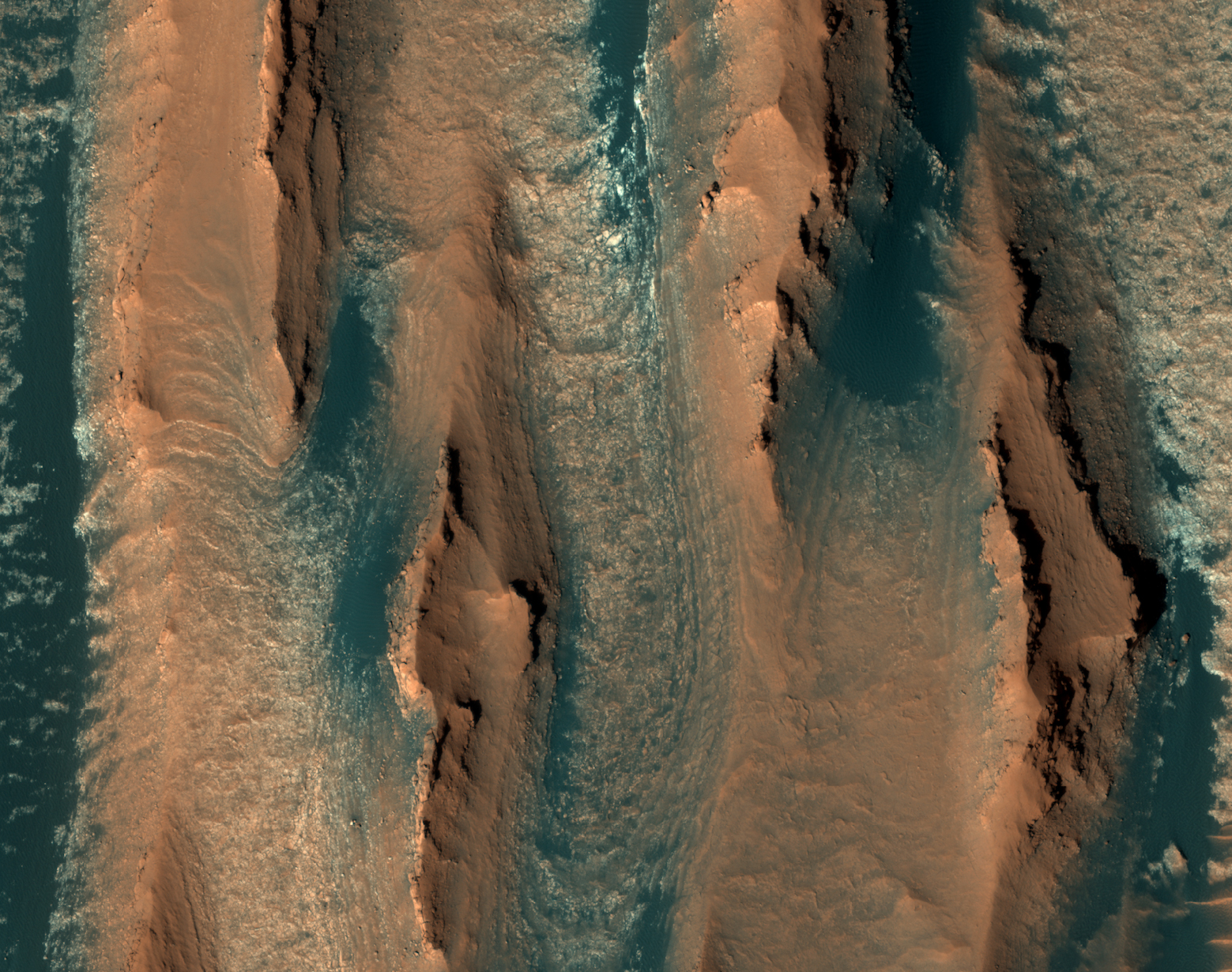
This observation shows terrain on the floor of a large, degraded crater. Many sharp ridges are visible across the image, all of them aligned in a similar direction. There are patches of dark sand in the low areas between the ridges and on the ridge slopes.

What creates these sharp ridges? This layered terrain has been sculpted by the wind. The aligned ridges are called yardangs, which are formed in areas where the dominant erosional force is the wind. Yardangs are also found on Earth, usually in very dry areas.

The subimage shows a closeup of some yardangs.

This is a stereo pair with ESP_023051_1865.

Photo credit: NASA/JPL/University of Arizona

Note: This crater is located south of Tikhonravov Crater in Terra Sabaea.

Saturday, October 30, 2010

Dark Slope Streaks Near Tikhonravov Crater


Dark streaks mark the slope of this crater rim south of Tikhonravov Crater.

Photo credit: NASA/JPL/Arizona State University

Note: Tikhonravov Crater actually cannot be seen in this image, as it lies just to the north of the photo.

Wednesday, September 29, 2010

Tikhonravov Crater


Tikhonravov Crater is a large, old crater in Terra Sabaea. The crater is pockmarked by numerous younger craters and other features. Today's VIS image shows a channel within Tikhonravov Crater.

Photo credit: NASA/JPL/Arizona State University

Monday, September 27, 2010

Dark Slope Streaks in Terra Sabaea


Today's VIS image shows dark slope streaks in an unnamed crater in Terra Sabaea.

Photo credit: NASA/JPL/Arizona State University

Note: This tiny crater lies between two much larger craters (also unnamed), the edges of which can be seen on the left and right. These craters, in turn, lie about halfway between Tikhonravov Crater, to the north, and Janssen Crater, to the south.

Tuesday, April 20, 2010

Dark Slope Streaks in Terra Sabaea


Dark slope streaks, like the ones in this unnamed crater in Terra Sabaea, are believed to be formed when surface dust is displaced and the darker rock below is exposed. Rocks falling due to gravity likely formed these streaks.

Photo credit: NASA/JPL/Arizona State University

Note: The closest major landmark to the location in the above image is Tikhonravov Crater, which lies to the west.