Showing posts with label Hecates Tholus. Show all posts

Friday, June 13, 2014

Northwestern Slope of Hecates Tholus


This VIS image shows part of the northern flank of Hecates Tholus, which is located on the northern part of the Elysium Volcanic Complex.

Orbit Number: 54574 Latitude: 33.2631 Longitude: 149.882 Instrument: VIS Captured: 2014-04-03 11:25

Photo credit: NASA/JPL-Caltech/Arizona State University

Tuesday, April 15, 2014

Buvinda Vallis


Today's VIS image shows part of Buvinda Vallis, located just outside the northeastern flank of Hecates Tholus.

Orbit Number: 54037 Latitude: 33.2014 Longitude: 151.998 Instrument: VIS Captured: 2014-02-18 06:47

Photo credit: NASA/JPL-Caltech/Arizona State University

Tuesday, March 11, 2014

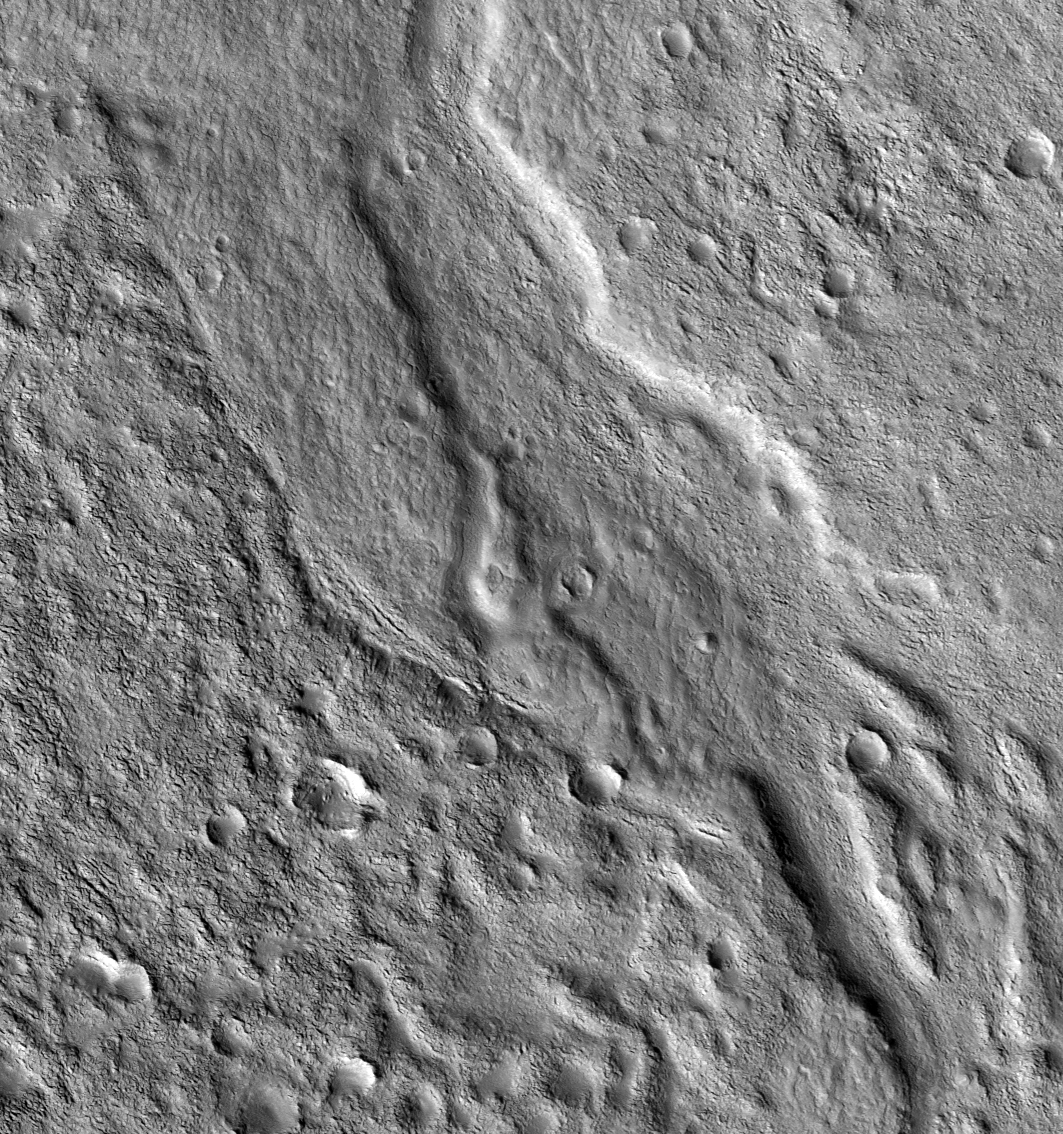
Channels on the Northwest Flank of Hecates Tholus


Multiple channels dissect the northwestern flank of Hecates Tholus in this VIS image.

Orbit Number: 53650 Latitude: 33.3016 Longitude: 149.105 Instrument: VIS Captured: 2014-01-17 10:27

Photo credit: NASA/JPL-Caltech/Arizona State University

Saturday, March 1, 2014

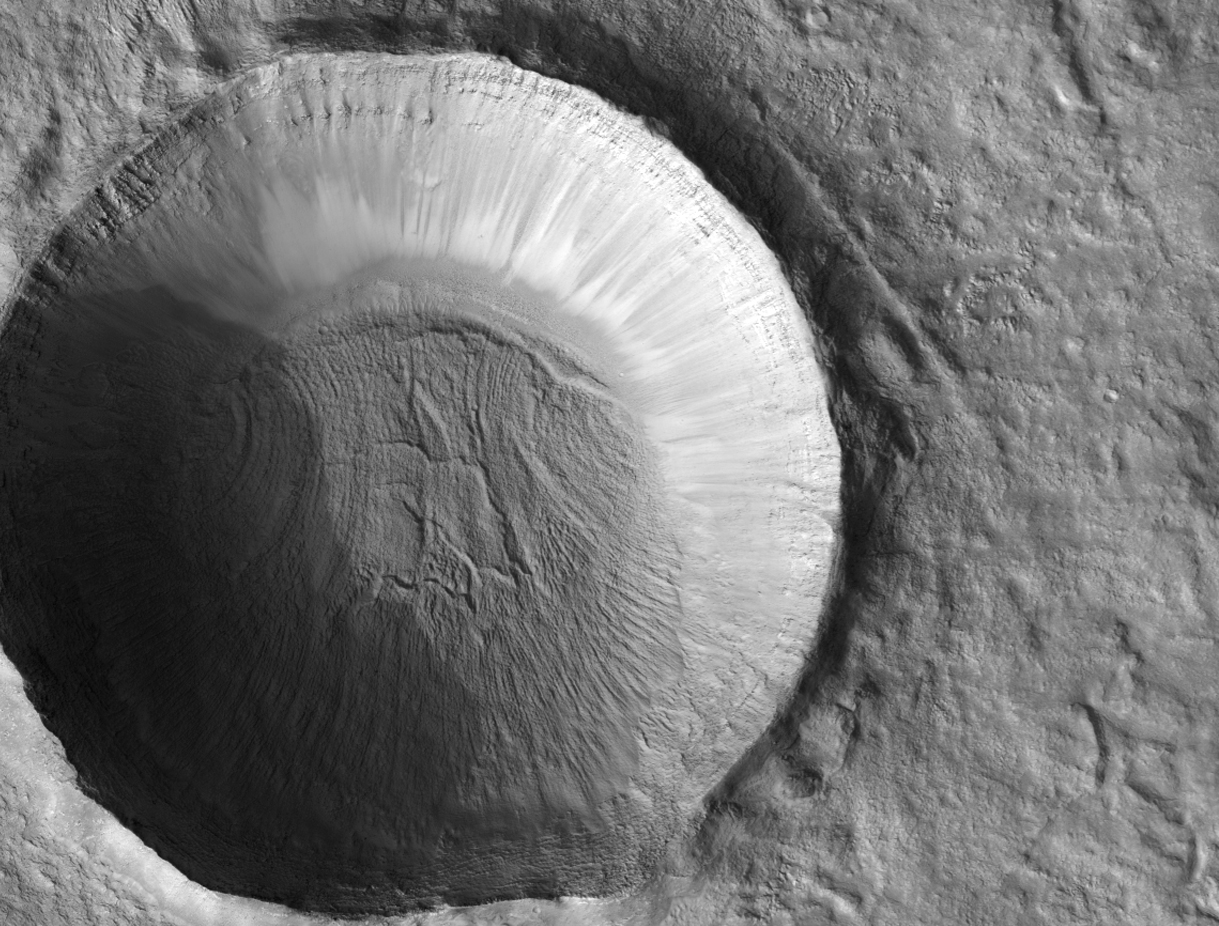
Channels on the Northeast Flank of Hecates Tholus


Several channels are located on the flank of Hecates Tholus. In this VIS image one of those channels enters a crater, creating a deposit on the floor of the crater. Age relationships can be derived from this image. Hecates Tholus was formed first, then the crater was created, and finally flow of lava or water carved the channel that bisects the crater rim.

Orbit Number: 53575 Latitude: 33.1381 Longitude: 151.349 Instrument: VIS Captured: 2014-01-11 06:19

Photo credit: NASA/JPL-Caltech/Arizona State University

Saturday, January 19, 2013

Channel and Crater Northeast of Hecates Tholus


The origins of channels on Mars is of great interest to understand the history of water.

There are several large (more than 30 kilometers wide) craters on Mars that appear to have spawned channels, perhaps draining from the fresh, hot impact ejecta.

Visible here is a well-preserved (meaning geologically young) crater that is about 3 kilometers wide, and a channel that appears from the margins of the ejecta and flows to the south. Did this small crater generate this relatively large channel?

Most likely the channel was there first, and the crater is younger. However, the channel might have been generated by a larger crater to the northwest.

Photo credit: NASA/JPL/University of Arizona

Note: This image is located west of Phlegra Montes and northeast of Hecates Tholus.

Monday, September 6, 2010

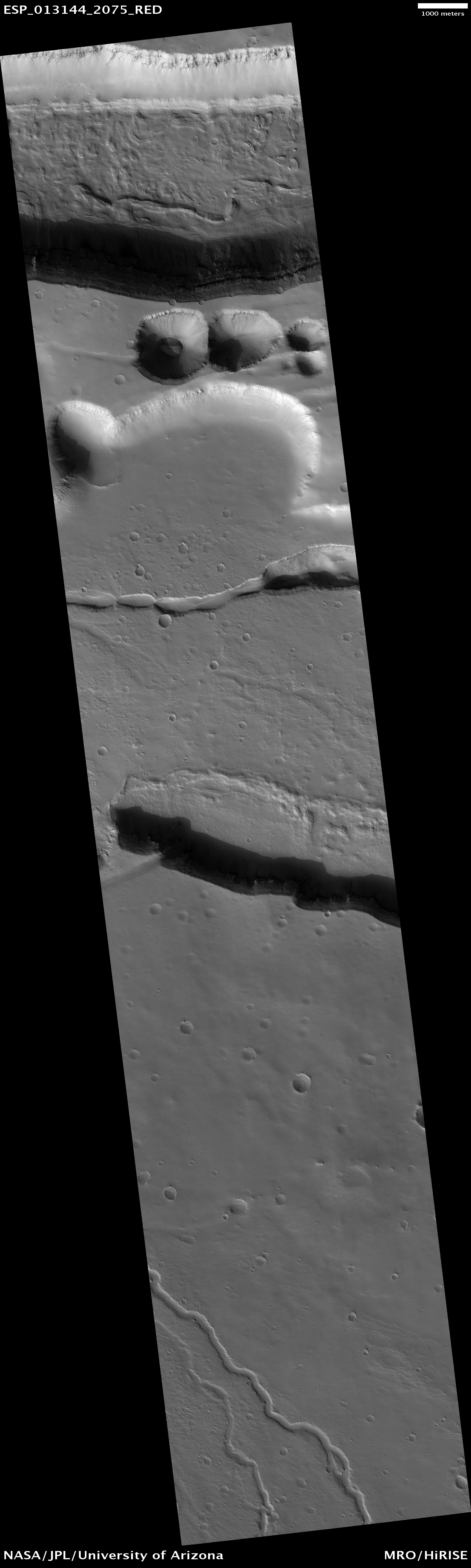
Valleys Carved into Elysium Mons


This image is of the flanks of the shield volcano Elysium Mons.

The volcano is considered to be the youngest within the Elysium Mons province, which also contains the volcanoes Hecates Tholus and Albor Tholus.

Of course, "young" is a relative term. The last eruption of Elysium Mons could well have been a billion years or more ago.

This image shows a series of flat bottomed valleys along the flanks of Elysium Mons. There is considerable debate on exactly how these valleys form. In Hawaii, the classic example of shield volcanoes on Earth, similar valleys are carved by prodigious rainfall. While some rain may have fallen in the earliest epochs of Mars' geologic history, the lack of small drainage networks shows that these Martian channels were not carved by rain.

However, mudflows and lava flows could potentially erode the sides of the volcano. An important hint for the origin of the valleys comes from the chain of pits visible in the northern part of the image. These pits form as the ground is pulled apart by Marsquakes. Thus it seems that many of these valleys are first formed by movement along faults. Then mud and/or lava flows widen the sides of the valley and give it a flat floor.

Photo credit: NASA/JPL/University of Arizona

Saturday, April 17, 2010