Showing posts with label Jeans Crater. Show all posts

Saturday, December 15, 2012

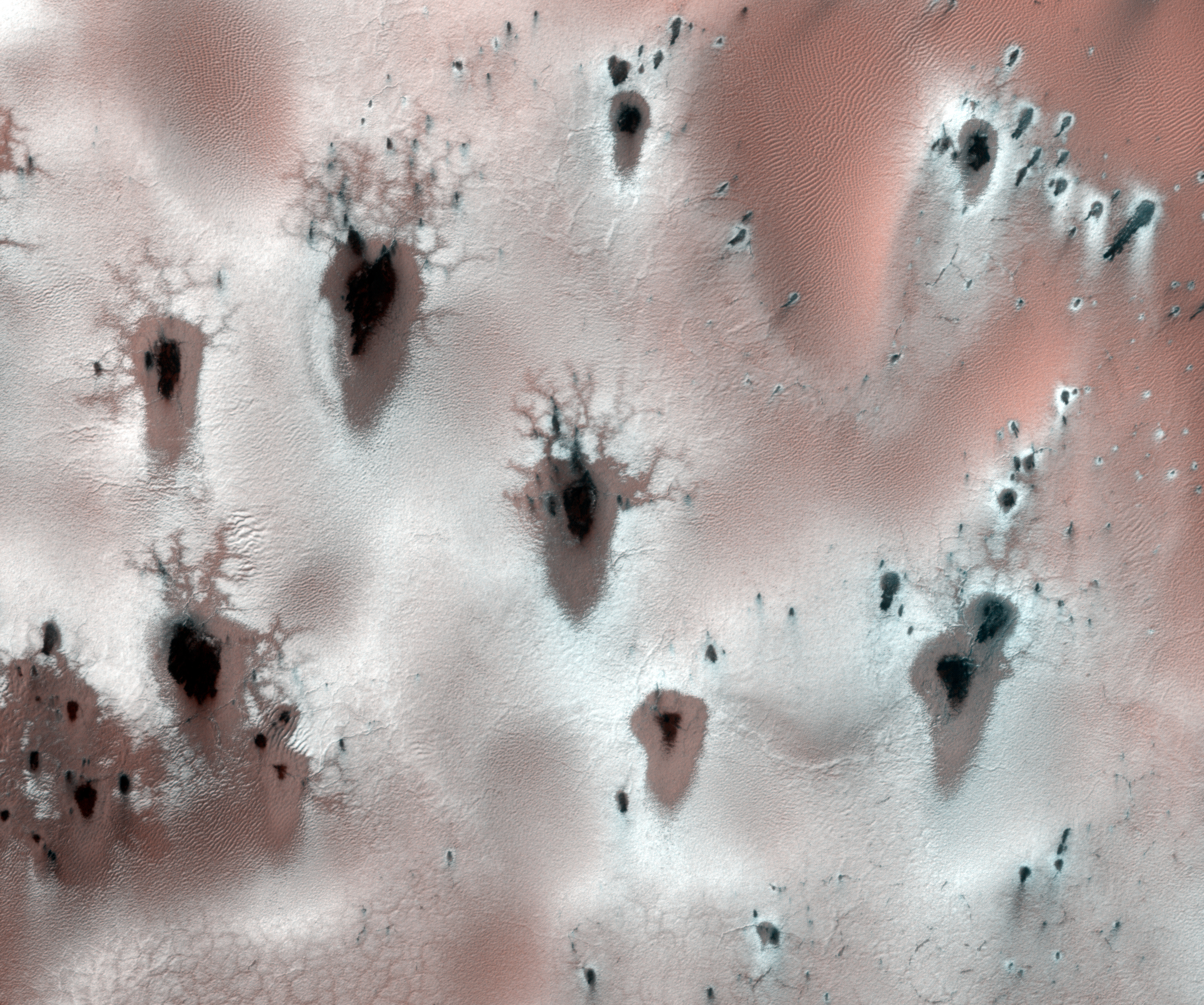
Defrosting Landscape Inside Jeans Crater


This image is from the high latitudes in the Southern hemisphere, about half-way through southern spring.

Just like on the Earth, the frost layer that accumulates over the winter will disappear as summer approaches and Mars heats up. However, most of this frost is not made of water ice and snow -- on Mars, most of the frost/ice is made of carbon dioxide (also known as "dry ice").

This material will not melt, but instead will go directly from solid into vapor (a process called sublimation) as it heats up (above approximately 147 K, which is -195 F, or -126 C). In doing so, it'll create all sorts of interesting landforms.

In this image, we can see sublimation spots (small spots where the frost/ice has sublimated away, exposing the darker ground). We also see small fans, which form when jets of gaseous carbon dioxide erupt through a weak spot in the surface ice, ejecting dark surface material that then gets smeared across the surface by the wind (so the different directions of the fans show us how the wind varies across this landscape).

Large darker "flows" are also visible; these are avalanches of material that extend downslope (and scientists are still debating if flows are dry or wet features). In the next few weeks, more of these features will appear and grow, until Mars heats up enough for all of the frost and ice (and sublimation features) to disappear.

References:
Gardin, E., et al. (2010). Defrosting, dark flow features, and dune activity on Mars: Example in Russell crater. J. Geophys. Res. 115, E06016.

Hansen, C.J., et al. (2010). HiRISE observations of gas sublimation-driven activity in Mars' southern polar regions: I. Erosion of the surface. Icarus 205, 283-295.

Kereszturi, A., et al. (2009). Recent rheologic processes on dark polar dunes of Mars: Driven by interfacial water? Icarus 201, 492-503.

Photo credit: NASA/JPL/University of Arizona

Note: This image is located inside Jeans Crater, which itself is located in Terra Cimmeria.

Saturday, August 21, 2010

Martian Zambonis?


This image of Mars' south polar area shows an amazing series of elliptical rings. Could these have been made by a Zamboni on Mars driving around and around on the ice? No, of course not! But the answer in some ways more fun.

The ice caps on Mars are surrounded by a thick stack of layered deposits. HiRISE and other instruments have shown that these layers are composed of dusty ice. Imagine this stack of layers as a cake with alternating layers. Now someone comes and takes a big scoop out of the middle of the cake! While our first reaction might be to get mad at them for ruining the cake, take a moment to think what the pattern would look like: it would have rings going round and round the hole. This is what we are seeing in this image of Mars.

Some erosional process has scooped a big hole into the layered deposits. So, no Zamboni, but we do have giant scoops digging into layer-cakes of ice!

Photo credit: NASA/JPL/University of Arizona

Note: This location is on the border between Planum Australe and Terra Cimmeria; the closest named feature is Jeans Crater.

Friday, April 23, 2010

Mound of South Polar Layered Deposits


The south polar layered deposits are a stack of layered ice up to 3000 meters (9800 feet) thick which is similar to terrestrial ice sheets. In places, this stack extends up to 1100 kilometers (680 miles) from the pole and many of the impact craters surrounding this ice-sheet appear to be filled with mounds of similar icy material and also sand dunes.

This image shows the material within one of these near-polar craters. The crater is about 44 kilometers (27 miles) across and contains a mound of material about 23 kilometers (14 miles) across and 300 meters (1000 feet) thick on its northern (south facing) wall. The dark material at the top (north) of the image shows the northern wall of the crater, the bright material that begins near the image top and extends toward the bottom is the surface of the mound.

This surface is covered with sand dunes that appear bright as they are still covered by seasonal carbon dioxide frost. Smaller dunes and ripples can be seen on the surfaces of the larger linear dunes. In the low lying areas between dunes, one can see a network of cracks that are reminiscent of the surface of the polar layered deposits, indicating that this mound is probably mostly ice with a thinner and incomplete covering of dunes.

The dark spots in the frost cover are characteristic of how this terrain defrosts, and are commonly observed in these locations during this season.

Photo credit: NASA/JPL/University of Arizona

Note: This photo is of the Terra Cimmeria region, and is located near the Ulyxis Rupes scarp and Jeans Crater, both of which are to the east.