Showing posts with label Holden Crater. Show all posts

Saturday, March 8, 2014

Ridges in Erythraea Fossa


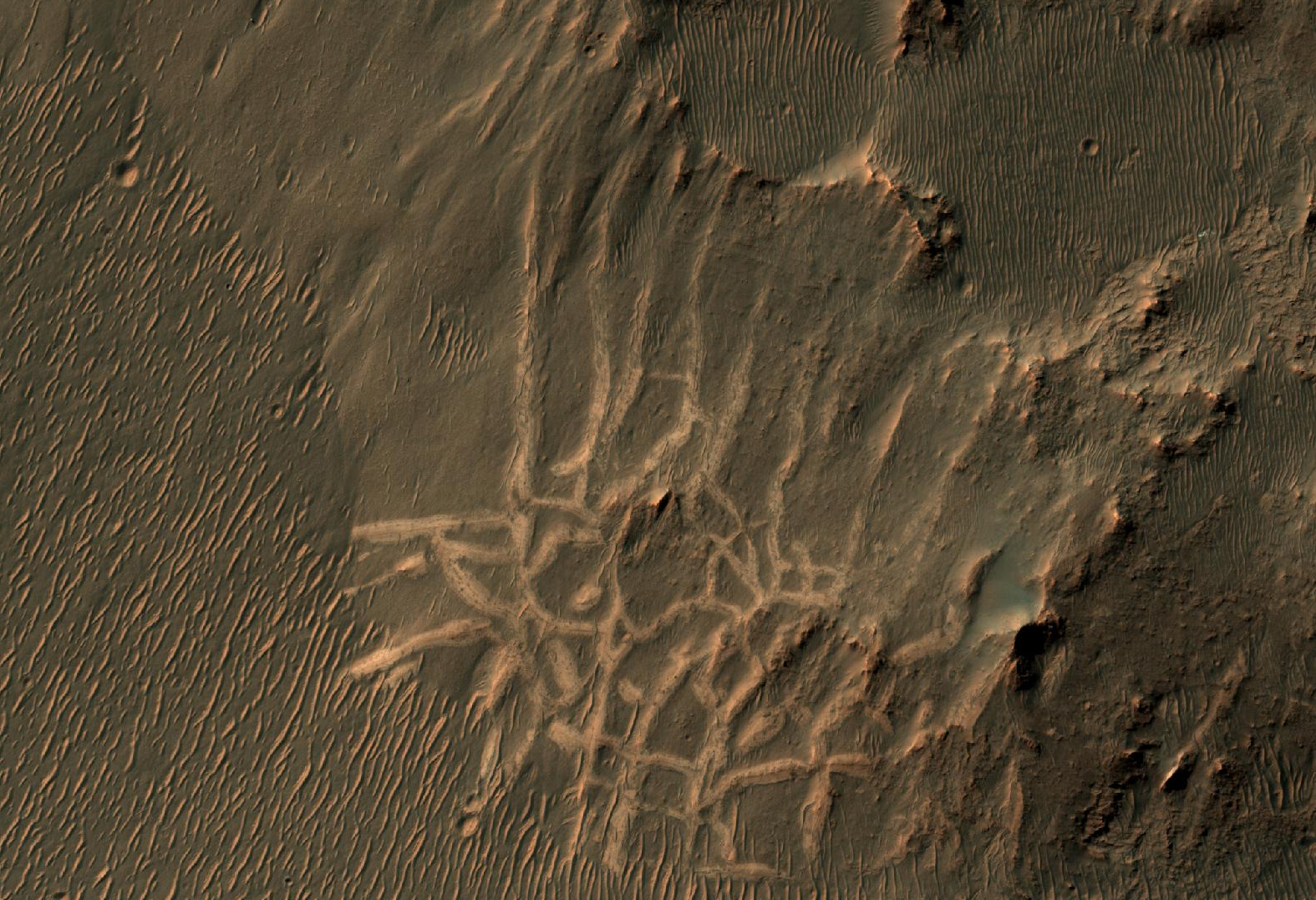
These light-toned ridges are found in a large fracture located east of Holden Crater and form a curious box-like pattern.

A hair-line fracture runs along the axis of each ridge line. The overall pattern spans several hundred meters across and individual ridges are several meters wide. Scientists are not sure how they formed yet, but some possible explanations suggest that mineral-rich ground water flowed out of the hairline fractures and deposited minerals at or near the surface as the water evaporated.

In addition, these minerals may have formed a cement along the fractures, making these patterns more resistant to subsequent erosion by wind or other processes. The resulting cemented ridges then stand high above the surrounding plains.

Photo credit: NASA/JPL/University of Arizona

Note: For more information, see PIA18112: Many Small Interesting Ridges in Erythraea Fossa.

Monday, November 28, 2011

Eberswalde Crater


Eberswalde crater on Mars formed more than 3.7 billion years ago. The rim of the crater is intact only in the north-eastern part. The rest has been buried by ejecta from the larger, more recent Holden impact crater nearby. The image was acquired by Mars Express around 25°S/326°E during orbit 7208 on 15 August 2009. The images have a ground resolution of about 22m per pixel.

Photo credit: ESA/DLR/FU Berlin (G. Neukum)

Sunday, October 24, 2010

Flood-Emplaced Blocks in Holden Crater


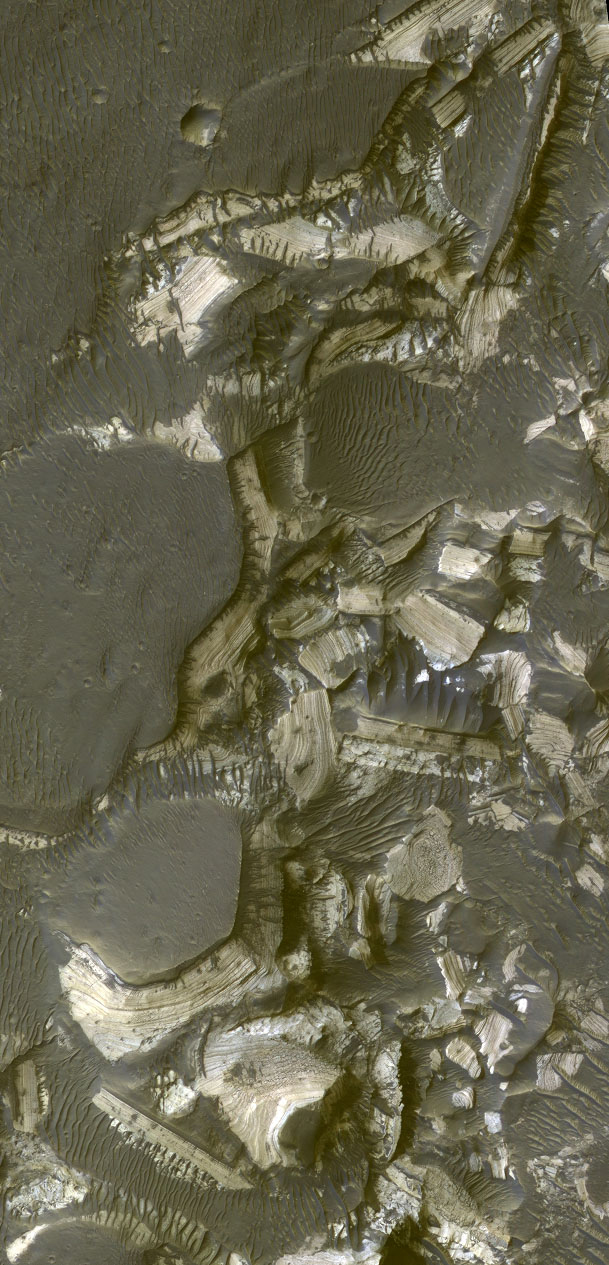
This image shows blocks of bright, layered rock embedded in darker material that are thought to have been deposited by a giant flood that occurred when Uzboi Valles breached the rim of Holden Crater (Grant et al., 2008, Geology v. 36, p. 195-198).

The magnitude of this ancient flood is indicated by the large size of the blocks (up to 100 meters across). The blocks do not appear to have been moved very far by the flood, as they are not rounded.

Holden Crater is one of the four potential landing sites for the Mars Science Laboratory rover, to be launched in November 2011. The bright layered rock in this image probably contain a record of a wetter, warmer period early in Martian history, and are therefore a prime target for exploration.

Photo credit: NASA/JPL/University of Arizona

Monday, September 13, 2010

Uzboi Vallis


This VIS image shows the western wall of Uzboi Vallis near the intersection of the vallis and Holden Crater. Many channels dissect the wall of the channel.

Photo credit: NASA/JPL/Arizona State University

Sunday, August 29, 2010

Landslide


Only a portion of a large landslide deposit is shown in this VIS image. The landslide occurred on the rim of an unnamed crater southwest of Holden Crater.

Photo credit: NASA/JPL/Arizona State University

Note: Holden Crater is located in the southern highlands north of Argyre Planitia. The unnamed crater lies just to the west of Uzboi Vallis.