Showing posts with label Margaritifer Sinus. Show all posts

Friday, December 12, 2014

Impact Crater in Morava Valles


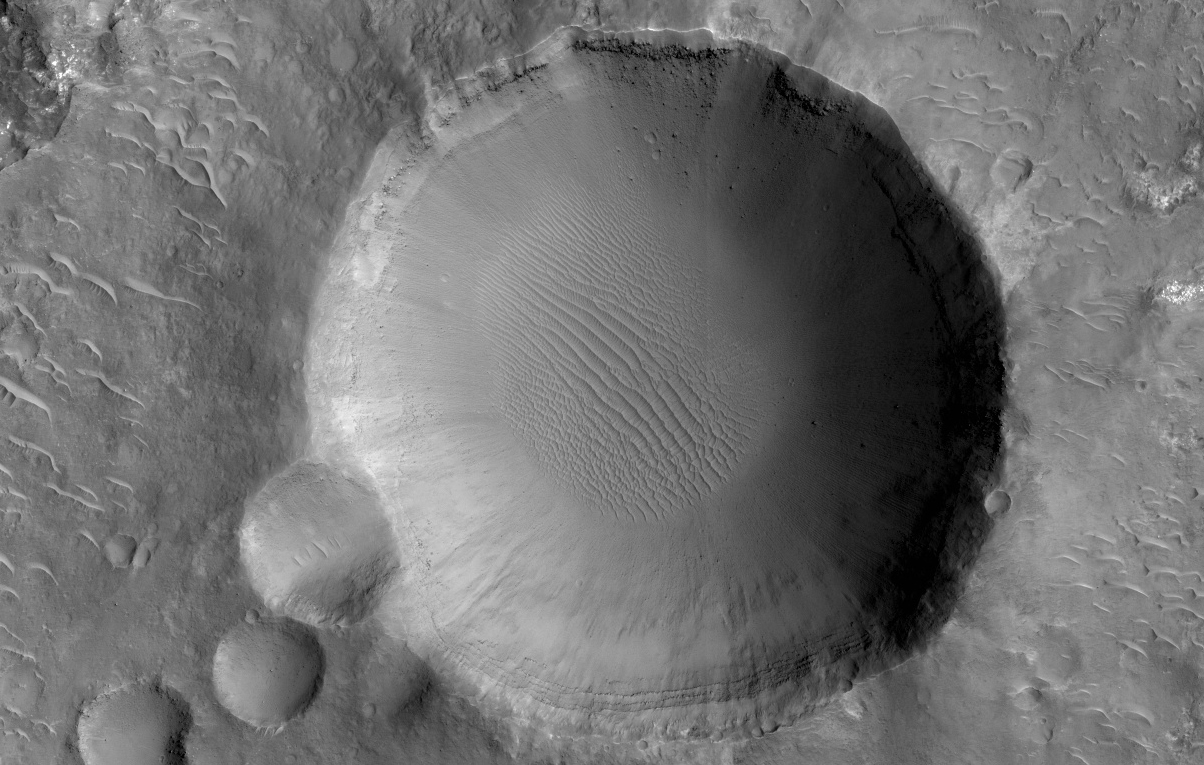
Morava Valles is a small outflow channel in the Margaritifer Sinus region of Mars. Several of the interior channels of Morava emanate from a localized region of terrain that is caving in, also called “subsidence.”

This region, comprised of jumbled blocks of flat-topped hills, is known as chaotic terrain. These channels, which emerge from the chaotic region, are separated by elongated hills that coalesce into a single channel before disappearing into the Margaritifer Chaos to the north. Chaotic terrains are thought to be the regions where ground water erupted catastrophically onto the surface, forming highly erosive flows that carved the outflow channels. The hills just downstream of the chaotic source region were shaped into streamlined islands by the erosive flows, forming blunt rounded ends in the upstream direction and tapering towards the north in the downstream direction.

Although windblown sediments now cover the original flood-carved channel floor in a sea of dunes, a 1.5 kilometer diameter impact crater provides a window into the sediment on the channel floor. The crater exposes several layers along its upper walls including a distinct bouldery layer just below the mantle of windblown sediments. These boulders may have originated from the eruption site and were transported and emplaced on the channel floor by high energy floods. Alternatively, these bouldery layers may be lava that subsequently flowed across the flood scarred channel floors.

Image credit: NASA/JPL/University of Arizona

Note: For more information, see PIA19116: Seeing Beneath the Surface in Morava Valles.

Monday, August 6, 2007

Oliver Morton on Giovanni Schiaparelli

Giovanni Schiaparelli's Map of Mars (1877)
Schiaparelli was not interested in celebrating his peers and forebears; he wanted to give Mars the high cultural tone of the classics. ... To the west were the lands beyond the pillars of Hercules, such as Tharsis, an Iberian source of silver mentioned by Herodotus, and Elysium, the home of the blessed at the far end of the Earth. Beneath them, part of the complex dark girdle strung around Mars below its equator, were the sea of sirens, Mare Sirenum, and Mare Cimmerium, the sea that Homer put next to Hades, "wrapped in mist and cloud." Then we come to the Mediterranean regions: the Tyrrhenian Sea and the Gulf of Sidra (Syrtis Major, the long-observed hourglass) dividing bright Hellas and Arabia. Along the far side of Arabia sits the Sinus Sabeus, a gulf on the fragrant coast of Araby, home to the Queen of Sheba. Beyond Arabia begins the Orient, with Margaritifer Sinus, the bay of pearls on the southern coast of India, and the striking bright lands of Argyre (Burma) and Chryse (Thailand). Finally, in the dark region others had called the eye of Mars, Schiaparelli placed Solis Lacus, the lake of the sun, from which all dawns begin.

Do not think for a moment that this means a good classical education will help you find your way around Mars. For a start, due to the way telescopes invert images, everything is flipped around: Greece is south of Libya, Burma west of Arabia. What's more, Schiaparelli's geography was often more allusive than topographical. His planet is 360° of free association. Thus Solis Lacus is surrounded by areas named for others associated with the sun: Phoenix, Daedalus, and Icarus. The sea of sirens borders on the sea of the muses, presumably because Schiaparelli wanted to provide opportunity for their earthly feud to continue. Elysium leads to Utopia.

...

By the time he was through with Mars, Schiaparelli had given 304 names to features on its surface... Schiaparelli's proper names were triumphant and have in large part lasted until today. It was his common nouns that caused the problems. Schiaparelli saw a large number of linear features on the face of the planet and called them "canali" -- channels. Schiaparelli claimedto be agnostic as to the nature of these channels -- they might have been natural, or they might have been artificial. Percival Lowell, his most famous disciple, plumped firmly for the artificial interpretation.
-- Oliver Morton, Mapping Mars, pp. 15-6