Showing posts with label Eridania Basin. Show all posts

Monday, September 15, 2014

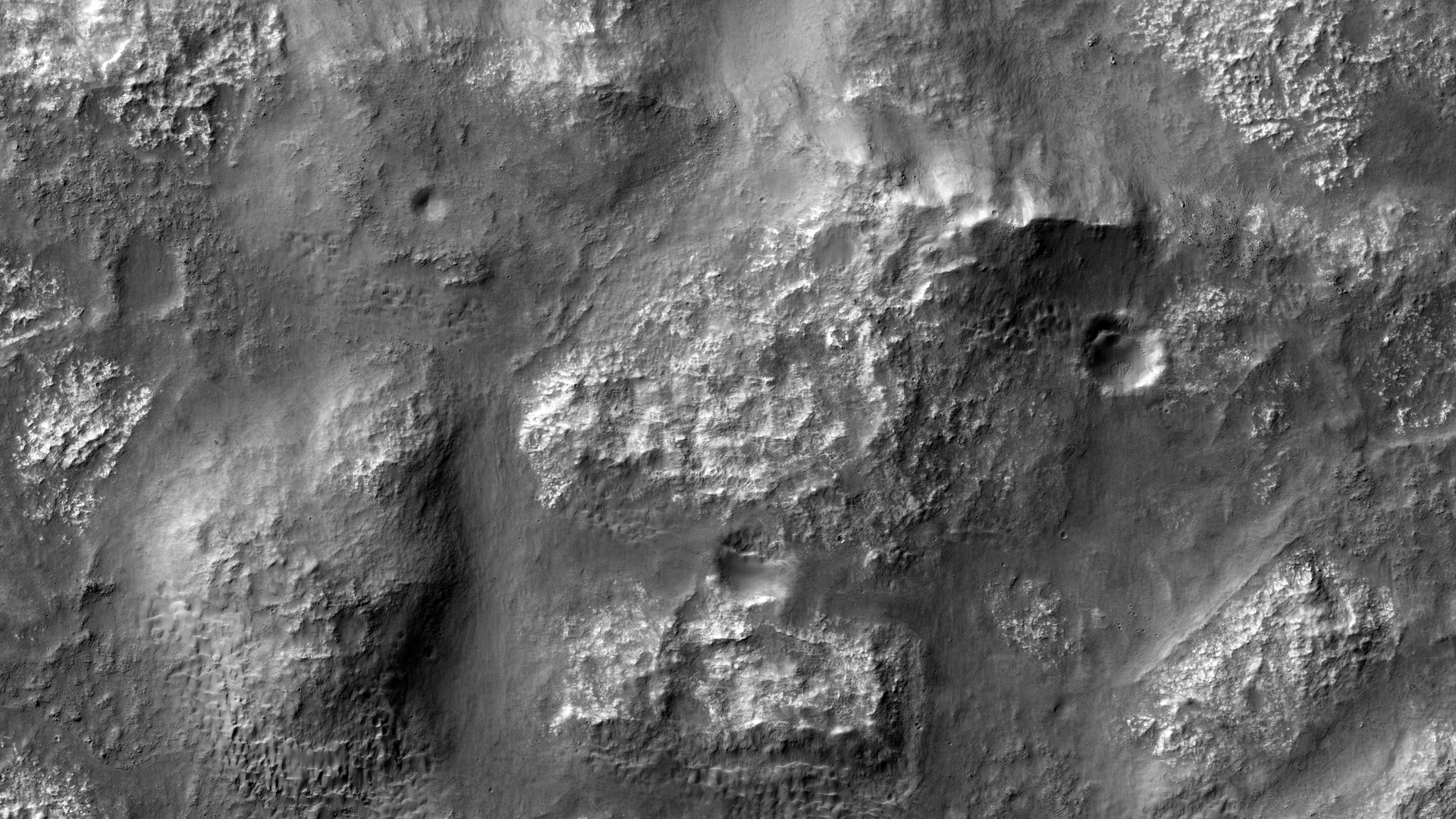
Chaotic Terrain in Eridania Basin


Eridania is the name of topographically enclosed basin located in the southern highlands of Mars that has been suggested to be the site of a large ancient lake or inland sea.

A chaotic jumble of relatively bright blocks sits on the lowest floor regions of the basin, sampled in this image. These blocks contain a variety of hydrated minerals that could have formed in the water, perhaps preserving information about an ancient habitable environment.

This lake or sea partially drained to form the Ma'adim Vallis, a large channel that itself drained into Gusev Crater to the north. The Spirit rover landed in Gusev Crater in 2004 to study the expected lake deposits, but found that the floor of the crater had been covered by lava that was younger than the fluvial activity.

Eridania is a better place to find lake sediments, but is too rough and dangerous for the landing systems sent to Mars in the past.

Image credit: NASA/JPL/University of Arizona

Note: For more information, see PIA18804: Chaos in Eridania Basin.

Friday, July 18, 2014

Ridges in Eridania Basin


Eridania Basin, located at the head of Maadim Vallis, has mounting geomorphic and spectral evidence that it may have been the site of an ancient inland sea.

This site presents interesting mineralogical and geological evidence for the past existence of a large aqueous system on Mars that could have been long lived, and may have been well suited for ancient life, and almost certainly contains important clues about the ancient climate.

In this HiRISE image, there are numerous dark ridges against a brighter substrate. These ridges could be cemented and topographically inverted fractures, although other origins (such as eskers, channels, or volcanic dikes) cannot be ruled out. One way to produce these ridges would be when fluids moved through the fractures, causing cementation and hardening. Later, erosion removed the softer rocks surrounding the fractures, while the more resistant cemented materials within the fractures were left standing higher, thus appearing inverted.

Image credit: NASA/JPL/University of Arizona

Note: For more information, see PIA18623: Ridges in Eridania Basin.