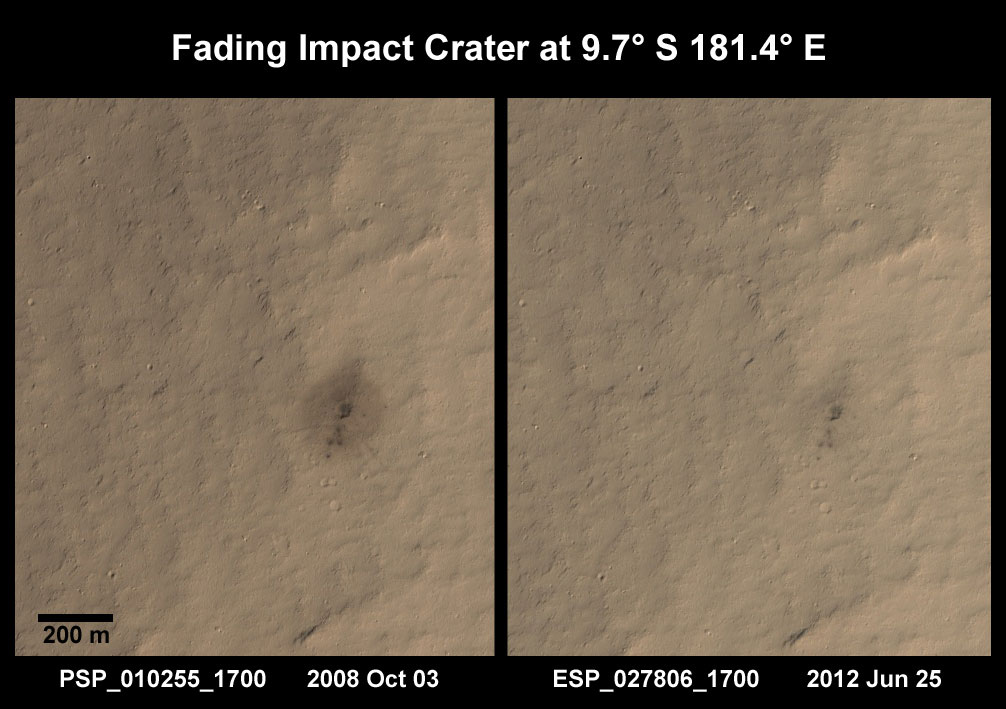
This cluster of craters formed quite recently from a weak impactor that broke apart in Mars' thin atmosphere before smashing into the surface. It was discovered by the MRO Context Camera (CTX) Team, who found a dark spot in a CTX image taken in August 2008 that was not present in earlier Mars Odyssey Mission THEMIS images from July 2005. HiRISE examined the feature in October 2008 and verified that the dark spot was impact ejecta excavated from beneath the bright surface.
On June 25 2012, HiRISE took another look at the young crater to see how it had fared after two Martian years. This image was timed to closely match the illumination and viewing conditions of the earlier HiRISE image. A comparison of the two images shows that the dark halo surrounding the crater cluster has nearly vanished. The delicate rays extending beyond the halo are also significantly faded. Only the individual craters remain distinctly dark in the new image.
This observation is important for two reasons. First, it raises questions about the Martian winds and sediments that produce such changes. Did the dark ejecta blow away, or was it buried by a layer of bright dust? Second, it tells us that the window for detection of these young craters can be very short. In this case, the dark spot that drew the attention of the Context Camera Team was the 200-meter diameter halo of ejecta that encircled the crater cluster. After two Martian years, the halo is gone and the impact cluster would not be easily detected.
Photo credit: NASA/JPL/University of Arizona
Note: This feature is located in
Lucus Planum to the west of
Memnonia Sulci.