Showing posts with label Stokes Crater. Show all posts

Tuesday, July 6, 2010

Hydrated Minerals at Stokes Crater


Stokes Crater, pictured here, is one of at least nine craters in the northern lowlands of Mars with exposures of hydrated minerals detected from orbit, according to a June 25, 2010, report.

These minerals, including phyllosilicates, have previously been found in thousands of small outcrops in the southern highlands of Mars, but had not previously been identified in the northern lowlands, which cover nearly half of the planet. The numerous outcrops in the south have been interpreted as evidence that early Mars -- about 4 billion years ago -- had wet conditions necessary for producing phyllosilicates and possibly conducive to life.

The exposures in some northern craters indicate these minerals are in an older layer underneath the younger surface of northern Mars and are made visible where crater-forming impacts have exposed the underlying material. The new report in the journal Science by John Carter of the University of Paris and his co-authors says that the northern finds suggest the ancient, wet conditions extended globally. Their report draws upon observations by the Compact Reconnaissance Imaging Spectrometer for Mars (CRISM) aboard NASA's Mars Reconnaissance Orbiter and the OMEGA spectrometer orbiting aboard the European Space Agency's Mars Express.

Stokes spans 66 kilometers (41 miles) in diameter, centered at 55.6 degrees north latitude, 171.2 degrees east longitude.

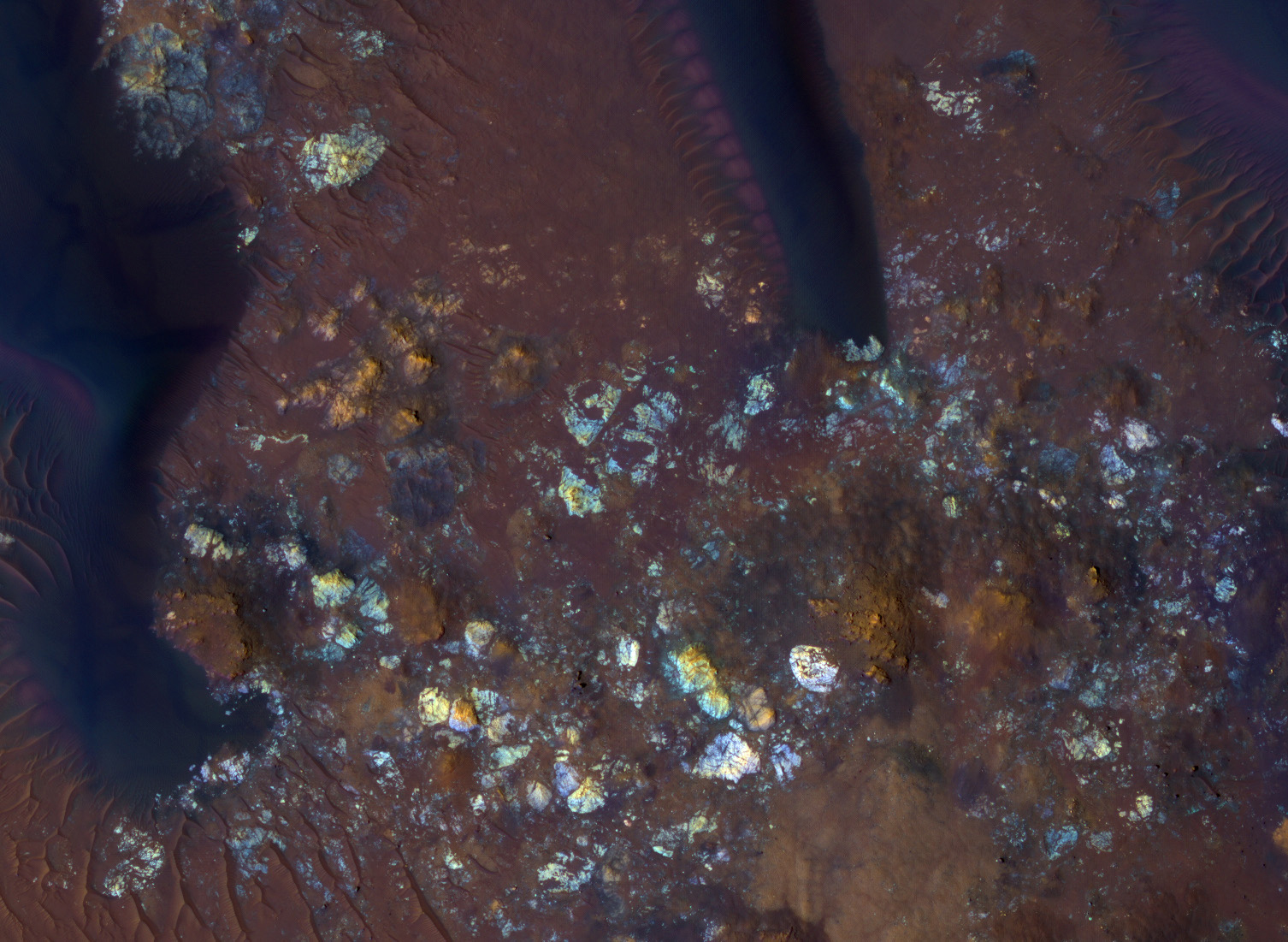
The above image shows an area near the center of the crater, with color coding [see below] for where CRISM observations have shown exposures of three types of hydrated minerals and nearby exposures of two volcanic minerals unaltered by water: pyroxene and olivine. The scale bar is 2 kilometers (1.2 miles).

Image credit: NASA/ESA/JPL-Caltech/JHU-APL/MSSS/FU-Berlin

Note: The color key for the above image can be found here. Unfortunately, this is a tif file, which I'm unable to upload. I'm also typing in the color key here: red = Iron-magnesium phyllosilicate or chlorite; light blue (cyan) = Aluminum phyllosilicate "montmorillonite"; dark blue = Aluminum phyllosilicate "kaolinite"; orange = pyroxene; and light green = olivine.

Monday, May 17, 2010

Megabreccia in the Central Uplift of Stokes Crater


Stokes is a large, approximately 60 kilometer diameter (38 miles) impact crater located in the Northern lowland plains of Mars.

Craters this large invariably have a central structural uplift, which form mountain peaks in or near the center of the crater. The Northern plains are largely covered by lavas and sediments, but craters such as Stokes allow us to observe the otherwise buried bedrock, exposed within its central uplift.

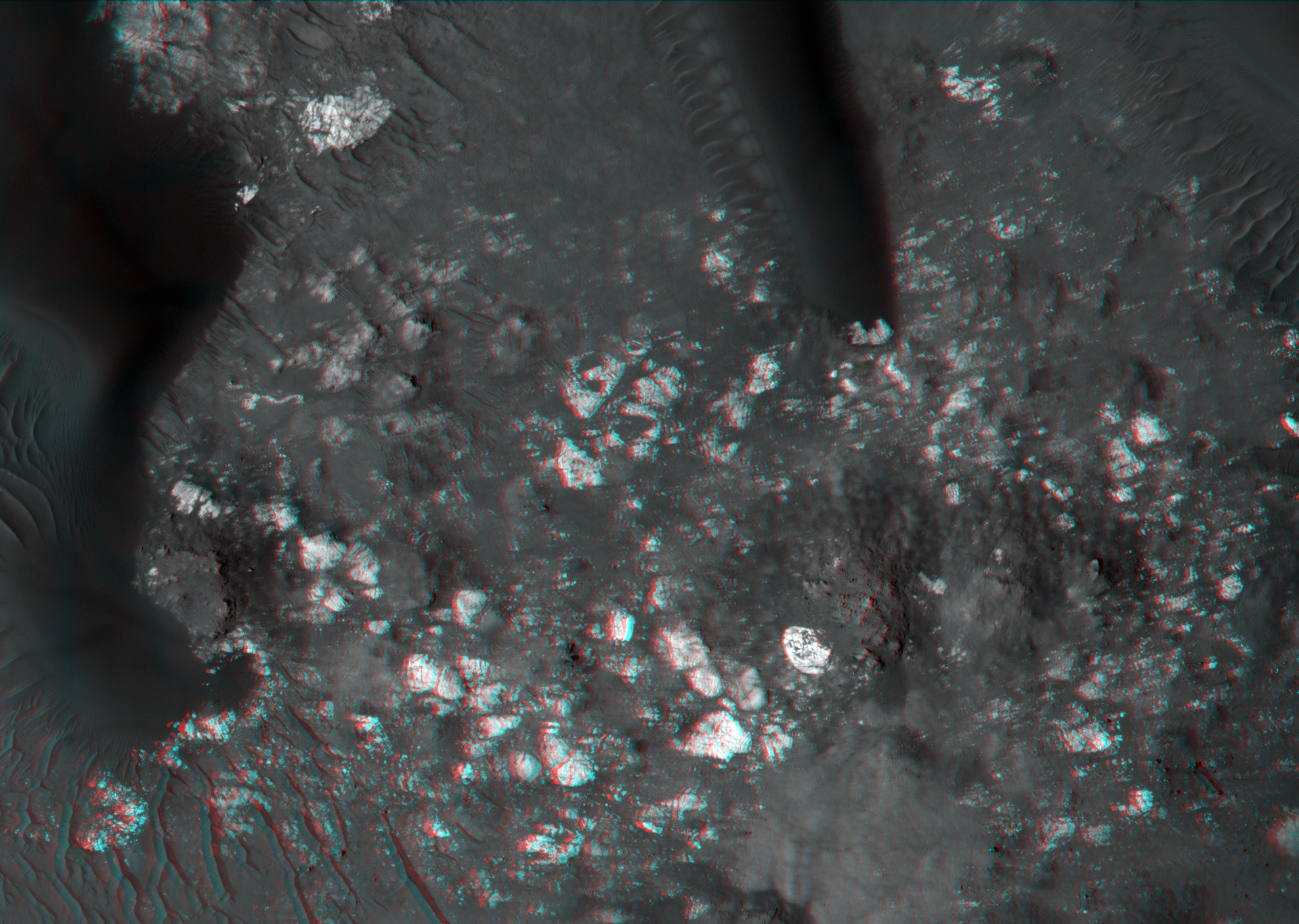
The first subimage shows a wide variety of colors and textures in a jumbled, fragmental pattern, i.e. "megabreccia." In the stereo anaglyph we can see that many of the fragmental blocks "stick out," indicating that they are more resistant to erosion than the the surrounding finer-grained material between the blocks. There is also an abundance of dark sand dunes and other smaller aeolian (wind-driven) bedforms on top of the area of exposed bedrock.

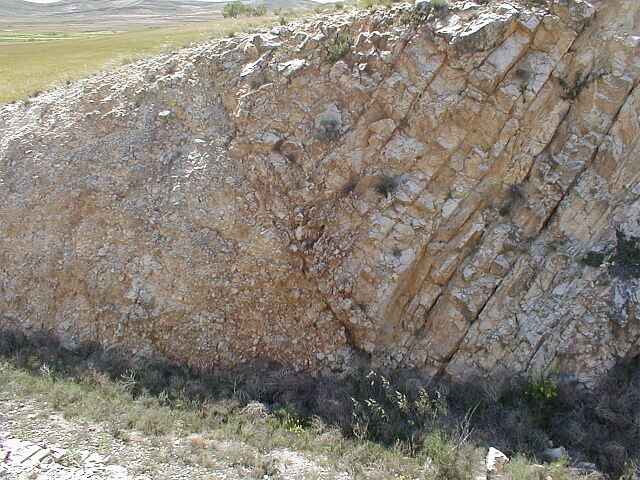
Megabreccia, consisting of very large fragments of pre-existing bedrock, is created by energetic processes, but especially by impact events on Mars. Although megabreccia deposits can coat central uplifts, it may not have been the Stokes impact that made this megabreccia.

The formation of a crater's central uplift does not commonly break up and jumble the deep bedrock. So if these megabreccias are exposures of the deep bedrock brought up to the surface by the central uplift, and are not merely deposits draped on the central uplift, then it is most likely that these megabreccias were created by much larger and older basin-forming impacts that now lie buried beneath the surface.

With the aid of high-resolution images, and especially the 3D anaglyphs, we hope to decipher whether the materials observed in the central uplift were formed by the host crater or prior to the formation of that crater. Either way, crater central uplifts can provide windows into the deepest and oldest geologic history of Mars. For example, if there was a very ancient ocean in the Northern lowlands, these rocks could include deposits from that ocean.

NOTE
This pair of images (also see ESP_016980_2360) was targeted to acquire stereo coverage of the Eastern slopes of the central uplift (see PSP_09332_2360 for an adjacent area).

Photo credit: NASA/JPL/University of Arizona