Showing posts with label Apollo Program. Show all posts

Monday, August 13, 2012

Landing Accuracy on Mars: An Historical Perspective


This image illustrates how spacecraft landings on Mars have become more and more precise over the years. Since NASA's first Mars landing of Viking in 1976, the targeted landing regions, or ellipses, have shrunk. Improvements in interplanetary navigation tightened the ellipses between the 1997 and 2008 landings of NASA's Pathfinder and Phoenix.

NASA's Curiosity used those improvements, in addition to hypersonic guided entry similar to that used by astronauts returning to Earth during NASA's Apollo program, to further reduce the ellipse size and land just north of the slopes of Mount Sharp. The area of Curiosity's landing ellipse was just seven percent the size of the previous best landing ellipse for Phoenix. This guided entry technique also allowed a much heavier rover to land on Mars.

The background picture is from the European Space Agency's Mars Express overlaid with topographical data from NASA's Mars Global Surveyor.

Image credit: NASA/JPL-Caltech/ESA

Sunday, November 21, 2010

Two Views of Yankee Clipper Crater


"Yankee Clipper" crater on Mars carries the name of the command and service module of NASA's 1969 Apollo 12 mission to the Moon. NASA's Mars Exploration Rover Opportunity recorded this view of the crater during a pause in a 102-meter (365-foot) drive during the 2,410th Martian day, or sol, of the rover's work on Mars (November 4, 2010).

This view is a mosaic of three frames taken by the left eye of Opportunity's navigation camera. Yankee Clipper crater is about 10 meters (33 feet) in diameter.

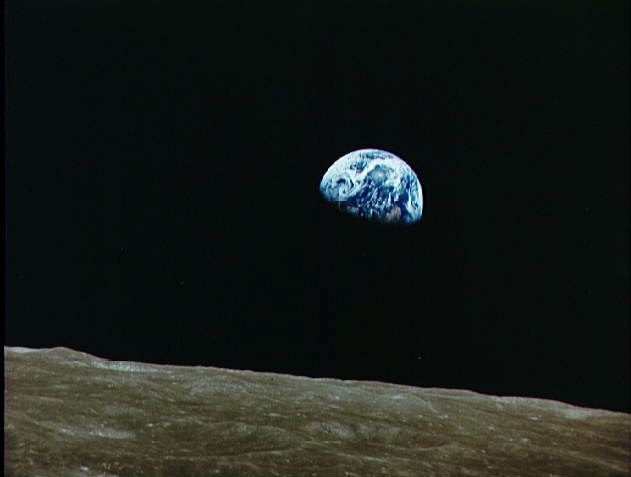
The rover science team uses a convention of assigning the names of historic ships of exploration as the informal names for craters seen by Opportunity. Apollo 12's Yankee Clipper orbited Earth's Moon while the mission's lunar module carried two astronauts to the lunar surface on November 19, 1969, and later brought all three of the mission's astronauts back to Earth, arriving November 24, 1969. A dramatic view of Earth rising over a lunar horizon, taken from Apollo 12's Yankee Clipper, is online at http://spaceflight.nasa.gov/gallery/images/apollo/apollo12/html/as12-47-6891.html.

Photo credit: NASA/JPL-Caltech

Note: The bottom photo is an anaglyph image, requiring red-green glasses.

Three Views of Intrepid Crater


"Intrepid" crater on Mars carries the name of the lunar module of NASA's Apollo 12 mission, which landed on Earth's Moon November 19, 1969. NASA's Mars Exploration Rover Opportunity recorded this view of the crater during the 2,417th Martian day, or sol, of the rover's work on Mars (November 11, 2010).

This view is presented in approximately true color, combining exposures taken by Opportunity's panoramic camera (Pancam) through three filters admitting wavelengths of 752 nanometers, 535 nanometers and 432 nanometers. Intrepid crater is about 20 meters (66 feet) in diameter. That is about the same size as the crater where Opportunity spent its first two months on Mars: Eagle crater. The rover's look-back image into Eagle crater after driving out of it in 2004 is at PIA05755.

The rover science team uses a convention of assigning the names of historic ships of exploration as the informal names for craters seen by Opportunity. Apollo 12's lunar module Intrepid carried astronauts Alan Bean and Pete Conrad to the surface of Earth's Moon while crewmate Dick Gordon orbited overhead in the mission's command and service module, Yankee Clipper. A view of Bean next to Intrepid on the moon is online at http://spaceflight.nasa.gov/gallery/images/apollo/apollo12/html/as12-46-6749.html. An image of Conrad inspecting robotic lander Surveyor 3, with Intrepid on the lunar horizon nearby, is online at http://spaceflight.nasa.gov/gallery/images/apollo/apollo12/html/as12-48-7133.html.

Photo credit: NASA/JPL-Caltech/Cornell University

Note: The middle photo is a false color image of the crater, designed to make differences in surface materials more visible. The bottom photo is an anaglyph image of the crater.