Showing posts with label Cinder Cones. Show all posts

Friday, August 15, 2014

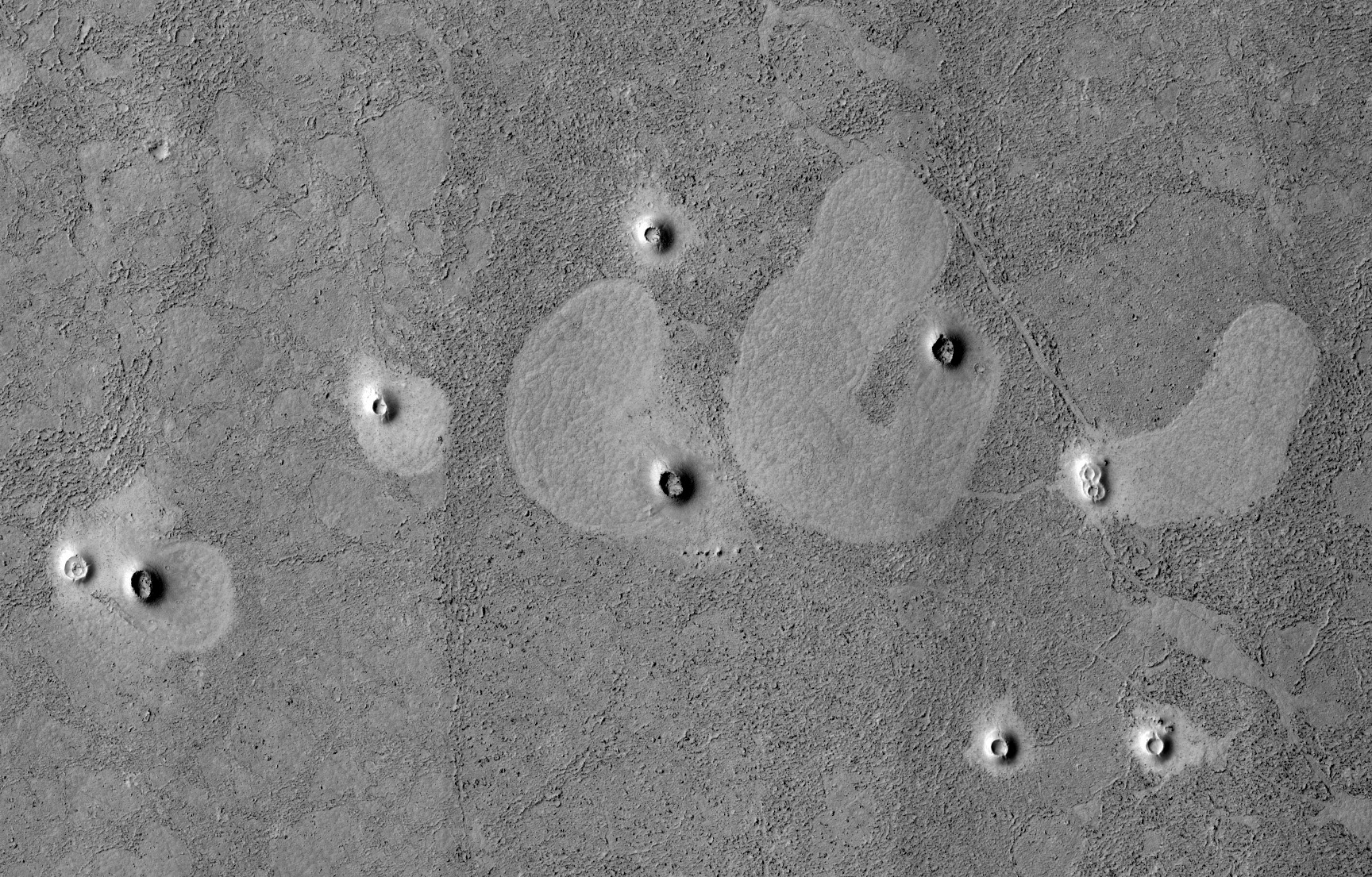
Lava Cones and Flows in Southern Elysium Planitia


The north end of this long image shows a lava surface in southern Elysium Planitia. Small cones are common on the extensive young flood lavas in this region.

Here, the cones are larger than usual, perhaps approaching cinder cone sizes. What's really odd here is that the cones are associated with lighter areas with polygonal patterns. Such polygons are commonly visible on the denser portions of lava flows, while the rougher areas have more broken-up low-density crust.

But the shapes of these regions are unusual, and the association with cones suggest that the cones were source vents for local lava flows. Other interpretations are also possible.

Image credit: NASA/JPL/University of Arizona

Note: For more information, see PIA18645: Strange Cones and Flows.

Tuesday, October 12, 2010

Possible Cinder Cone on the Southern Flank of Pavonis Mons


This image is centered on a small cone on the side of one of Mars' giant shield volcanoes [Pavonis Mons]. The cone shows some layers of hard rock but most of it is made of relatively soft material. This appears to be an example of a "cinder" cone composed of pieces of lava thrown into the air during a small volcanic eruption.

Typically, such eruptions produce fountains of molten lava. Most of the lava would have cooled in this fountain, producing a loose pile of lava rocks. However, it appears that some pulses of the eruption allowed the lava to land without cooling much. These pieces were hot enough to weld together to make the hard layers we see today. The cone is 700 x 1,100 meters (2,300 x 3,600 feet) in size, similar to many cinder cones on Earth.

In other parts of the image, we see channels carved by lava. It is sometimes difficult to tell if a channel was formed by flowing water or lava; in this case, it is possible to see that lava flows feed out of these channels.

Photo credit: NASA/JPL/University of Arizona