Showing posts with label Promethei Planum. Show all posts

Friday, January 7, 2011

Aerosols in the Air


HiRISE images are monochromatic across much of the scene, but in the center we return color data. The color strip down the center of this image gives us insight into aerosols (particles of dust and frost) suspended in the atmosphere and the seasonal processes that get them there.

In the winter Mars' south polar region is covered by a layer of carbon dioxide ice (dry ice). In the spring this ice evaporates from the top and the bottom of the seasonal ice layer (typically tens of centimeters thick). Where there are cracks in the ice the gas from below escapes, carrying fine particles from the surface up to the top of the ice. Larger particles fall back onto the ground in fan-shaped deposits pointing in a direction determined by the local winds.

We see the smaller particles (dust) suspended in the air locally over the cracks as the bluish tone over the regions with fans. Over regions without fans, where gas and dust from the surface are not escaping into the atmosphere, the surface is a more pinkish tone.

Photo credit: NASA/JPL/University of Arizona

Note: This image is located in Promethei Planum, which lies just north of Planum Australe.

Friday, October 15, 2010

Spring Colors on the Southern Polar Cap


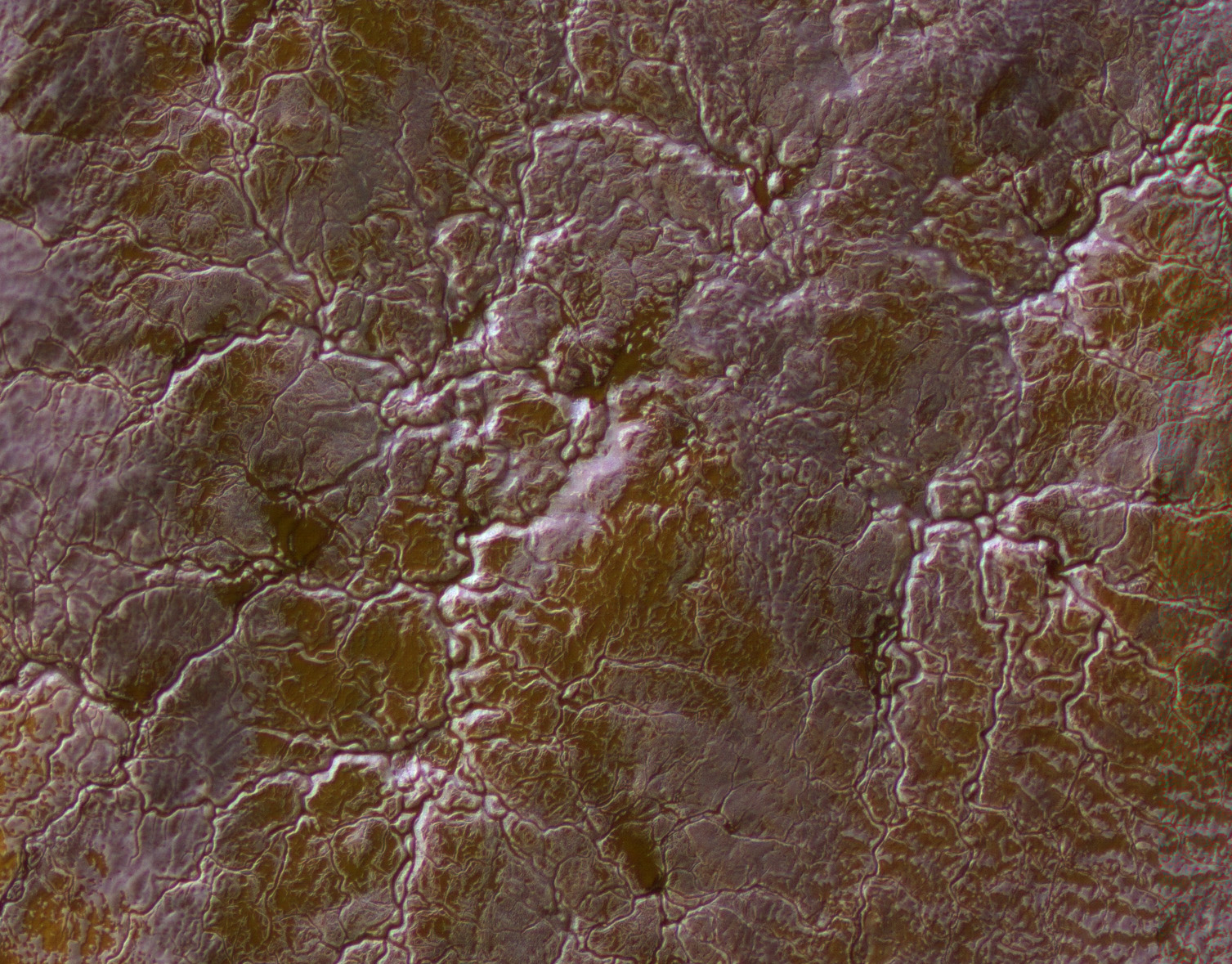
Mars has a seasonal southern polar cap composed of carbon dioxide (commonly known as dry ice), that overlies a permanent polar cap which is a mixture of carbon dioxide ice, water ice and dust. As the carbon dioxide evaporates in the spring the escaping gas carves channels in the permanent cap below. Often these channels radiate outward (or converge inward), giving them a spider-like appearance [araneiform].

In this false color image the seasonal frost is whitish-lavender. The tan areas starting to show through are where the frost has already evaporated (sublimated is actually the correct term, when ice changes directly to a gas). Tan-colored dust blows around and accumulates in the bottom of some of the channels.

This is truly other-worldly terrain, with exotic landforms with no earthly analogs.

Photo credit: NASA/JPL/University of Arizona

Note: The location of this photo is on the Planum Australe ice cap, south of Promethei Planum and west of Chasma Australe.