Showing posts with label Charitum Montes. Show all posts

Saturday, December 8, 2012

Charitum Montes Topographical Map


This color-coded overhead view is based on an ESA Mars Express HRSC digital terrain model of the region, from which the topography of the landscape can be derived. The color coding shows the very edge of the Charitum Montes mountain region at the top of the image, with the highest elevation, while the subtle pedestal craters that dot the image almost fade away with just a small amount of relief difference between the elevated ejecta and the surrounding area. Centered at around 53°S and 334°E, the image has a ground resolution of about 20 m per pixel. The image was taken during revolution 10778 on 18 June 2012.

Image credit: ESA/DLR/FU Berlin (G. Neukum)

Friday, December 7, 2012

Charitum Montes Anaglyph


Charitum Montes imaged during revolution 10778 on 18 June 2012 by ESA’s Mars Express using the High-Resolution Stereo Camera (HRSC). Data from HRSC’s nadir channel and one stereo channel have been combined to produce this anaglyph 3D image that can be viewed using stereoscopic glasses with red–green or red–blue filters. Centered at around 53°S and 334°E, the image has a ground resolution of about 20 m per pixel.

Photo credit: ESA/DLR/FU Berlin (G. Neukum)

Saturday, August 27, 2011

Exposures of Layered Rocks in the Argyre Region


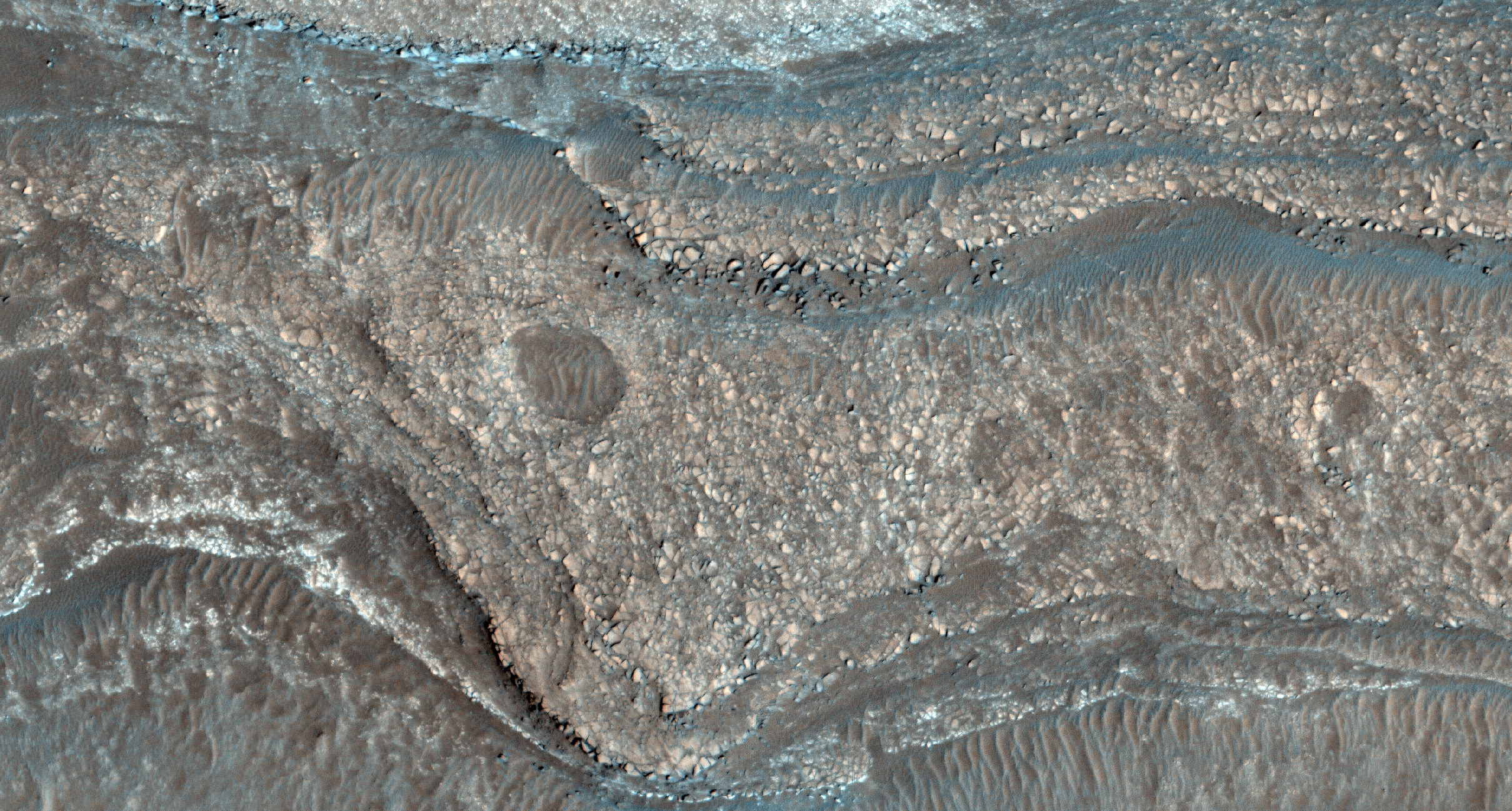
This observation shows great exposures of layered rocks in Argyre region. Could it be evidence for an ancient sea or lake?

The Argyre region, also known as the Agyre quadrangle by the USGS, is also home of the Argyre impact basin, which contains some ancient eroded terrains, as well as other impact craters that HiRISE has imaged: Green Crater, Galle Crater, and Charitum Montes.

This subimage from the color swath (approximately 1.2 kilometers across) shows some of the rocks and layers in greater and impressive detail. (Note: the subimage is not map-projected so North is approximately down.)

This is a stereo pair with ESP_014167_1300.

Photo credit: NASA/JPL/University of Arizona