Showing posts with label Eumenides Dorsum. Show all posts

Thursday, July 11, 2013

Bumblebee Crater


Do you see what I see? A large bumble bee!

Orbit Number: 36521 Latitude: 4.44421 Longitude: 208.319 Instrument: VIS Captured: 2010-03-09 11:46

Photo credit: NASA/JPL-Caltech/Arizona State University

Note: These impact craters are located in Amazonis Planitia to the east of Eumenides Dorsum.

Wednesday, November 10, 2010

Wind Effects Near Eumenides Dorsum


One of the most active agent of erosion on Mars today is the wind. This region, near Nicholson Crater, as been sculpted by untold years of blowing grit and wind.

Photo credit: NASA/JPL/Arizona State University

Note: This area is actually some distance away from Nicholson Crater, which lies well to the west. Rather, this picture was taken in the southern region of Eumenides Dorsum, which extends out of the Martian southern highlands toward Amazonis Planitia.

Wednesday, August 18, 2010

Monday, May 3, 2010

Newly-Formed Slope Streaks


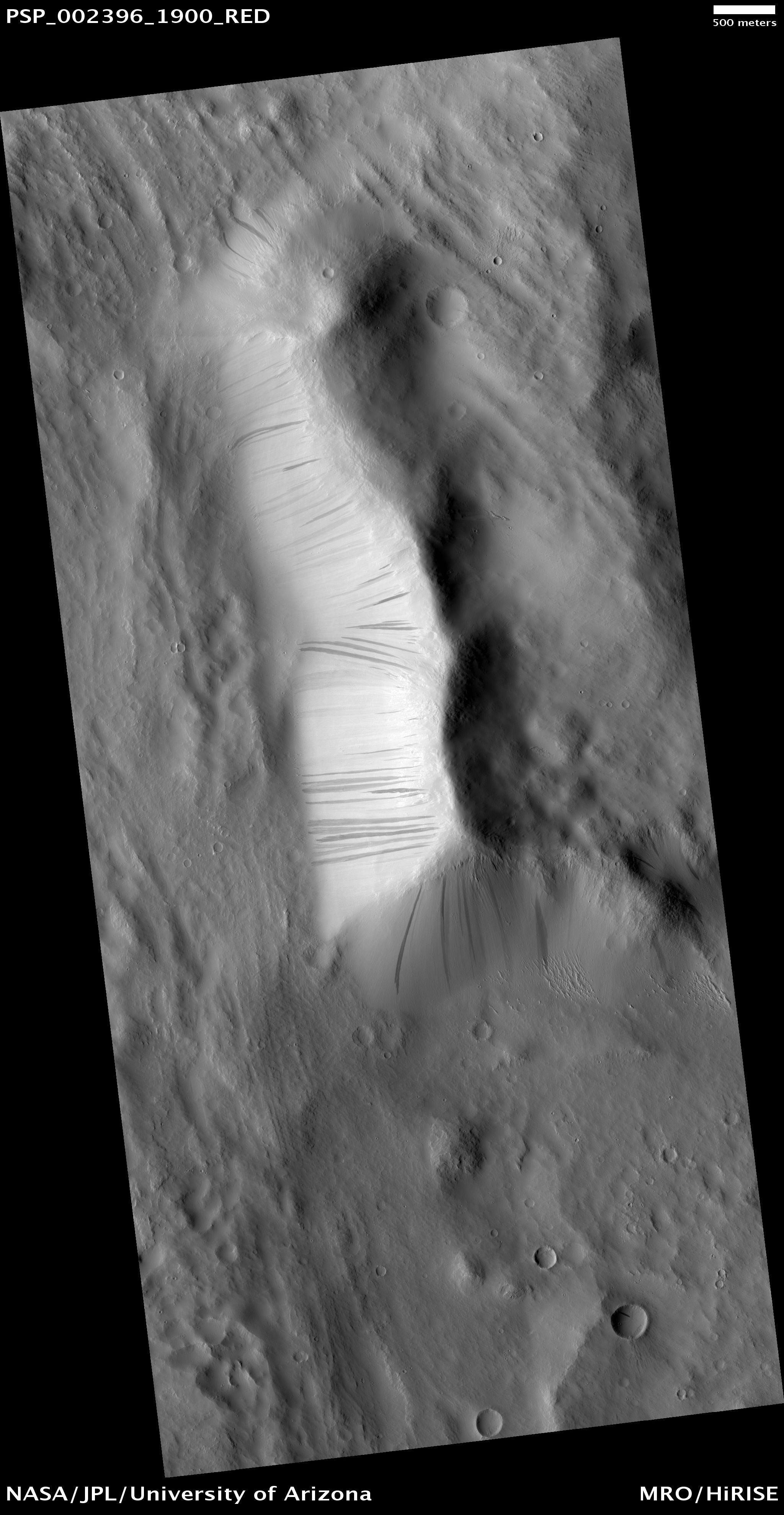
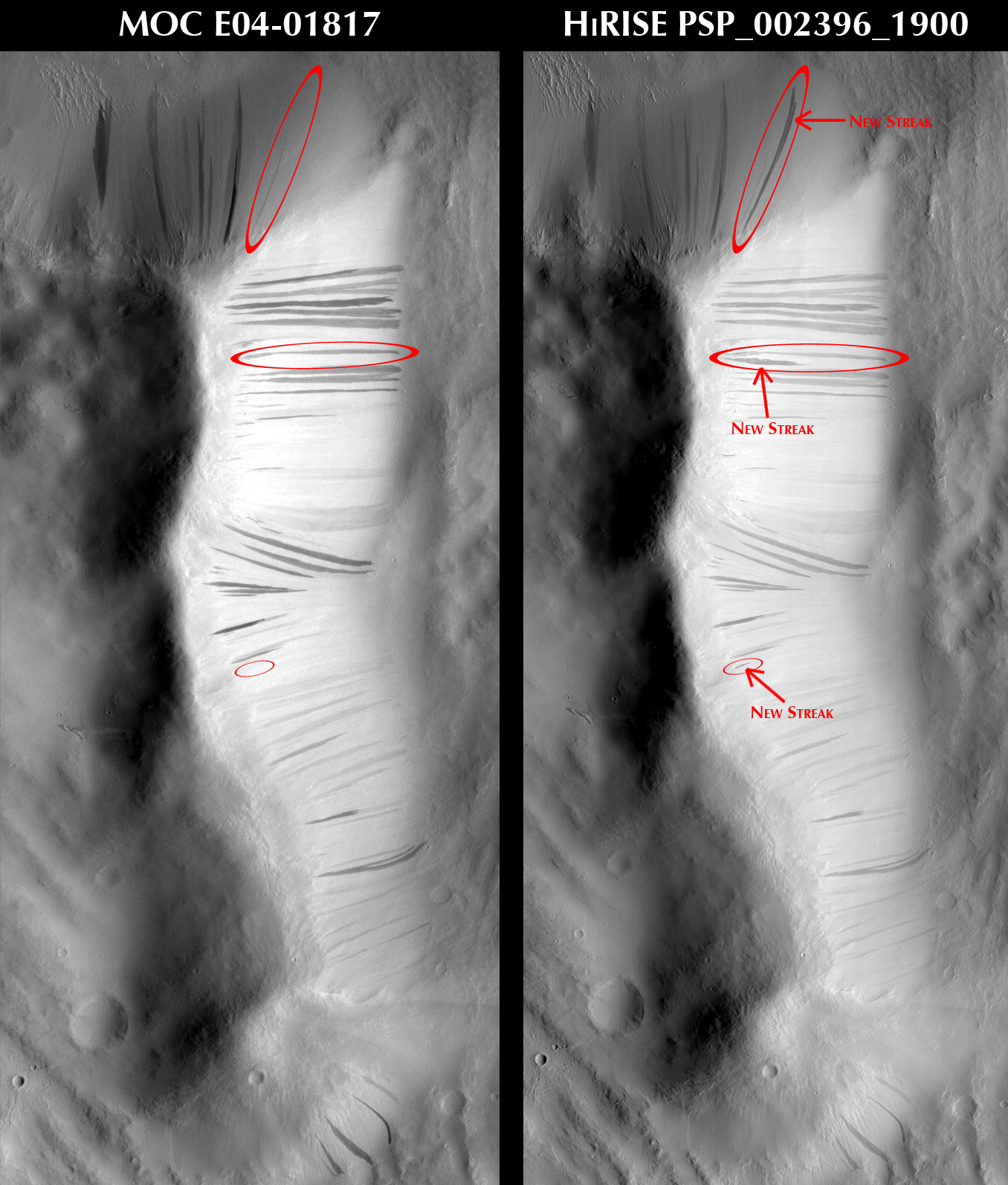
This observation features three newly-formed slope streaks. These are features which occur on crater walls, hills, and other slopes on Mars.

They always begin at a point source and widen downslope, sometimes weaving around existing topographic features (such as dunes or craters), but other times they flow over them. Many slope streaks do not show topographic relief in available images, and there are no observable deposits of displaced materials surrounding their borders.

In general, slope streaks tend to be many hundreds of meters long and less than 200 meters wide. They are observed in varying shades of darkness, where lighter-toned streaks appear to be older than darker ones. The formation mechanism responsible for slope streaks is still under debate; theories range from dry dust avalanches (most widely-accepted theory) to briney water seepage.

Slope streak formation is among the few surface processes known to be currently active on Mars, making slope streaks some of the youngest features on Mars. A comparison of this HiRISE image with MOC image E04-01817 shows that three new slope streaks have formed during the six years separating these images (2001 - 2007). The shortest time frame in which new slope streaks have been observed to form is six months (MOC images SP2-37303 and E02-02379), though it is not yet known how long it actually takes for a slope streak to form.

Photo credits: NASA/JPL/University of Arizona; MOC Image E04-01817: NASA/JPL/Malin Space Science Systems.

Note: These slope streaks are located in Amazonis Planitia to the northwest of Eumenides Dorsum.