Showing posts with label Ariadnes Colles. Show all posts

Sunday, April 14, 2013

Bright Tracks from Bouncing and Rolling Boulders


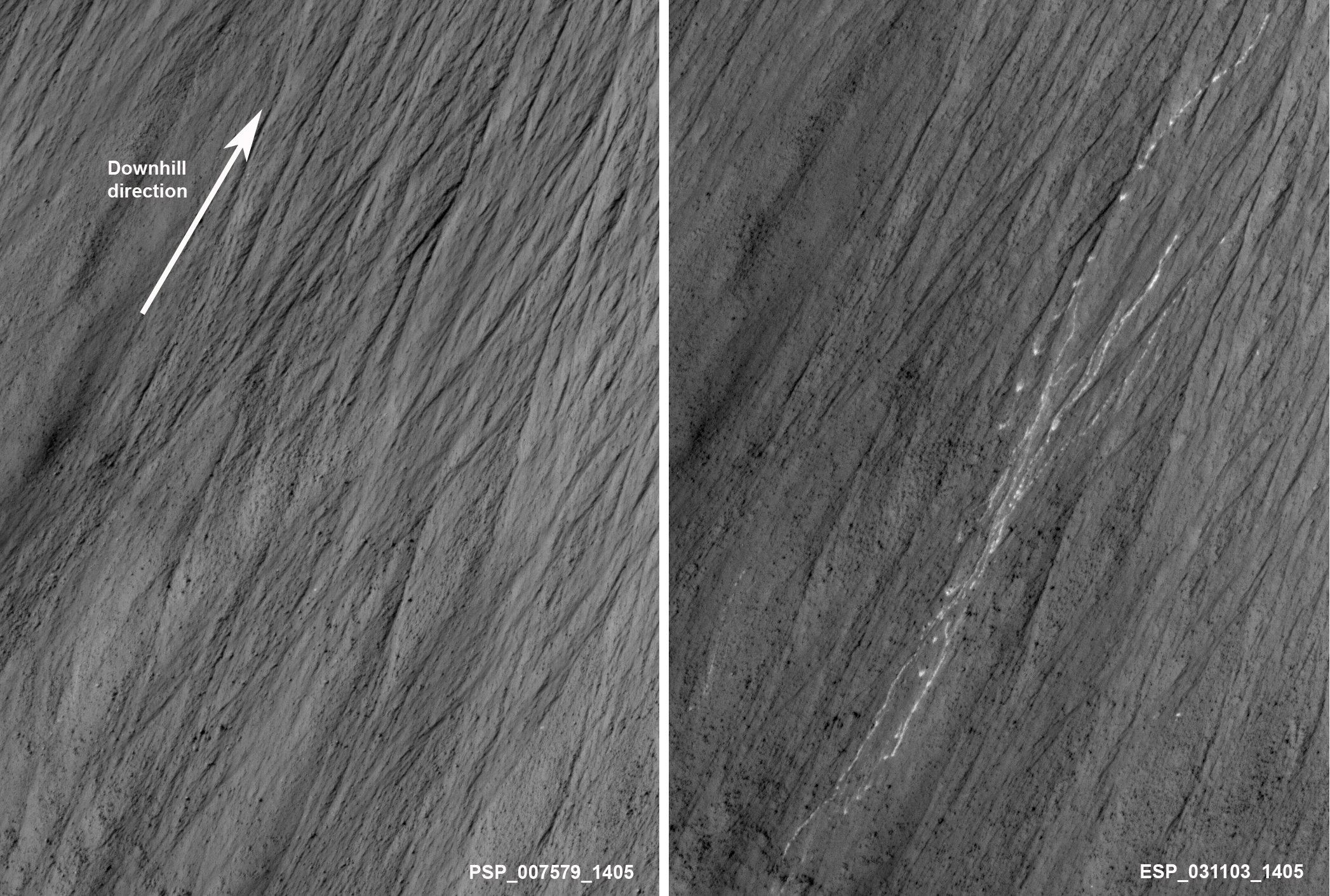
This image shows a well-preserved impact crater. A closeup view highlights distinctive bright lines and spots on the steep slope on the north side.

HiRISE imaged this crater 5 years ago (2.6 Mars years ago), in March 2008, and no such pattern was visible. The discontinuous bright spots indicate bouncing, so we interpret these features as due to boulders bouncing and rolling down the slope.

Where did the boulders come from? Maybe they fell off of the steep upper cliffs of the crater, although we don't see any new bright features there that point to the source. Maybe the rocks were ejecta from a new impact event somewhere nearby.

Why are the trails bright? Perhaps the shallow subsurface soil here is generally brighter than the surface soil, as revealed by the Spirit rover in a part of Gusev Crater. It can't be bright from ice because this is a warm equator-facing slope seen in the summer.

Photo credit: NASA/JPL/University of Arizona

Note: This image is located in Terra Cimmeria, about halfway between Ariadnes Colles to the north and Bjerknes Crater to the south.

Wednesday, January 5, 2011

Small Valleys and Colorful Bedrock in Terra Cimmeria


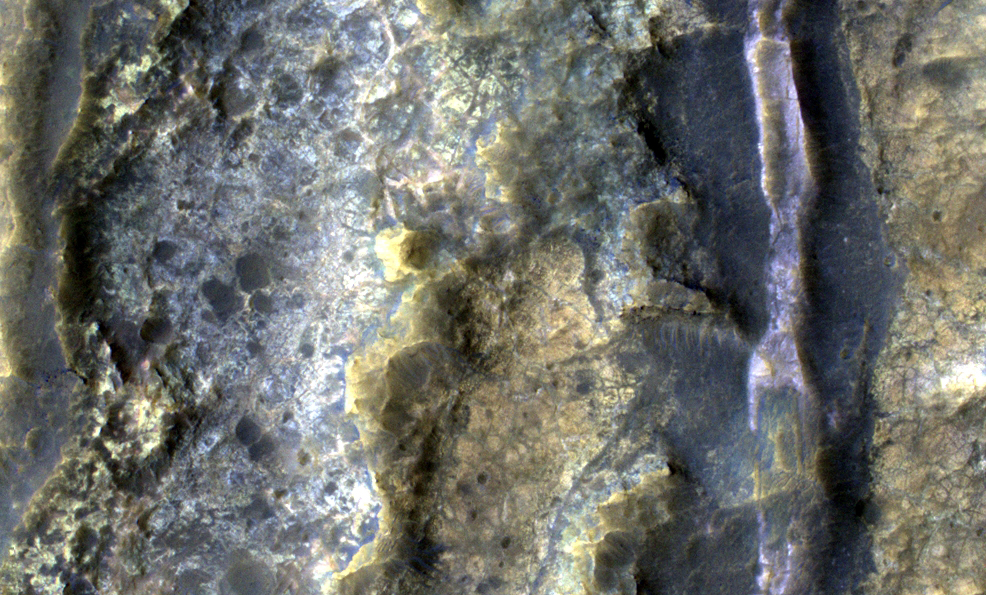
This image shows a network of small valleys in the Terra Cimmeria region of the Martian southern highlands. This location is approximately 1,000 kilometers (600 miles) south of Gusev Crater, the landing site of the Mars Exploration Rover Spirit.

The valleys in this image are carved into light-toned bedrock exhibiting a range of colors, which likely reflect a range of mineralogical compositions. The bedrock is pervasively fractured, and some of the fractures appear to be filled with material of a different color, possibly composed of minerals that crystallized or were cemented together when fluids (perhaps water) circulated through the fractures.

On the right side of the subimage is a valley filled with dark material and a central, bright ridge. If the valley was carved by liquid water, then this ridge may mark a former stream channel where coarse-grained sediment was deposited, which has survived erosion more effectively than the finer-grained sediment in the valley outside the channel.

Similar “inverted channel” deposits are visible elsewhere on Mars, and some examples in the southern highlands have been inferred to contain chloride salts (similar to table salt). The color and texture of the possible inverted channels in this image are similar to those inferred to contain chlorides, which may have been deposited when salty water evaporated.

Considered together, the features in this image attest to a history of water-related activity at this location on Mars.

Photo credit: NASA/JPL/University of Arizona

Note: This image is located about halfway between Ariadnes Colles and the source of Ma'adim Vallis.

Saturday, November 13, 2010

Southern Hemisphere Crater with Gullies


This observation shows an approximately 6 kilometer diameter crater with gullies and interesting crater fill.

The crater fill may have formed from mass wasting (downward movement of material due to gravity) of ice-rich material. It is distinct from the walls of the crater, which is unusual. Often crater fill will take the form of concentric circles, suggesting that material has been transported down each wall similarly. This is not the case here.

There are two main sets of gullies, one deeply incised (left) next to one that is shallower (right). The gullies on the left are well developed and have likely experienced more flow than the gullies on the right. The well-developed gullies cross several wrinkles that wrap around much of the crater fill, indicating the gullies formed after the crater fill was in place. The gullies on the right (see subimage) are shallow and narrow. Several have linear depressions above their sources suggesting that subsurface water flowing to the gully heads removed some material creating the collapse depressions visible here.

Photo credit: NASA/JPL/University of Arizona

Note: This unnamed crater is located on the western edge of a larger unnamed crater, both of which are located in Terra Cimmeria. The craters lie to the west of Ariadnes Colles.