Showing posts with label Earth. Show all posts

Saturday, February 8, 2014

The Earth and Moon from Mars


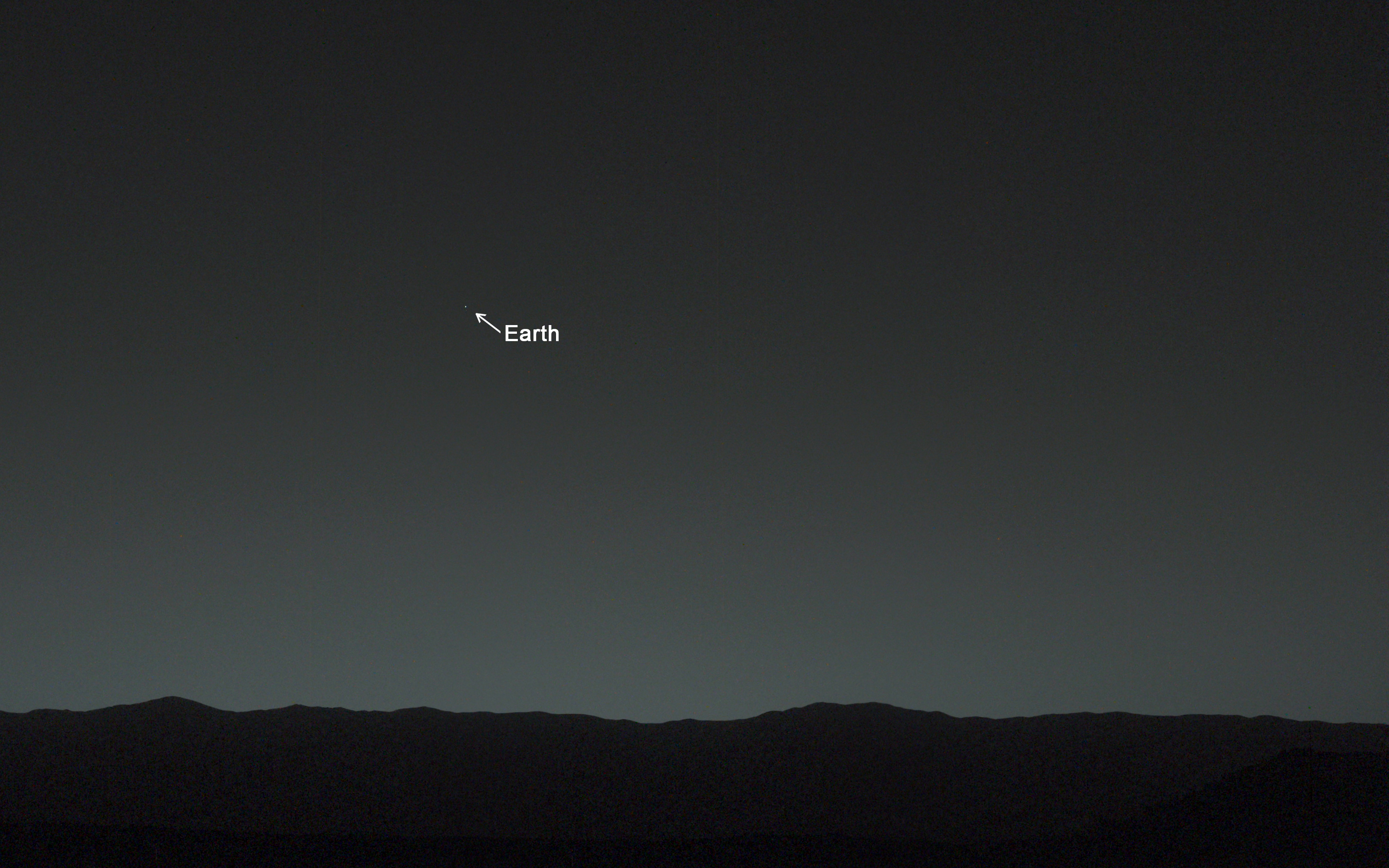
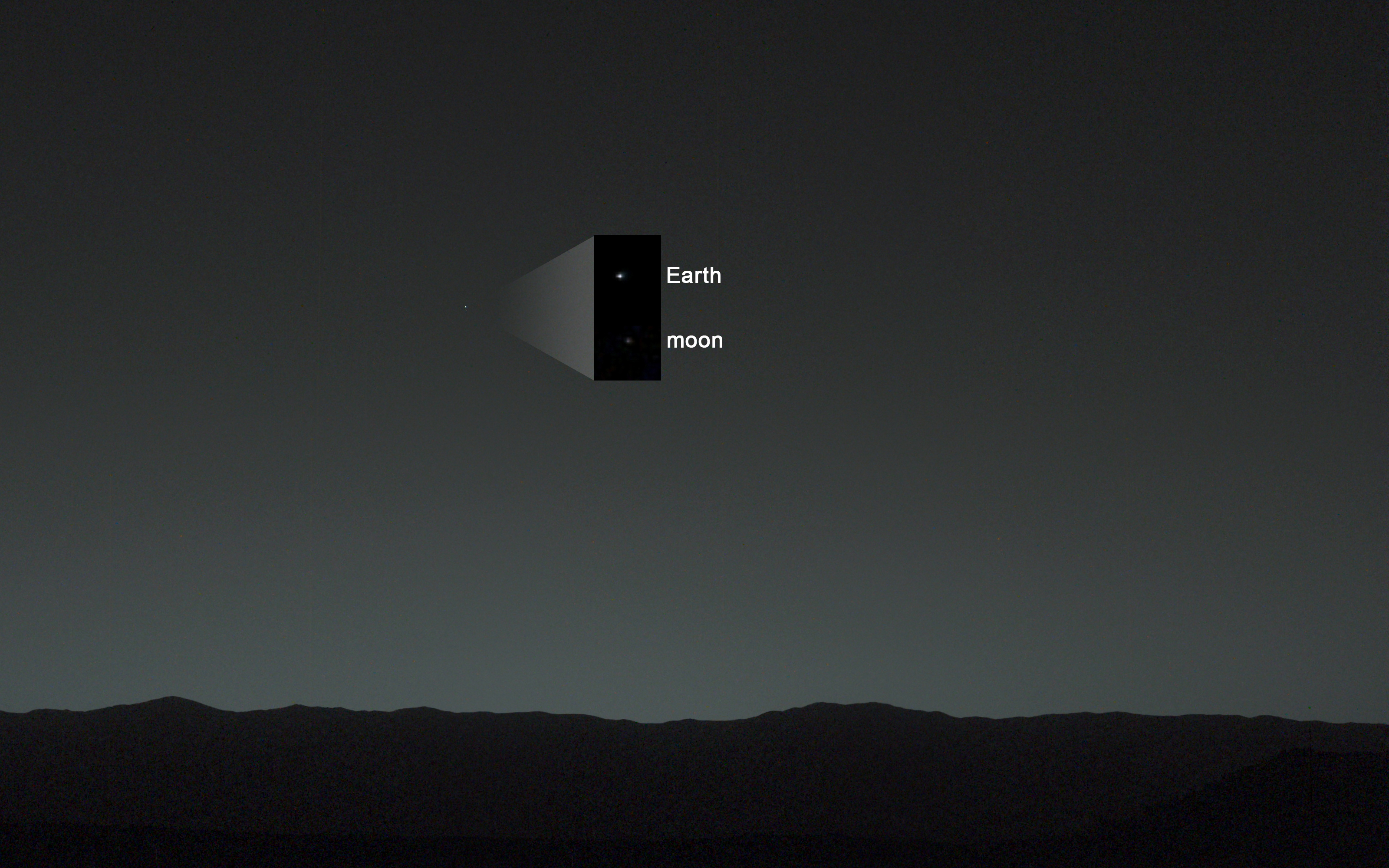
This view of the twilight sky and Martian horizon taken by NASA's Curiosity Mars rover includes Earth as the brightest point of light in the night sky. Earth is a little left of center in the image, and our moon is just below Earth. Two annotated versions of this image are also available in Figures 1 and 2.

Researchers used the left eye camera of Curiosity's Mast Camera (Mastcam) to capture this scene about 80 minutes after sunset on the 529th Martian day, or sol, of the rover's work on Mars (January 31, 2014). The image has been processed to remove effects of cosmic rays.

A human observer with normal vision, if standing on Mars, could easily see Earth and the moon as two distinct, bright "evening stars."

The distance between Earth and Mars when Curiosity took the photo was about 99 million miles (160 million kilometers).

Photo credit: NASA/JPL-Caltech/MSSS/TAMU

Note: For more information, see PIA17935: Curiosity Mars Rover's First Image of Earth and Earth's Moon and NASA Mars Rover Curiosity Sees 'Evening Star' Earth.

Friday, August 3, 2012

Magnetic Fields of Earth and Mars


This is an artist's concept comparing the present day magnetic fields on Earth and Mars. Earth's magnetic field is generated by an active dynamo -- a hot core of molten metal. The magnetic field surrounds Earth and is considered global (left image). The various Martian magnetic fields do not encompass the entire planet and are local (right image). The Martian dynamo is extinct, and its magnetic fields are "fossil" remnants of its ancient, global magnetic field.

Image credit: NASA/GSFC

Thursday, March 1, 2012

Comparison of Earth's Interior with Mars and the Moon


Mars has the same basic internal structure as the Earth and other terrestrial (rocky) planets. It is large enough to have pressures equivalent to those throughout the Earth's upper mantle, and it has a core with a similar fraction of its mass. This diagram shows the depths at which high pressures cause certain minerals to transform to higher-density crystal structures. In contrast, the pressure even near the center of the Moon barely reach that just below the Earth's crust and it has a tiny, almost negligible core. The size of Mars indicates that it must have undergone many of the same separation and crystallization processes that formed the Earth's crust and core during early planetary formation.

Illustration credit: JPL/NASA