Showing posts with label Olympia Mensae. Show all posts

Monday, February 27, 2012

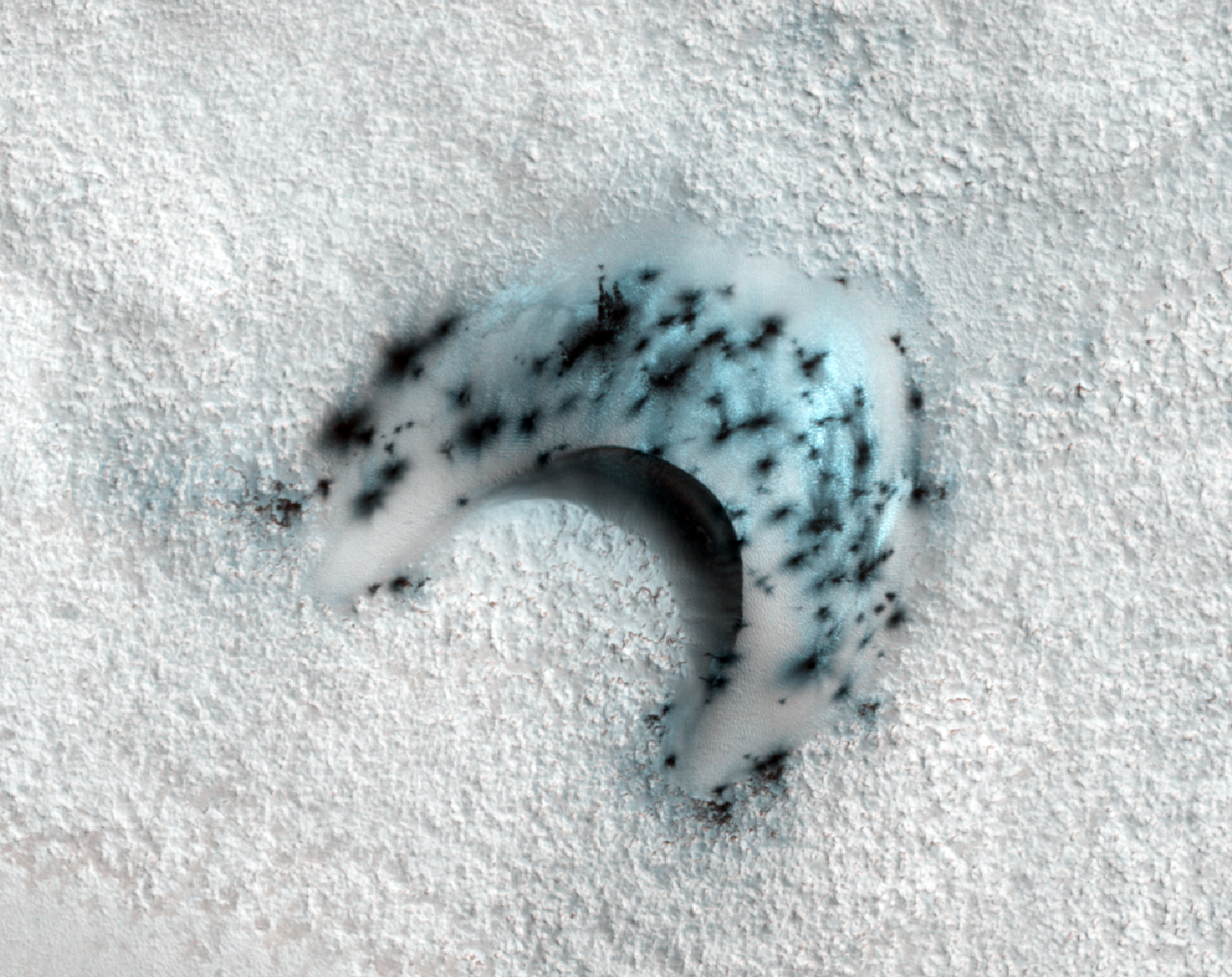
Well-Speckled Polar Dunes


These barchan (crescent-shaped) sand dunes are found within the North Polar erg of Mars. This type of dune provides a great record of the wind environment when they formed and moved: barchan dunes' horns point downwind. Although the question of present-day sand motion is still open, it appears possible that these dunes are active (when not covered in frost) as their crestlines are very sharp and their slipfaces (the inner curved region between the horns/downwind surface) appears very smooth and steep.

In this image, taken during the northern spring season, the dunes and ground are still covered in seasonal frost. The speckled appearance is due to the warming of the area -- as the carbon dioxide frost and ice on the dunes warms, small areas warm and sublimate (turn from solid to gas) faster, creating small jets that expose/deposit dark sand and dust onto the surface. Notice that there are no spots on the ground between the dunes -- that is because the ground stays more uniformly cold, unlike the darker dune sand.

As spring continues, more spots will appear on the dunes until, suddenly, all of the frost on the dunes and ground will be gone and the dark dune sand will be exposed until next winter.

Photo credit: NASA/JPL/University of Arizona

Note: This image is located in Olympia Mensae.

Friday, January 13, 2012

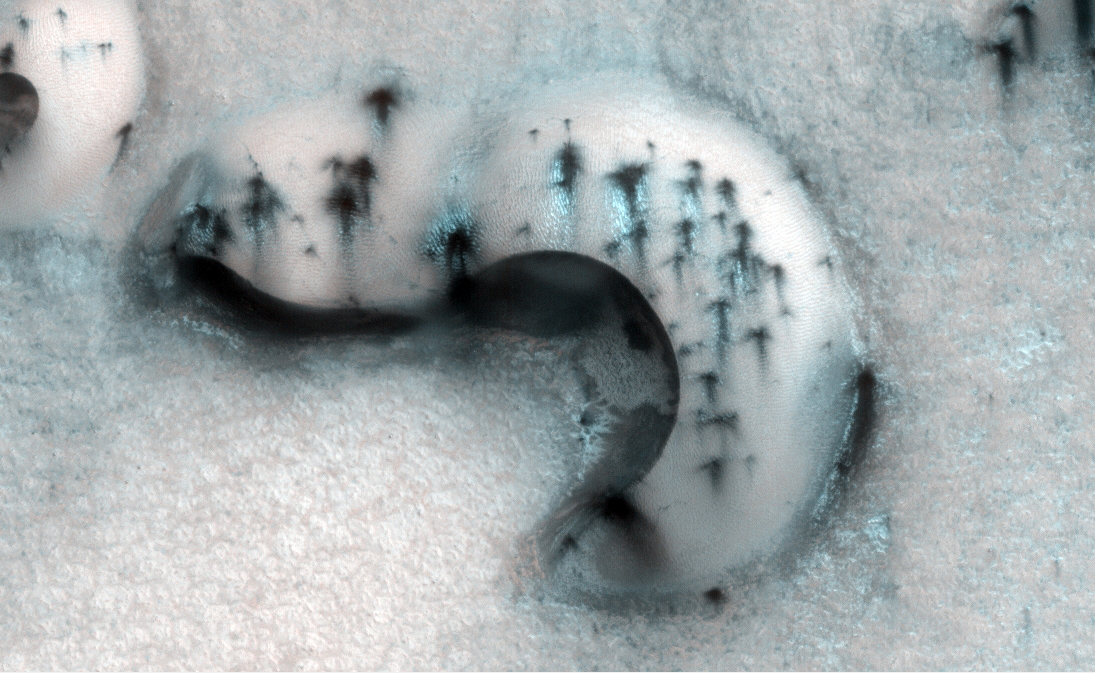
Defrosting Barchan Dunes


This HiRISE image shows sand dunes near the eastern part of North Polar erg.

The dunes imaged here are similar to barchan dunes, commonly found in desert regions on Earth. Barchan dunes are generally crescent-shaped with a steep slip face bordered by horns oriented in the downwind direction. Barchan dunes form by winds blowing mainly in one direction and thus are good indicators of the dominant wind direction when the dunes formed.

The dunes and surrounding surface appear bright because they are covered with seasonal frost left over from the northern hemisphere winter. Sunlight is now falling on the North Polar region, and carbon dioxide frost that accumulated during winter is sublimating (going directly from solid to gas) and the surface beneath the frost is being revealed.

Composed primarily of basaltic sand, the dunes will appear dark during the northern hemisphere summer. The dark spots are areas where some of this frost has begun to sublime away, and/or where wind has exposed the underlying dark sand.

Photo credit: NASA/JPL/University of Arizona

Note: This image is located west of Olympia Mensae, and north of Louth Crater. I am not quite sure what "north polar erg" the author is referring to in the first sentence. The eastern end of the primary north polar erg, Olympia Undae, is actually on the other side of the planet. This location is much closer to the western end of Olympia Undae, although that is still some distance away. Personally, I would say that the image location is in Vastitas Borealis.

Thursday, September 9, 2010

North Polar Dunes (Again)


As the Sun warms the surface and more frost is removed, the dunes and other features near the north pole of Mars are revealed. This VIS image shows that the inter-dune areas are complex.

Photo credit: NASA/JPL/Arizona State University

Note: The location of these dunes is to the south of Olympia Undae and to the east of Olympia Mensae.