Showing posts with label Herschel Crater. Show all posts

Saturday, September 21, 2013

Dunes in Herschel Crater


This VIS image shows dunes in and around a crater located on the floor of the much larger Herschel Crater.

Orbit Number: 51566 Latitude: -14.3607 Longitude: 128.67 Instrument: VIS Captured: 2013-07-29 21:05

Photo credit: NASA/JPL-Caltech/Arizona State University

Saturday, August 17, 2013

Dunes in Herschel Crater


The dunes in this VIS image are located on the floor of Herschel Crater.

Orbit Number: 51029 Latitude: -13.6442 Longitude: 129.104 Instrument: VIS Captured: 2013-06-15 16:36

Photo credit: NASA/JPL/Arizona State University

Saturday, November 19, 2011

Rippling Dune Front in Herschel Crater


A rippled dune front in Herschel Crater on Mars moved an average of about two meters (about two yards) between March 3, 2007 and December 1, 2010, as seen in these images from NASA's Mars Reconnaissance Orbiter. Note that the pattern of ripples on the dune surface has changed completely between the two images. Herschel Crater is located just south of the equator in the cratered highlands.

This is one of several sites where the orbiter has observed shifting sand dunes and ripples. Previously, scientists thought sand on Mars was mostly immobile. It took the mission's High Resolution Imaging Science Experiment (HiRISE) to take sharp enough images to finally see the movement.

While dust is easily blown around the Red Planet, its thin atmosphere means that strong winds are required to move grains of sand.

Photo credit: NASA/JPL-Caltech/University of Arizona/JHUAPL

Notes: For an animated GIF file that shows the movement of the dune over time, see here. Also, for more pictures, including animated GIFs of shifting sand dunes in Herschel Crater, see PIA14877: Shifting Sand in Herschel Crater and PIA14879: Rippling Dune Front in Herschel Crater on Mars.

Saturday, December 25, 2010

Saturday, December 11, 2010

Dunes in Terra Cimmeria


These dunes are located on the floor of an unnamed crater in Terra Cimmeria.

Photo credit: NASA/JPL/Arizona State University

Note: The location of this image is just west of Herschel Crater.

Sunday, October 10, 2010

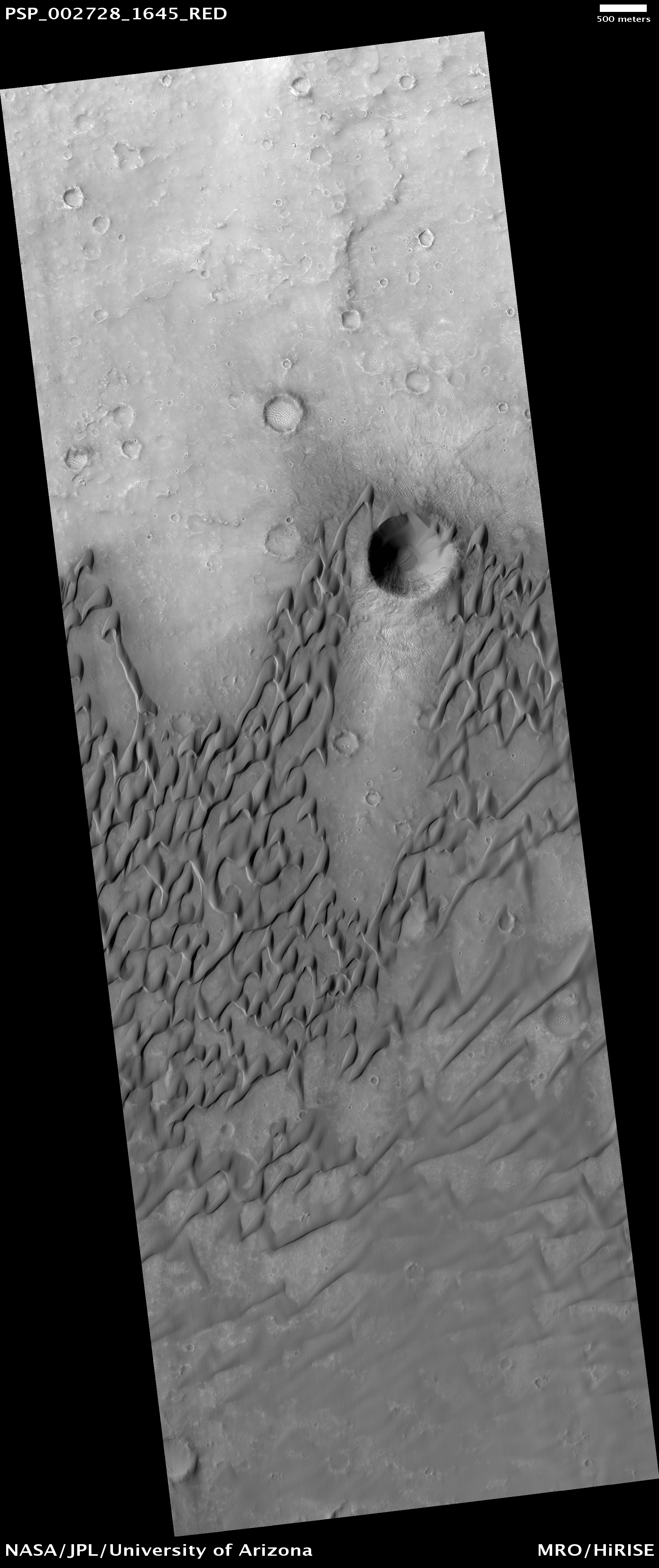
Dunes in Herschel Crater


This image shows dunes on the floor of Herschel Crater. The steep faces ("slipfaces") are oriented downwind, in the direction of motion of the dunes. One feature of particular interest is the dune-free area downwind of the crater at the image center. Some sand has been trapped in the crater, but the crater prevents the dunes from migrating directly downwind.

Sand dunes form naturally as a result of the transport of sand by the wind. The dunes in this image are somewhat crescent-shaped, but are being extended and distorted downwind and merging with nearby dunes; this complex behavior is common in dune fields on Earth.

In the southern part of the image the sand lies in sheets rather than well-defined dunes. At high resolution, the dune surfaces are covered in small ripples and scallops, also shaped by the wind.

Photo credit: NASA/JPL/University of Arizona

Wednesday, October 6, 2010

Linear Dunes and Sand Sheets in Herschel Crater


This image shows sand dunes and sheets in the central part of Herschel Crater.

In the northern (top) part of the image, the dunes grade between two morphologies, "barchan" and "linear." Barchans are crescent-shaped, with the horns of the crescents pointing downwind. One barchan is visible in the upper part of the image, with the southeast (lower right) horns longer than the other (see subimage, red box). This trend, along with the position of the steep face of the dune on the south side, indicates that the predominant winds which formed the dunes came from the north.

Southward of the barchan, the dunes grade into long streamers, called "linear dunes." On Earth, barchans form in areas of limited sand supply and linear dunes require two dominant wind directions that meet at an acute angle (i.e., less than 90 degrees). South of the linear dunes the sand covers the terrain in a vast sand sheet (see subimage, blue box). Together, these observations suggest that this part of Mars contains a limited supply of sand that has been subjected to high speed winds coming from two northerly directions.

The surface texture on the upper surface of the barchan dune and sand sheet exhibits corrugated patterns not seen on other dune surfaces. This may be caused by induration and subsequent erosion of some of the sand. Such a hypothesis was proposed by earlier investigators using lower resolution data from the Mars Orbiter Camera.

Photo credit: NASA/JPL/University of Arizona

Saturday, September 11, 2010

Alluvial Fan along a Crater Wall


This observation covers an alluvial fan along the wall of a large crater in the mid latitudes of the Southern hemisphere of Mars.

The fan was formed when water and sediments drained down the steep wall of the crater creating a cone-shaped pile of debris at the base. As the fan grew with time, the channels carrying water and sediment across the fan surface changed locations, producing a layered deposit capped by channels radiating from the fan apex along the crater wall.

Subsequent stripping of the fan surface by the wind has left the coarser channel deposits in relief and exposed the fine scale layering within the fan in many locations. While is it is not known whether the source of the water responsible for creating the fan was related runoff from precipitation or groundwater or perhaps both, alluvial fans of broadly similar form are observed in many locations on Earth and are usually formed by runoff from precipitation.

Photo credit: NASA/JPL/University of Arizona

Note: The larger crater in which this smaller crater is located is in the uplands northwest of Terra Cimmeria. These craters are to the southwest of Herschel Crater.

Tuesday, August 3, 2010

Dark Dunes in Herschel Crater


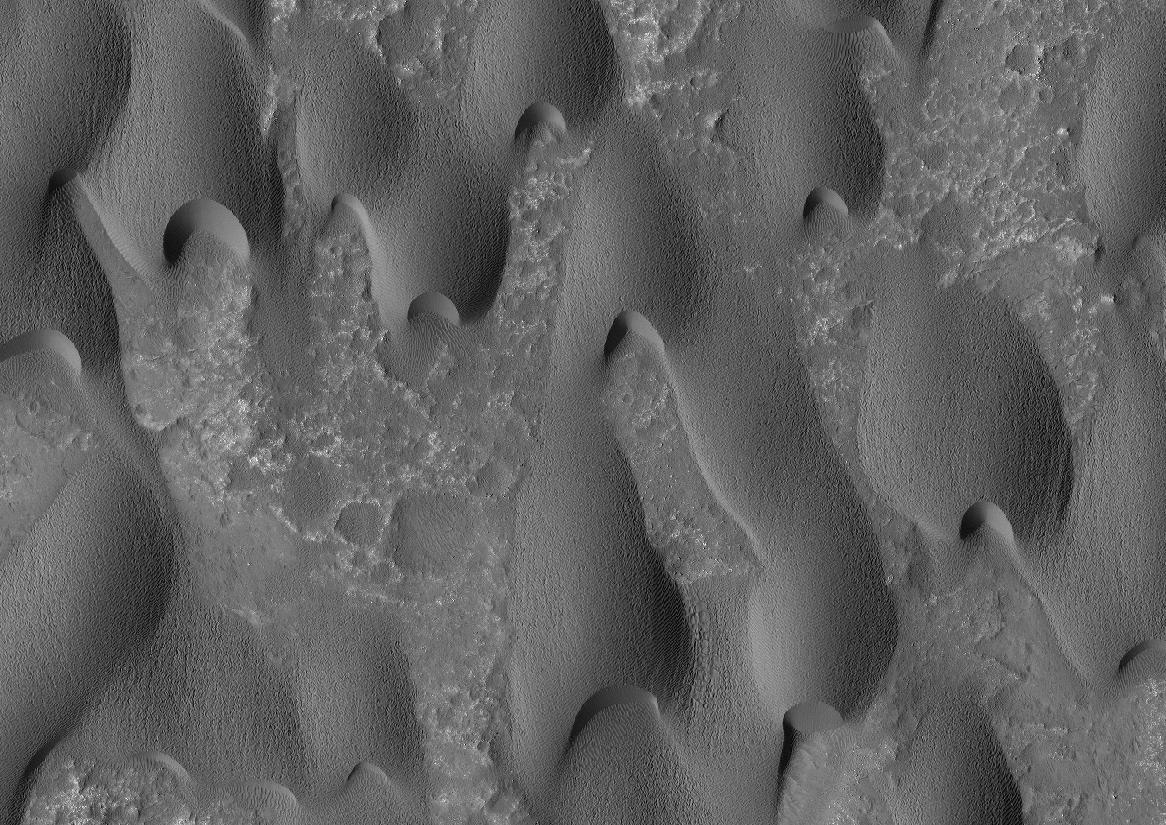
This observation shows part of the floor of Herschel Crater, a roughly 300 kilometer wide impact basin located in the southern cratered highlands of Mars.

The subimage is a close-up of a dark-toned sand dune field located on the crater floor. These dunes are "barchan" dunes, which are also commonly found on Earth. Barchan dunes are generally crescent-shaped, with their "horns" oriented in the downwind direction. They have a steep slip face (the downwind side of the dune).

Barchan dunes form by winds that blow mostly in one direction and thus are good indicators of the dominant wind direction. In this case, the strongest winds blow approximately north to south.

The surface of the dunes has a generally pitted and grooved texture and, in some places, is covered with smaller ripples. The grooved texture has led researchers in the past to believe the dune sands are "lithified," or cemented together. The rock that formed as a result has since been eroded and scoured by wind.

These dark dunes in Herschel Crater are most likely composed of basaltic sand.

Photo credit: NASA/JPL/University of Arizona

Monday, May 17, 2010