Showing posts with label Moon. Show all posts

Saturday, February 8, 2014

The Earth and Moon from Mars


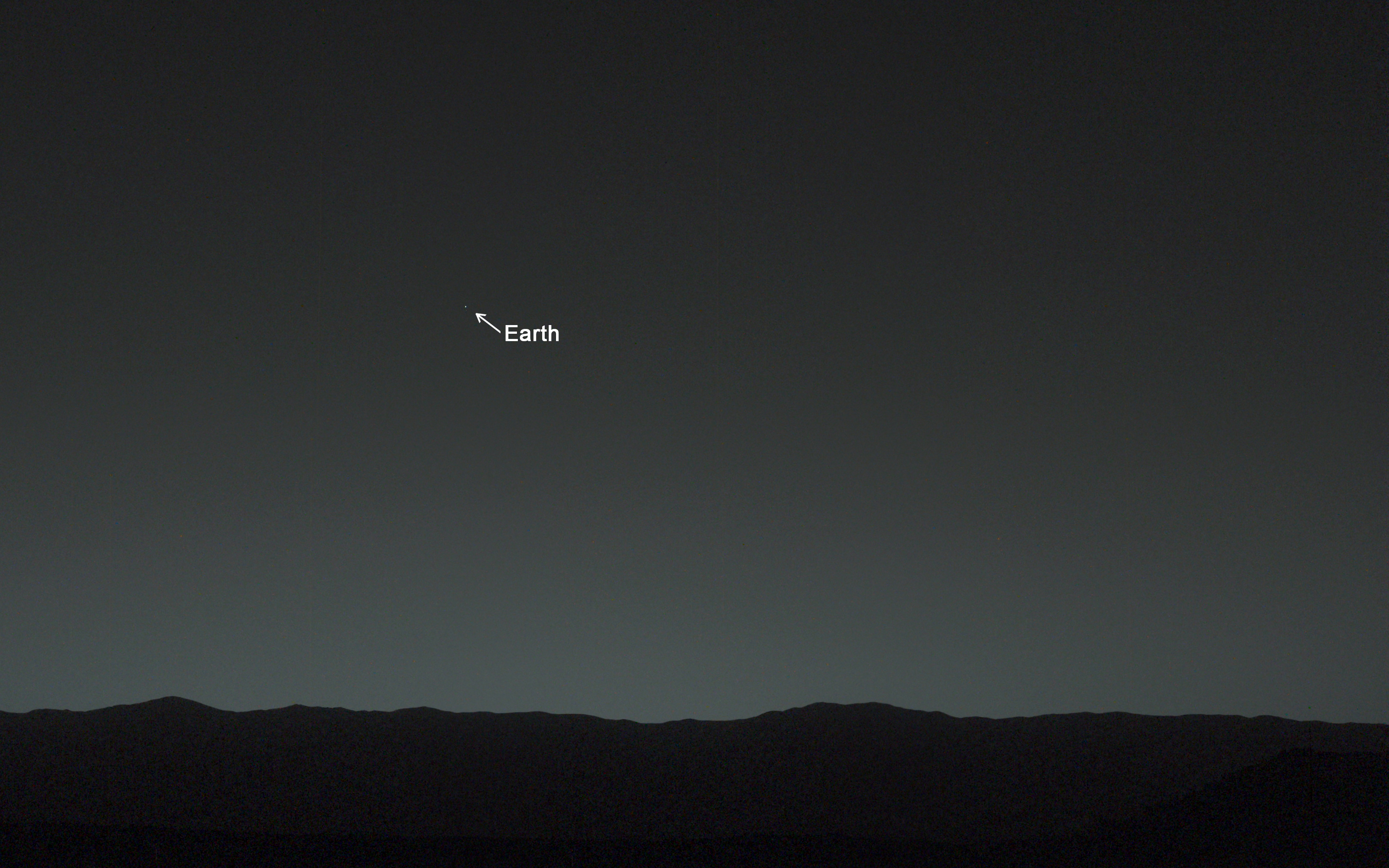
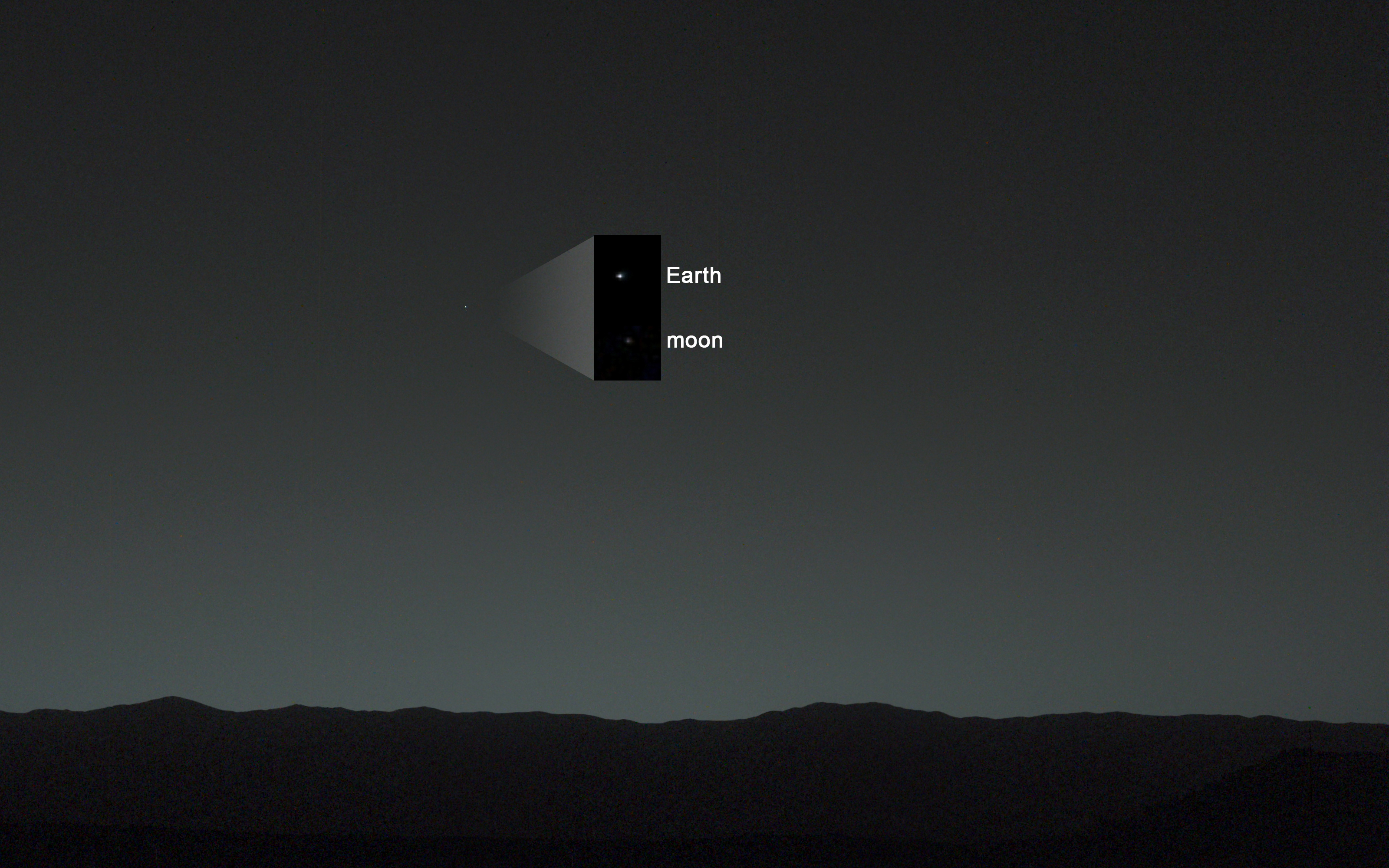
This view of the twilight sky and Martian horizon taken by NASA's Curiosity Mars rover includes Earth as the brightest point of light in the night sky. Earth is a little left of center in the image, and our moon is just below Earth. Two annotated versions of this image are also available in Figures 1 and 2.

Researchers used the left eye camera of Curiosity's Mast Camera (Mastcam) to capture this scene about 80 minutes after sunset on the 529th Martian day, or sol, of the rover's work on Mars (January 31, 2014). The image has been processed to remove effects of cosmic rays.

A human observer with normal vision, if standing on Mars, could easily see Earth and the moon as two distinct, bright "evening stars."

The distance between Earth and Mars when Curiosity took the photo was about 99 million miles (160 million kilometers).

Photo credit: NASA/JPL-Caltech/MSSS/TAMU

Note: For more information, see PIA17935: Curiosity Mars Rover's First Image of Earth and Earth's Moon and NASA Mars Rover Curiosity Sees 'Evening Star' Earth.

Thursday, March 1, 2012

Comparison of Earth's Interior with Mars and the Moon


Mars has the same basic internal structure as the Earth and other terrestrial (rocky) planets. It is large enough to have pressures equivalent to those throughout the Earth's upper mantle, and it has a core with a similar fraction of its mass. This diagram shows the depths at which high pressures cause certain minerals to transform to higher-density crystal structures. In contrast, the pressure even near the center of the Moon barely reach that just below the Earth's crust and it has a tiny, almost negligible core. The size of Mars indicates that it must have undergone many of the same separation and crystallization processes that formed the Earth's crust and core during early planetary formation.

Illustration credit: JPL/NASA

Thursday, December 23, 2010

A Fresh, Lunar-Like Crater on Mars


This image is of an approximately 5 kilometer (approx. 3.1 mile) diameter crater that is one of the rare examples of a fresh "lunar-like" crater on Mars. The impact crater formed in the Tharsis region, which is the volcanic region on Mars that harbors the great Olympus Mons volcano -- in fact, this crater lies just 150 kilometer (94 miles) from the flanks of Olympus.

Now most really fresh craters on Mars typically have floors with a frothy, pitted deposit on them (see Zumba Crater caption), which possibly suggesting that water/ice was present in the subsurface prior to impact.

This 5 kilometer crater completely lacks such materials. Instead, the crater possess a deposit is generally smooth with some rocks peppered throughout the deposit. This is more similar to observations of fresh craters on the Moon. This distinction from the more typical pitted crater floor deposit may support that the lavas sampled by this crater were low in water/ice or dry at the time of impact. There are some smaller craters superimposed on the floor, which is a sign that the crater is reasonably fresh, but not as recent as other craters on Mars.

There's also a lot of Martian dust in this crater, which often gives geologic forms a somewhat muted appearance, some of that dust and fine-grained material may be the source of the materials that comprise the "sand" ripples in the bottom-half of the subimage.

Note: By "fresh," we are speaking in geologic terms, not something that just occurred.

Photo credit: NASA/JPL/University of Arizona

Note: This crater is located due south of Olympus Mons.