Showing posts with label Megabreccias. Show all posts

Sunday, April 20, 2014

Red Bedrock in an Impact Crater Northeast of Hellas Planitia


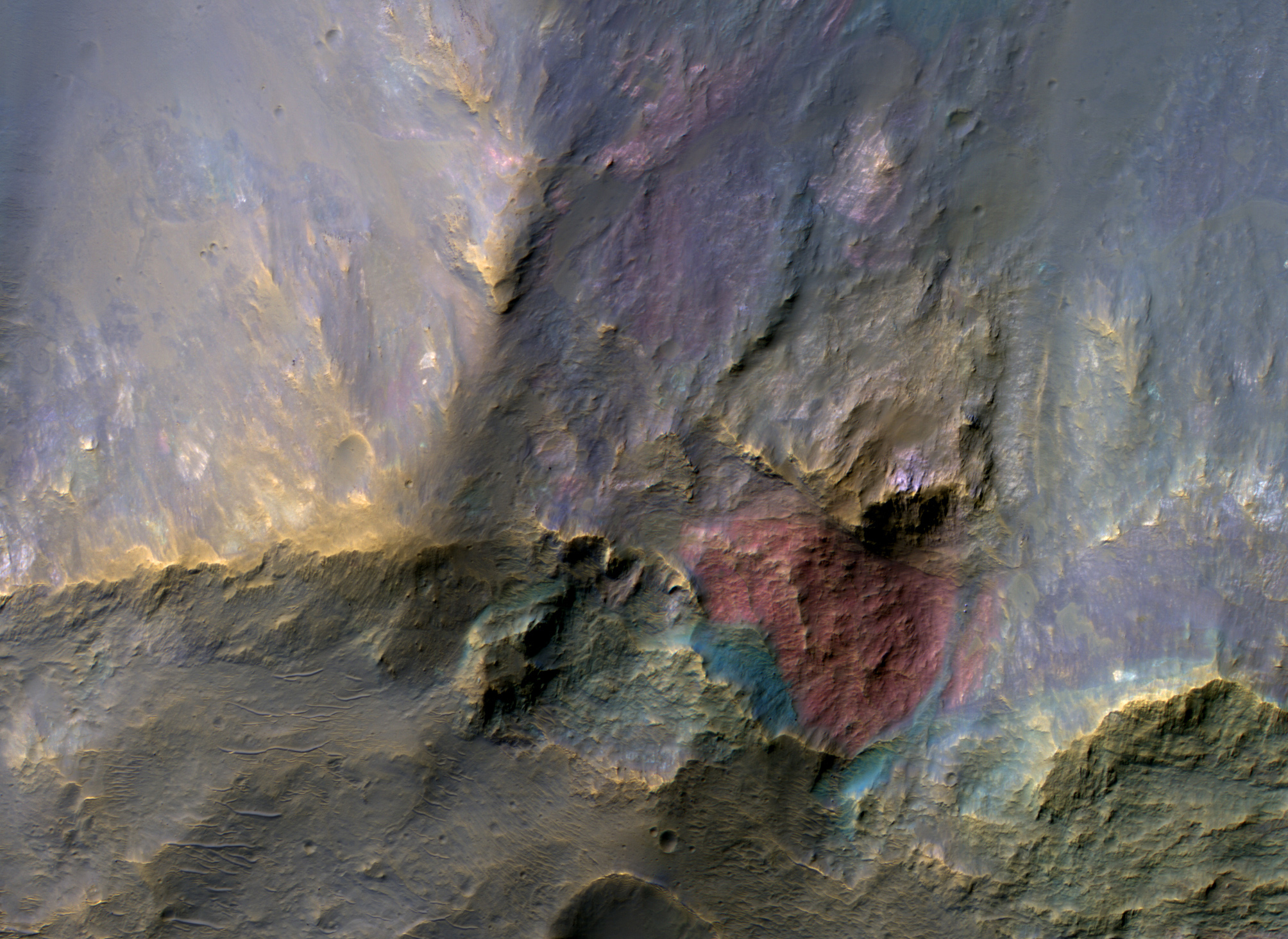
This image covers a 26-kilometer-wide impact crater northeast of the Hellas impact basin. The crater exposes large blocks of bedrock (called "megabreccia") in both the central uplift and in the walls of the crater.

The enhanced-color subimage from the wall shows a large, approximately 250-meter-wide reddish block, although actually "red" in the infrared-shifted color of HiRISE. These blocks could be ejecta from the ancient Hellas impact or other large impacts from billions of years ago.

Image credit: NASA/JPL/University of Arizona

Note: For more information, see PIA18226: A Big Block of Red Bedrock.

Monday, April 15, 2013

Megabreccia in a Terra Cimmeria Impact Crater


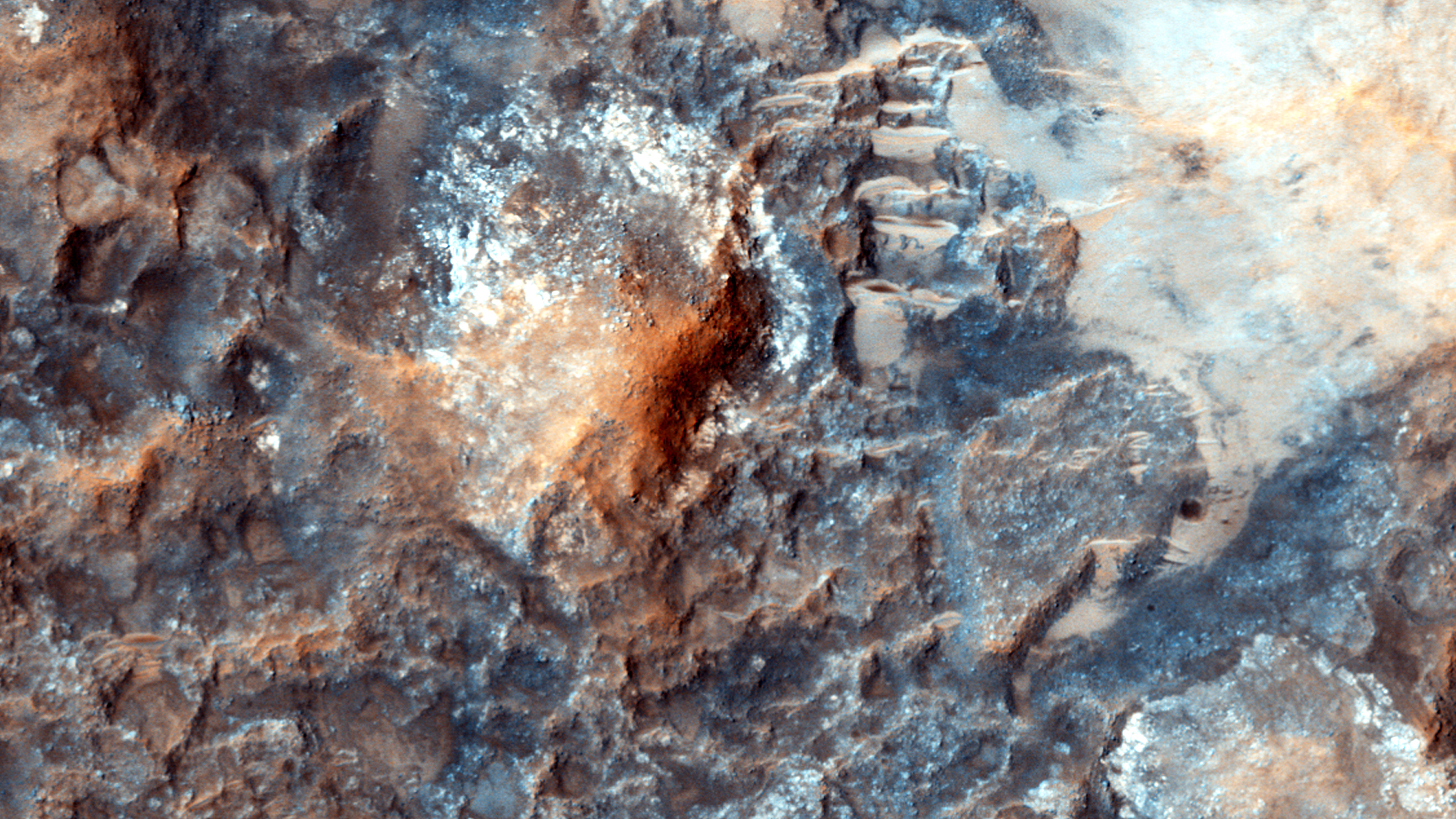
"Megabreccia" is a term we use to describe jumbled, fragmented blocks of rock larger than 1 meter across, in a matrix of finer-grained materials. It's the result of energetic processes, typically from an impact event.

This image was acquired by HiRISE only in the narrow color strip, as a ride-along with a CRISM target, since HiRISE had previously imaged this location.

Photo credit: NASA/JPL/University of Arizona

Note: This image is located in northern Terra Cimmeria, near the "shore" of Elysium Planitia. The closest named feature is Al-Qahira Vallis, to the northwest.

Saturday, May 22, 2010

Megabreccia in Toro Crater


This false color image covers the western half of the central peak of Toro Crater, a 42 kilometer diameter crater in Syrtis Major.

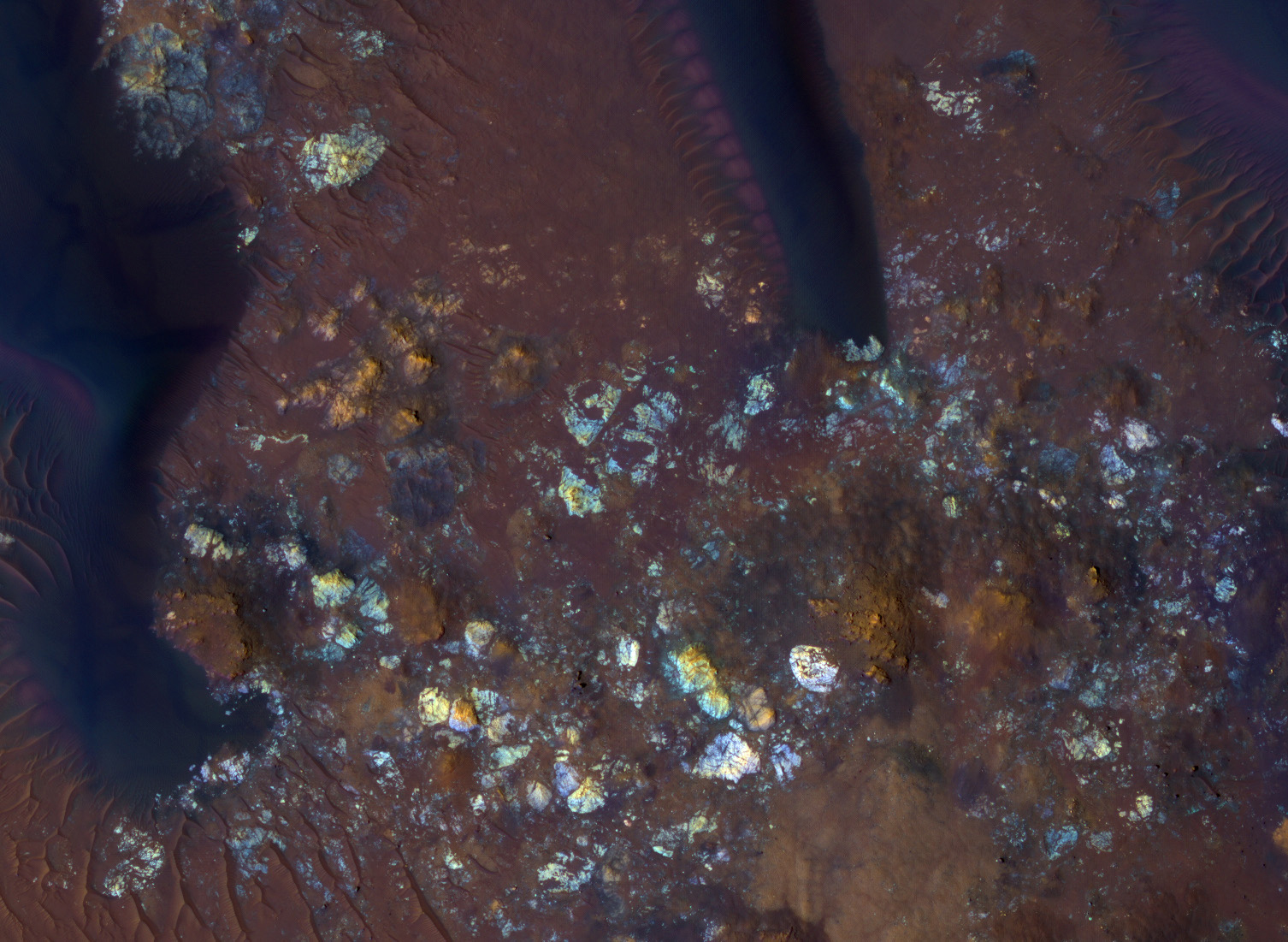
The subimage shows a close-up of one of the features that make Toro Crater a great target for HiRISE images: colorful patches of megabreccia. Breccia is a mixture of chunks of rock (clasts) that have been broken by an energetic geologic event, such as a landslide or crater-forming impact, that are then cemented together in a finer grained material. Megabreccia features very large clasts that are big enough for HiRISE to see on the surface - some even larger than 30 feet across. In this 200 meter (about 1/8 of a mile) diameter exposure of megabreccia, clasts of various colors (indicating different kinds of rocks) and sizes have been exposed in the uplifted central peak of Toro Crater.

Scientists think that megabreccia may have formed early in Mars' history during a period of frequent impact crater formation. These early rocks were then covered by younger rock layers. HiRISE frequently targets the central peaks of craters, because these features tend to bring up rocks like these megabreccia that are usually buried under the surface.

So far, HiRISE has found megabreccia in more than a hundred places on Mars. In many of these locations, CRISM has identified clays in the material cementing the clasts together, providing yet another motivation for the study of megabreccia.

HiRISE first imaged Toro Crater (in PSP_005842_1970) because CRISM detected hydrated minerals, like clays, on the floor. The instruments of MRO often observe the same areas of Mars simultaneously through a process known as "ride-alongs." That earlier image was so interesting that HiRISE has since acquired a number of images over the crater (PSP_006910_1975, PSP_007266_1970, ESP_011538_1970).

Photo credit: NASA/JPL/University of Arizona

Note: Toro Crater is located to the west of Isidis Planitia.

Monday, May 17, 2010

Megabreccia in the Central Uplift of Stokes Crater


Stokes is a large, approximately 60 kilometer diameter (38 miles) impact crater located in the Northern lowland plains of Mars.

Craters this large invariably have a central structural uplift, which form mountain peaks in or near the center of the crater. The Northern plains are largely covered by lavas and sediments, but craters such as Stokes allow us to observe the otherwise buried bedrock, exposed within its central uplift.

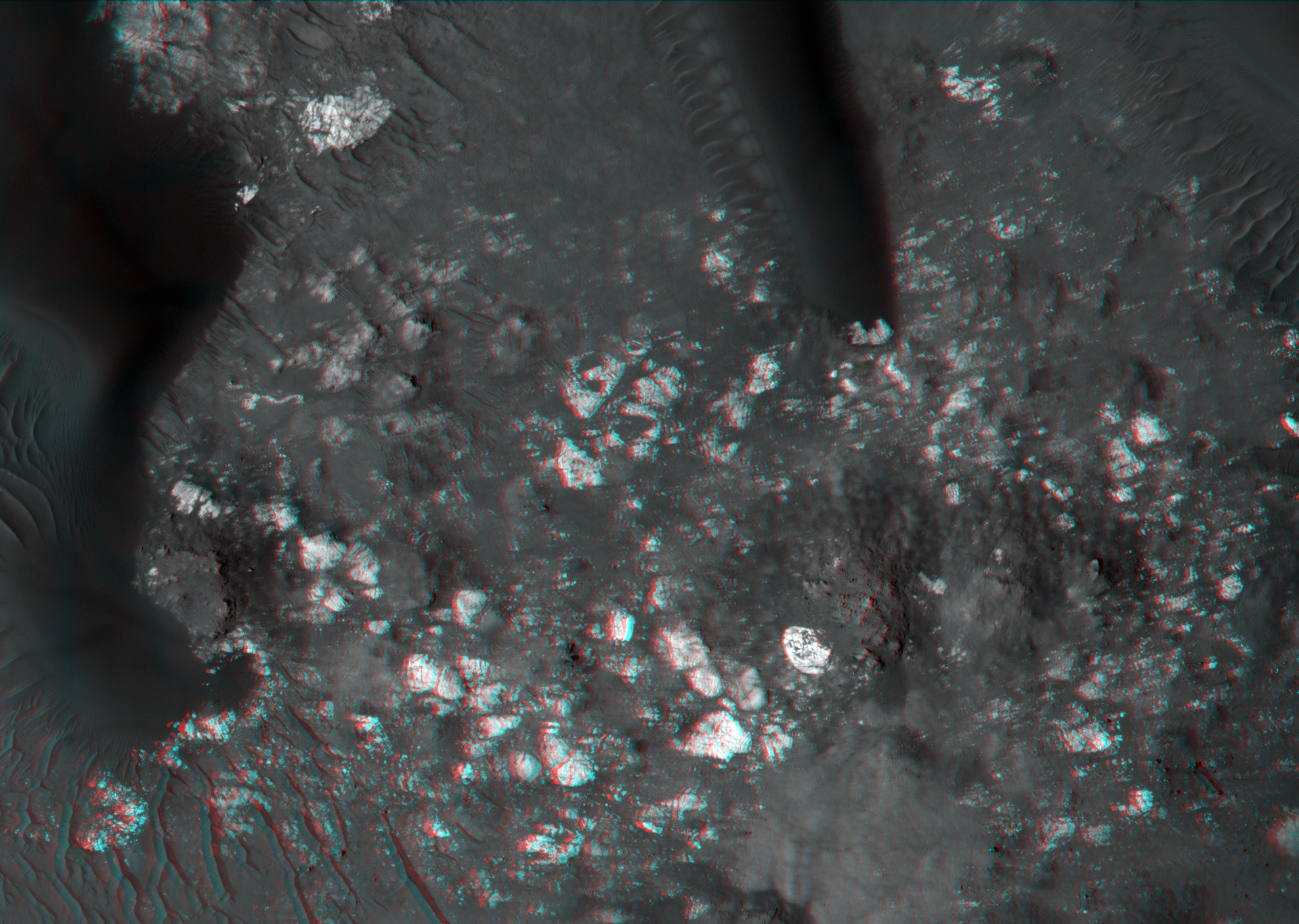
The first subimage shows a wide variety of colors and textures in a jumbled, fragmental pattern, i.e. "megabreccia." In the stereo anaglyph we can see that many of the fragmental blocks "stick out," indicating that they are more resistant to erosion than the the surrounding finer-grained material between the blocks. There is also an abundance of dark sand dunes and other smaller aeolian (wind-driven) bedforms on top of the area of exposed bedrock.

Megabreccia, consisting of very large fragments of pre-existing bedrock, is created by energetic processes, but especially by impact events on Mars. Although megabreccia deposits can coat central uplifts, it may not have been the Stokes impact that made this megabreccia.

The formation of a crater's central uplift does not commonly break up and jumble the deep bedrock. So if these megabreccias are exposures of the deep bedrock brought up to the surface by the central uplift, and are not merely deposits draped on the central uplift, then it is most likely that these megabreccias were created by much larger and older basin-forming impacts that now lie buried beneath the surface.

With the aid of high-resolution images, and especially the 3D anaglyphs, we hope to decipher whether the materials observed in the central uplift were formed by the host crater or prior to the formation of that crater. Either way, crater central uplifts can provide windows into the deepest and oldest geologic history of Mars. For example, if there was a very ancient ocean in the Northern lowlands, these rocks could include deposits from that ocean.

NOTE
This pair of images (also see ESP_016980_2360) was targeted to acquire stereo coverage of the Eastern slopes of the central uplift (see PSP_09332_2360 for an adjacent area).

Photo credit: NASA/JPL/University of Arizona