Showing posts with label Law of Superposition. Show all posts

Wednesday, May 2, 2012

How Did Valles Marineris Form?


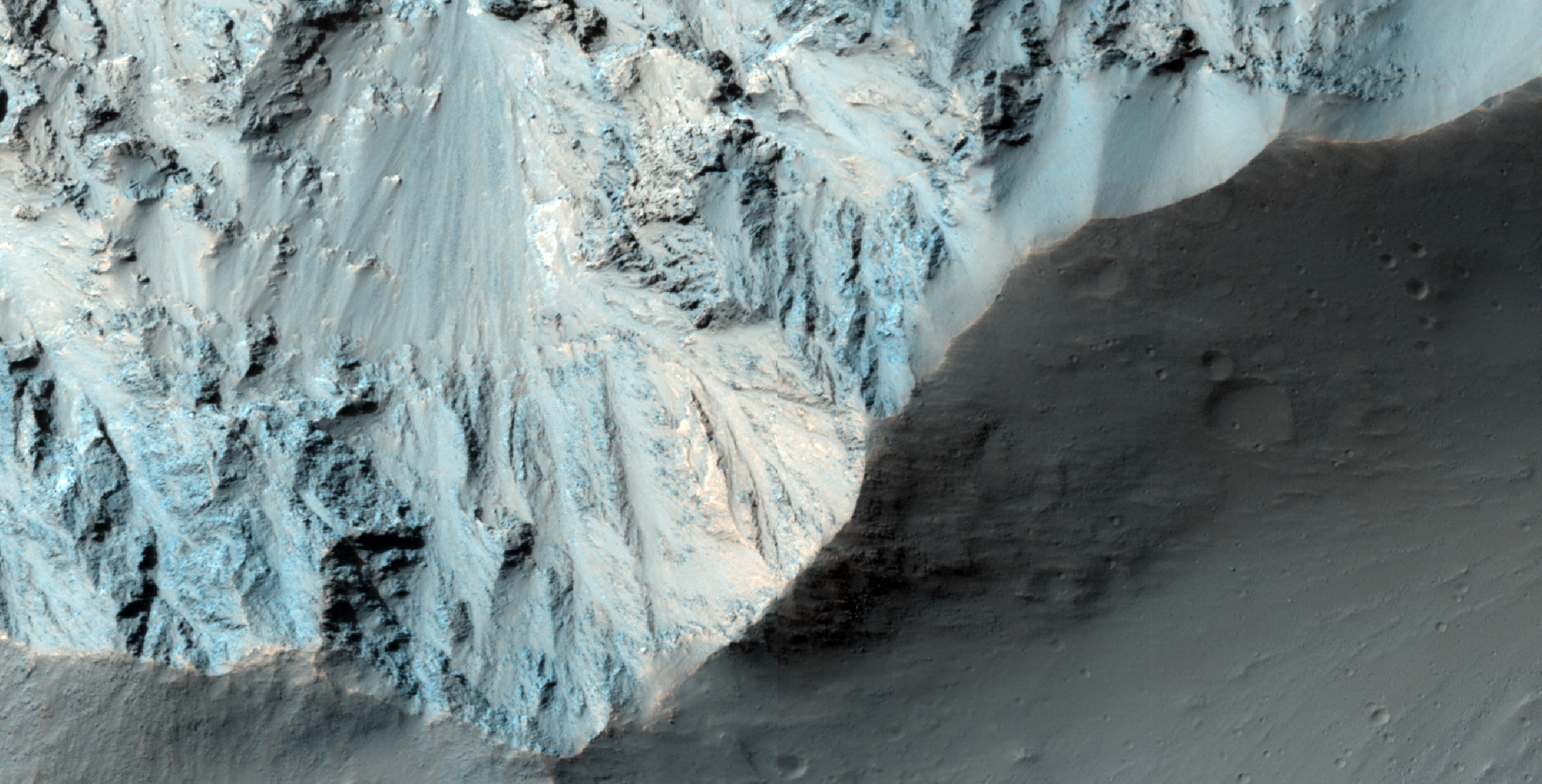
This image (and its companion for stereo) crosses an impact crater about 50 kilometers (30 miles) wide. The crater was visible in Mariner 9 and Viking Orbiter images acquired decades ago, and was interpreted as evidence that the floor of Coprates Chasma was an old surface like that of the surrounding plateaus north and south of the canyon, and had dropped more than 10 kilometers (6 miles) as a huge intact block of crust.

However, this image and others acquired by MRO reveal a geologically young crater, with far fewer superimposed craters than the high plateaus, and well-preserved primary impact morphologies. This crater must have formed after the opening of Valles Marineris, and is not evidence, by itself, that this portion of the canyon system formed from simple downdrop of a giant intact block.

The opening of Valles Marineris did involve crustal spreading and faulting, but may have had a more complex history. Many of the large landslides in Valles Marineris could have been triggered by this impact event.

Photo credit: NASA/JPL/University of Arizona

Wednesday, November 3, 2010

Fresh Crater with Gullies


This observation shows a fresh, approximately 7.5 kilometer diameter crater that resides in a larger crater in the southern hemisphere.

The crater shown here has very few craters superposed on it, which attests to its youth. It also has very steep slopes and a sharp rim; more evidence of its young age. Young, fresh craters are of interest on Mars because they help place constraints on the rate at which new impact craters and other young features have formed in recent times.

This fresh crater is particularly interesting because it contains gullies. Gullies are slope features that are proposed to require some amount of liquid water to form. The gullies must have formed after the crater did, which means that if liquid water was involved in the formation of these gullies, then it existed on the surface of Mars more recently. The existence of recent liquid water is especially important in terms of the search for life on Mars and its future exploration.

Several of the gullies show features such as terraces, discontinuous channels, and abandoned channels (see subimage), all of which imply that more than one flow event occurred. It is unknown whether or not such multiple flows would have been closely spaced in time.

Terraces are thought to indicate past flow levels. Discontinuous channels may represent some subsurface flow in addition to surface flow, or they may be channels that were once continuous that have since been filled in with wind-blown sediment and dust. The latter is the most likely in the subimage. For example, see the discontinuous channel near the center; it appears to have sediment infilling it. Abandoned channels are paths that fluid flowed through in the past before another flow took a different direction.

Photo credit: NASA/JPL/University of Arizona

Note: This crater is located just south of Morpheos Rupes, which is in the border region between Promethei Terra and Terra Cimmeria east of Hellas Planitia.