Showing posts with label Asimov Crater. Show all posts

Friday, March 28, 2014

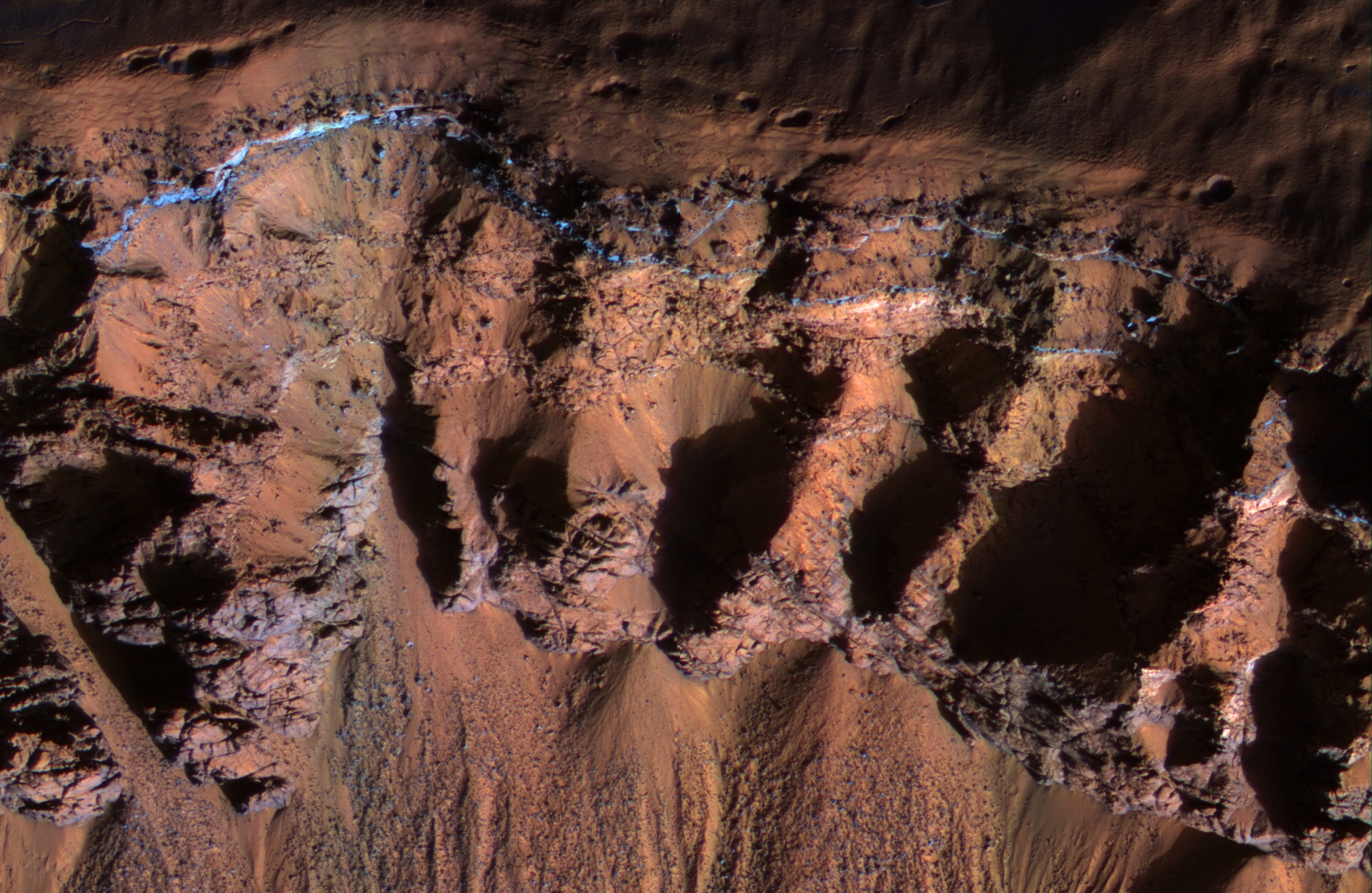
Bedrock in a Trough in Asimov Crater


This image was acquired in southern winter over part of Asimov Crater (latitude 47.5 S), showing the equator-facing slope of a deep trough inside the crater. The crater appears to have been completely filled by a thick sequence of materials, perhaps including sediments and lava flows.

Later, deep troughs formed around the outer edge of the fill material<, probably by collapse over void spaces at depth. What made the void space is not known, but one idea is that there were lenses of ice that slowly sublimated into the atmosphere. Another idea is that this is part of a sequence of crater fill and "exhumation", that includes Gale Crater (home of the Curiosity rover). In other words, continued collapse and erosion of Asimov crater could eventually lead to a central mound like Eolis Mons (popular known as "Mt. Sharp") in Gale Crater. However, at Asimov crater, the southern trough has destroyed the southern rim of the original crater, which didn't happen at Gale Crater.

Many of these steep trough slopes in Asimov crater, where facing the equator, have recurring slope lineae (RSL) activity in the summer when the sun-facing slopes get warm. The RSL fade in the winter, so none are seen in this image even if they were present last summer. There are no previous HiRISE images acquired in the summer over this location.

Asimov Crater was named after Isaac Asimov, professor of biochemistry and prolific writer of science fiction and popular science books.


Photo credit: NASA/JPL/University of Arizona

Friday, August 23, 2013

Asimov Crater


This VIS image shows some of the depressions in the material that fills Asimov Crater.

Orbit Number: 51158 Latitude: -47.1293 Longitude: 4.95194 Instrument: VIS Captured: 2013-06-26 07:03

Photo credit: NASA/JPL-Caltech/Arizona State University

Wednesday, April 3, 2013

Gullies in Asimov Crater


This VIS image shows gullies on the northern face of one of the large depressions that mark the inner rim of Asimov Crater. Asimov Crater is very unusual, with the interior of the crater being filled with materials to bring it almost level with the surrounding rim.

Orbit Number: 49672 Latitude: -47.1395 Longitude: 5.72787 Instrument: VIS Captured: 2013-02-24 00:42

Photo credit: NASA/JPL-Caltech/Arizona State University

Saturday, March 24, 2012

Magical Mystery Mound


How exactly these strange landforms came to be is a mystery. It probably isn't magical, but the catchy Beatles-era title did get you to read this caption.

The contorted material sits on the floor of a degraded impact crater. It has some bizarrely grooved textures that show up nicely with the low-sun illumination (with the Sun approximately 7 degrees above the horizon). We've seen this texture elsewhere on Mars, so a systematic study might lead to a good hypothesis about its origin.

The color data reveals some bluish material-- seasonal frost that is just starting to accumulate here in late fall.

Photo credit: NASA/JPL/University of Arizona

Note: The crater where this mound is located is in Noachis Terra, very close to Asimov Crater, to the northwest, and Maunder Crater, due west.

Monday, October 24, 2011

Four New Names Approved for use on Mars

From the USGS Astrogeology Science Center:

The names Corozal, Palikir, Raga, and Tivat have been approved for use on Mars. For more information, see the maps of Mars in the Gazetteer of Planetary Nomenclature.

Note: Corozal is a small crater located within a much larger unnamed crater in Terra Cimmeria, and is named for the town of Corozal, Belize. Palikir Crater is also a small crater, but located in the southern half of Newton Crater; it is named for the capital of the Federated States of Micronesia. Raga Crater is located in western Aonia Terra, to the southwest of Icaria Planum, and is named for a town in South Sudan. Tivat Crater is located in Noachis Terra, and is northeast of Asimov Crater. It is named for a town in Montenegro.

Thursday, December 2, 2010

Gullies on Southwest Slope of Ring Trough in Noachis Terra


Geologically young gullies are a prime target for the HiRISE camera. Gullies are located in a variety of settings and are found all over Mars.

This "ring trough" or eroded pit crater, is located in the rugged southern highland terrain known as Noachis Terra. The HiRISE image shows the layered, boulder-rich wall rock facing to the northeast and gullies that are transporting material downslope.

The material collects into debris aprons along the walls, which often exhibit narrow channels along its surface.

Photo credit: NASA/JPL/University of Arizona

Note: The location of these gullies is Asimov Crater, which is located roughly halfway between Argyre Planitia and Hellas Planitia.

Thursday, July 29, 2010

Gullies along South Wall of Asimov Crater


This image shows part of the southern wall region of Asimov Crater (centered at -47S, 5E) in Noachis Terra, located west of Hellas Planitia. This ancient crater displays an intriguing large trough-shaped feature (a.k.a. Noachis ring trough) that encircles the entire inner crater wall.

In this image, the northern slope exhibits crisp-appearing gullies that appear to have sourced from jumbled, gravelly indistinct regions. Some tributaries seem to originate in fractured bedrock. The tributaries coalesce forming sinuous gullies that dissipate into the trough floor deposits. Frost or ice covers much of this south facing slope. In contrast, the south wall of Asimov Crater seems to lack the pristine gully morphology evident on the trough slope to the north, but contains more distinct rock layers near the rim. Gullies on the upper crater wall exhibit more of a debris chute morphology likely formed by the persistent erosion of the southern rim. These gullies coalesce into more channelized forms across the lower reaches, creating fans of sediment and debris before terminating on the crater floor below.

Photo credit: NASA/JPL/University of Arizona