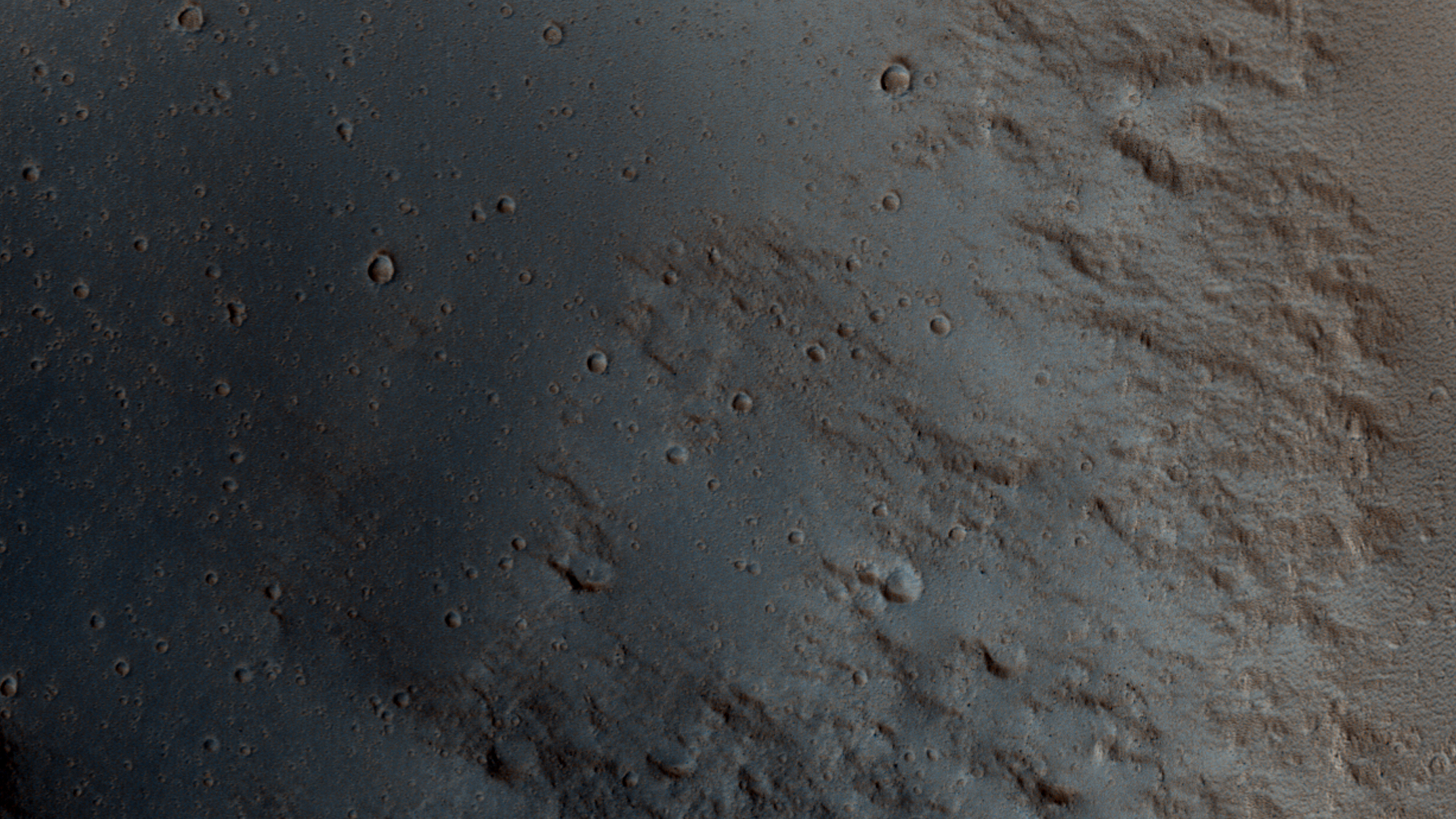
Today's VIS image shows some of the lava flows located east of the large Tharsis volcanoes.
Orbit Number: 54145 Latitude: 17.9142 Longitude: 275.981 Instrument: VIS Captured: 2014-02-27 04:11
Photo credit: NASA/JPL-Caltech/Arizona State University
Today's VIS image shows some of the lava flows located east of the large Tharsis volcanoes.
Orbit Number: 54145 Latitude: 17.9142 Longitude: 275.981 Instrument: VIS Captured: 2014-02-27 04:11

Tharsis Tholus is one of the smaller shield volcanoes on Mars' massive "Tharsis Rise." The main shield is covered by a very thick blanket (or "mantle") of loose material. This is likely to be the same dust that is found across all of Mars.
It accumulates on the tall volcanoes because the thin atmosphere at these elevations has a very hard time moving the dust after it is dropped out from the global dust storms. But another reason for the great thickness of the mantle here could be volcanic ash derived from the volcanoes themselves.
The flanks of Tharsis Tholus are cut by large channels, similar to those visible on other Martian shield volcanoes like Arsia Mons and Elysium Mons. Like the channels on those volcanoes, these channels probably formed by a combination of erosion by flowing lava, and the collapse of the volcano under its own weight. However, because of the thick covering, we cannot say this definitively.
A striking feature at the northern end of this image is the fact that the dust cover is much thinner on the lava flows that surround the shield. This indicates (1) the surrounding lavas are much younger than the shield and (2) the mantle on the volcanoes is old.

There have been a number of claims in recent years that there are small dark volcanic ash deposits on Mars, suggesting very recent volcanic eruptions. However, most of these claims have not stood up to scrutiny by HiRISE.
Dark wind blown sand, not volcanic ash, explains most examples of diffuse dark patches on Mars. This area is especially intriguing because the wind blown material in the region has a light, not dark, tone. Furthermore, there are fresh looking lava flows adjacent to the possible vent, lending additional weight to the idea of recent volcanism here.
The difference in the way small craters resist erosion within this dark deposit is also suggestive of coarser fallout from a lava fountain. Overall, this is a top contender for a recent volcanic vent on Mars.

Tharsis Tholis towers 8 km above the surrounding terrain with a base that stretches 155 x 125 km and a central caldera measuring 32 x 34 km. The image was created using a Digital Terrain Model (DTM) obtained from the High Resolution Stereo Camera on ESA’s Mars Express spacecraft. Elevation data from the DTM is color-coded: purple indicates the lowest lying regions and beige the highest. The scale is in meters. In these images, the relief has been exaggerated by a factor of three.

This image captures one of the cleaner portions of the interior wall of the caldera at the top of Tharsis Tholus.
Tharsis Tholus is an intermediate sized shield volcano, much smaller than giants such as Olympus Mons, but still large by terrestrial standards. While relatively dust-free, this section of the caldera wall is still extensively covered by dust that is being sculpted into curious shapes by the wind and by gravity.