Showing posts with label Linear Gullies. Show all posts

Friday, June 14, 2013

Linear Gullies in Matara Crater


These examples of one distinctive type of Martian gullies, called "linear gullies," are on a dune in Matara Crater, seen at different times of year to observe changes. The observations support a new hypothesis that chunks of frozen carbon dioxide, also known as "dry ice," may create linear gullies. In early Martian spring at some latitudes, dry-ice blocks may glide down sandy slopes on self-generated cushions of sublimating carbon-dioxide gas, plowing the grooves as they go and sometimes leaving pits where they stop sliding and sublimate away.

The three images were taken by the High Resolution Imaging Science Experiment (HiRISE) camera on NASA's Mars Reconnaissance Orbiter, of a site at 49.4 degrees south latitude, 34.7 degrees east longitude. The top image is from Mars southern-hemisphere early summer. The middle image is from the start of spring not quite two Martian years later. The white arrow points out a frost block, which appears very bright against the defrosting dune surface. The bottom image is from later the same spring. Black arrows indicate regions where new channels and pits appeared during the intervening seasons since the top image was taken. The scale bar is 50 meters (55 yards).

The three images are excerpts from HiRISE observations cataloged as ESP_013834_1300 (taken July 9, 2009); ESP_029038_1305 (taken October 6, 2012) and ESP_029961_1305 (taken December 17, 2012).

Image credit: NASA/JPL-Caltech/University of Arizona

Note: For more information, see Marks on Martian Dunes May Reveal Tracks of Dry-Ice Sleds.

Wednesday, June 12, 2013

Linear Gullies Inside Russell Crater


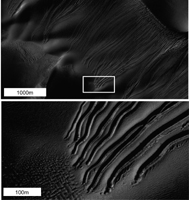
Several types of downhill flow features have been observed on Mars. This image from the High Resolution Imaging Science Experiment (HiRISE) camera on NASA's Mars Reconnaissance Orbiter is an example of a type called "linear gullies." Linear gullies are characterized by relatively constant width and by raised banks or levees along the sides. Unlike gullies caused by water-lubricated flows on Earth and possibly on Mars, they don't have aprons of debris at the downhill end of the channel. The grooves shown here, on the side of a large sand dune inside Russell Crater, are the longest linear gullies known, extending almost 1.2 miles (2 kilometers) down this dune slope.

New research points to chunks of frozen carbon dioxide, commonly called "dry ice," creating linear gullies by gliding down sandy slopes on cushions of carbon-dioxide gas sublimating from the dry ice. Linear gullies are on mid-latitude sandy slopes, where the ground is covered with carbon-dioxide frost in Martian winter. Before-and-after pairs of HiRISE images indicate that the linear gullies are formed during early spring. Some linear gullies -- such as the ones in the magnified section of this image shown as Figure 1 -- have pits at the downhill end that could be caused by a block of dry ice ending its slide and resting in place as it sublimates away.

This image is a portion of the HiRISE exposure cataloged as PSP_001440_1255 taken on November 16, 2006, at 54.25 degrees south latitude, 12.92 degrees east longitude.

Photo credit: NASA/JPL-Caltech/University of Arizona

Note: For more information, see Marks on Martian Dunes May Be Tracks of Dry-Ice Sleds; also, Dry Ice "Snowboards" on Mars.