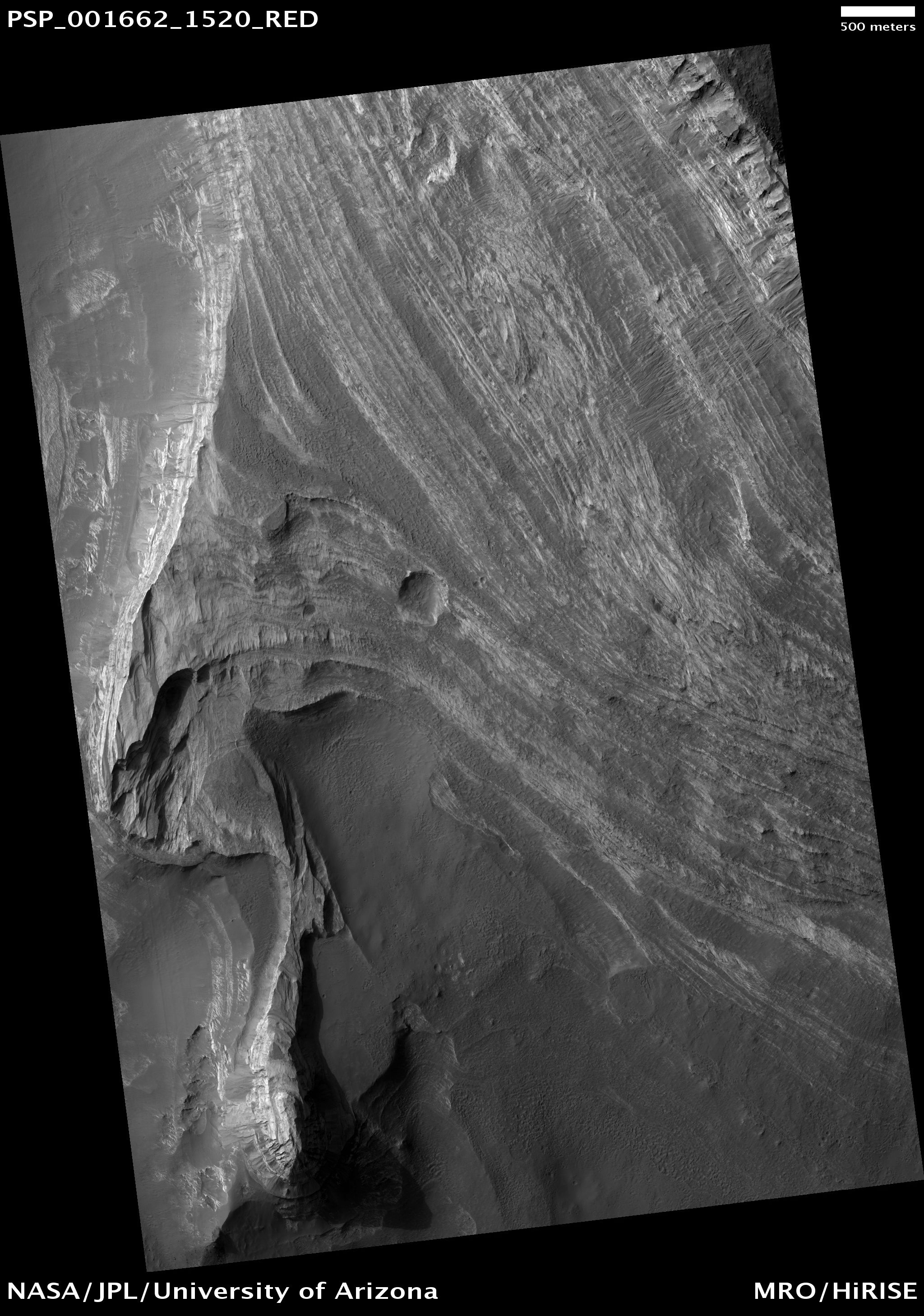
Terby Crater, sitting on the northern rim of Hellas Basin, has been filled by sedimentary deposits, perhaps deposited by or in water.
The northeast portion of these layers have been eroded by the wind, exposing the layers. The enhanced-color subimage is a sample of these materials, in which the different colors and textures represent different rock types.
Be sure to take a look at the stereo anaglyph for a 3D view of the landscape.
This is a stereo pair with ESP_031278_1525.
Photo credit: NASA/JPL/University of Arizona

Terby Crater is a large (approximately 165 kilometer), Noachian-aged crater located on the northern rim of the Hellas impact basin.
Terby hosts a very impressive sequence of predominantly light-toned layered deposits, up to 2.5 kilometers thick that are banked along its northern rim and extend toward the center of the crater.
The full image shows this stack of layered rocks as they are exposed westward facing scarp. The layered sequence consists of many beds that are repetitive, relatively horizontal and laterally continuous on a kilometer scale. Many beds are strongly jointed and fractured and exhibit evidence of small-scale wind scour.
The light-toned layers are typically at least partially covered with dark mantling material that obscures the layers as well as debris and numerous, meter-scale boulders that have cascaded down slope. The processes responsible for formation of these layers remain a mystery, but could include deposition in water, by the wind, or even volcanic activity.
This HiRISE image is a proposed landing site for the Mars Science Laboratory (MSL) in Terby Crater.
Photo Credit: NASA/JPL/University of Arizona