Showing posts with label Arabia Terra. Show all posts

Saturday, December 6, 2014

Dunes and Wind Streaks in Arabia Terra


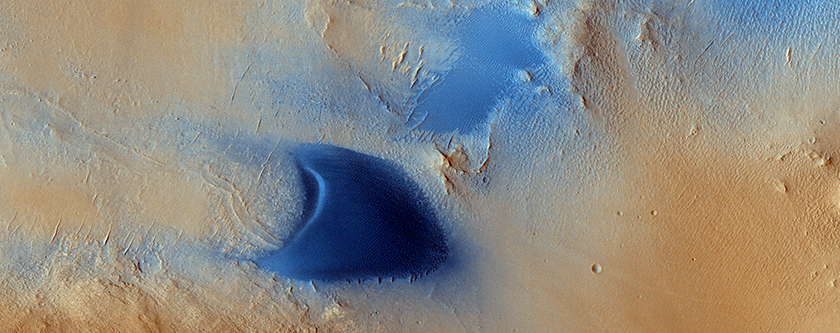
Arabia Terra is one of the more dusty regions on Mars, where ever-falling red dust covers the surface allowing only minor variations in color and tone. One exception is when wind-driven, dark-toned sand moves across the surface ejecting the bright dust into the atmosphere to reveal the dust-free surface below.

This HiRISE image shows sand dunes with surrounding larger tear drop-shaped light streaks pointing west (or, to the left). This orientation, along with the morphology of the local dunes, indicates winds from the east have stripped sand particles off the dunes and carried them downwind to form these light streaks. More importantly, active sand has a role in the slow erosion of the rocks here and the overall landscape evolution of the region.

Image credit: NASA/JPL/University of Arizona

Note: For more information, see PIA18931: Dunes and Wind Streaks in Arabia Terra.

Monday, October 6, 2014

Bright Slope Streaks in Arabia Terra


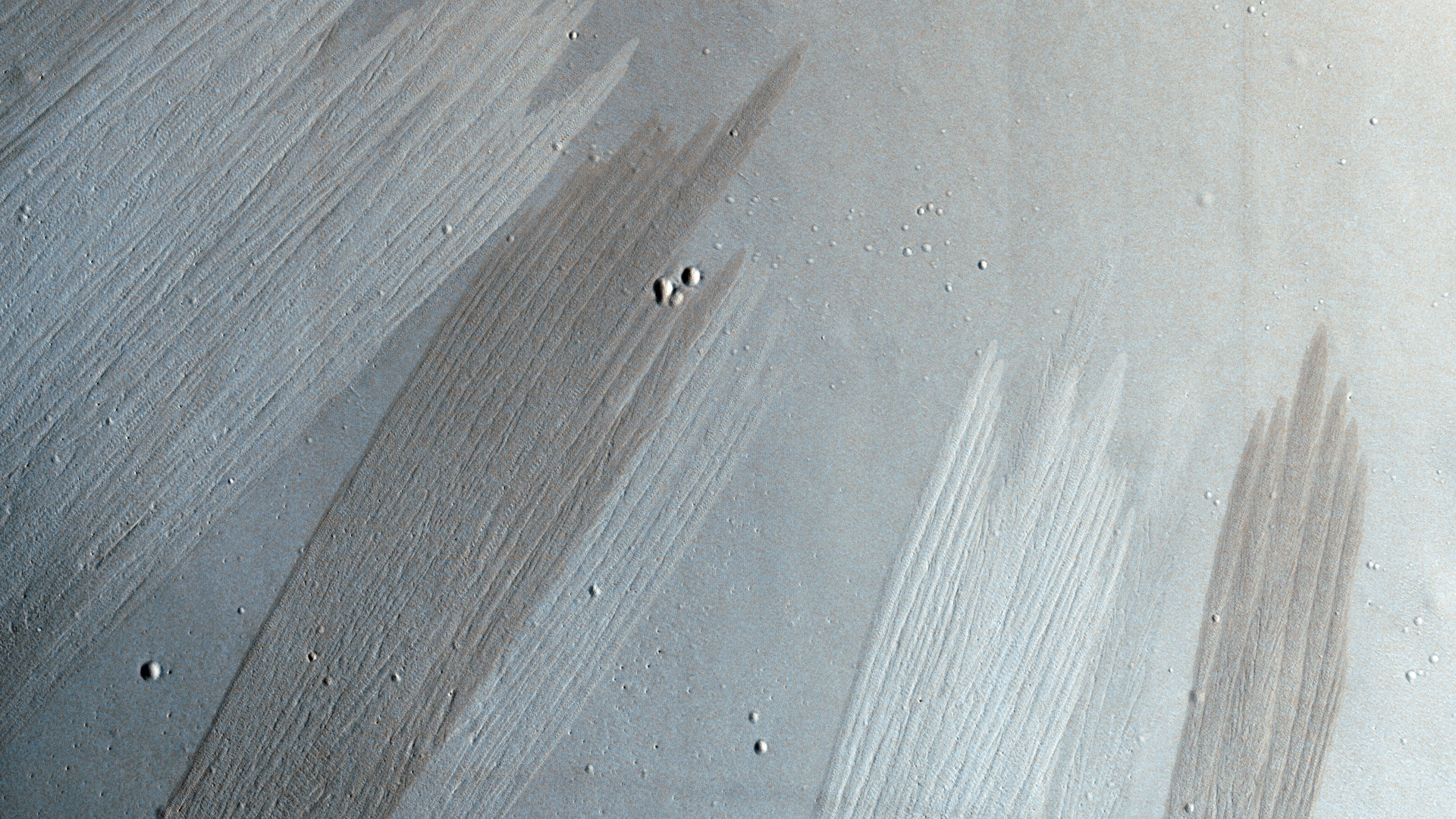
This observation shows bright and dark slope streaks in craters in the Arabia Terra region.

Slope streak formation is among the few known processes currently active on Mars. The cause of slope streaks is still debated, and both dry and wet processes have been proposed to explain their formation. They are most commonly believed to form by gravity-driven movement of extremely dry sand or very fine-grained dust in an almost fluid-like manner (analogous to a terrestrial snow avalanche) exposing darker underlying material.

The darkest slope streaks are the youngest and can be seen to cross cut and lie on top of the older and lighter-toned streaks. The lighter-toned streaks are believed to be dark streaks that are brightening with time as new dust is deposited on their surface. Where they occur, dark slope streaks are typically more plentiful than the bright streaks. However in this area, distinct bright slope streaks appear to be more plentiful, especially in the two smaller craters on either side of the larger crater in the center of the image.

Image credit: NASA/JPL/University of Arizona

Note: For more information, see PIA18819: Bright Slope Streaks in Arabia Terra.

Thursday, September 4, 2014

Crater Dunes in Arabia Terra


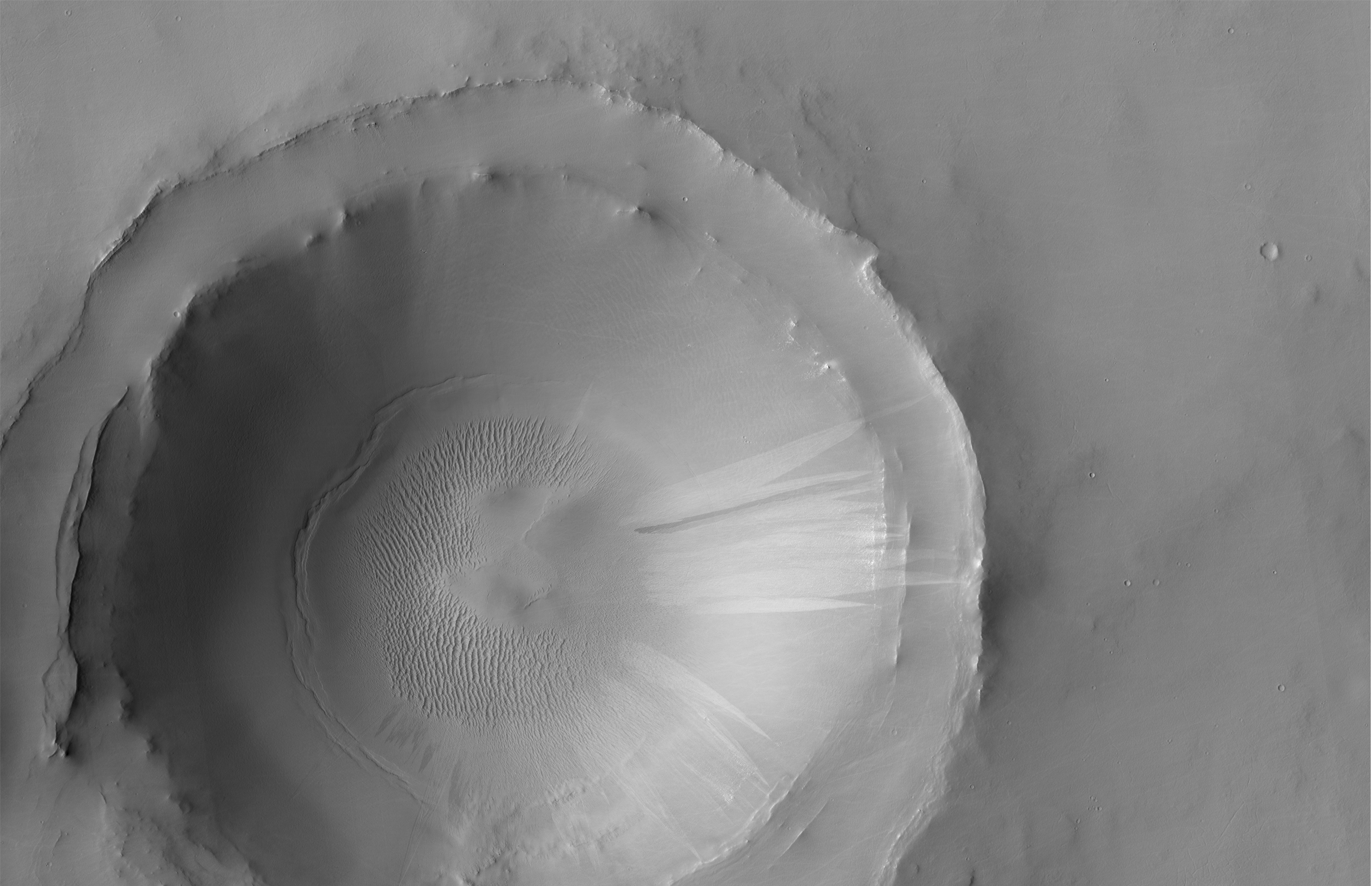
Today's VIS image shows sand dunes on the floor of an unnamed crater in Arabia Terra.
Orbit Number: 56122 Latitude: 12.6451 Longitude: 345.967 Instrument: VIS Captured: 2014-08-08 20:16

Photo credit: NASA/JPL-Caltech/Arizona State University

Saturday, July 19, 2014

Crater Lake Sediments in Arabia Terra


This image shows some interesting fractured materials on the floor of an impact crater in Arabia Terra.

There is a channel entering the crater and exiting it (see CTX image). This channel, along with an unusual deposit on the lowest part of the floor, suggests that there was once an ancient lake that deposited sediments here.

Our enhanced-color sample shows layered deposits, some with polygonal patterns, as might be expected from lake sediments. The fracturing of these deposits might have resulted from the sudden breaching of the crater rim, draining the lake.

This is a stereo pair with ESP_035843_2165.

Image credit: NASA/JPL/University of Arizona

Note: For more information, see PIA18625: Ancient Lake Sediments in a Crater.

Wednesday, July 16, 2014

Hills in Arabia Terra


The group of hills in this VIS image are located on the floor of a large unnamed depression in northern Arabia Terra.
Orbit Number: 54816 Latitude: 36.2303 Longitude: 13.2263 Instrument: VIS Captured: 2014-04-23 09:02

Photo credit: NASA/JPL-Caltech/Arizona State University

Tuesday, June 17, 2014

(Another) Channel in Northern Arabia Terra


Like the previous VIS image, this one shows one of the many unnamed channels on the northern margin of Arabia Terra.
Orbit Number: 54617 Latitude: 32.8763 Longitude: 350.048 Instrument: VIS Captured: 2014-04-07 00:21

Photo credit: NASA/JPL-Caltech/Arizona State University

Saturday, June 14, 2014

Channel in Northern Arabia Terra


Today's VIS image shows part of one of the numerous unnamed channels that dissect the northern margin of Arabia Terra.
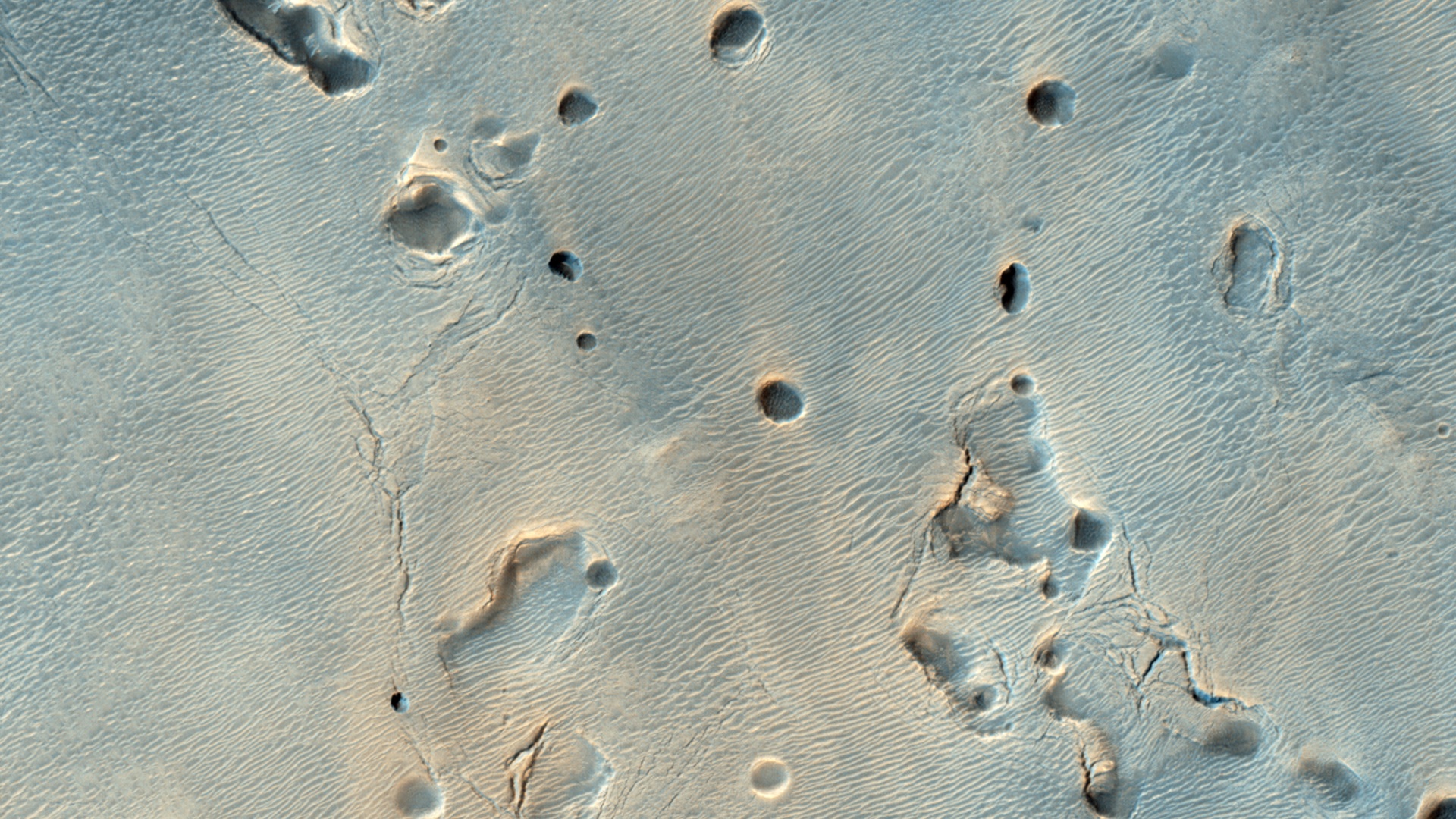
Orbit Number: 54578 Latitude: 39.37 Longitude: 35.6148 Instrument: VIS Captured: 2014-04-03 19:17

Photo credit: NASA/JPL-Caltech/Arizona State University

Monday, June 9, 2014

Slope Streaks in Arabia Terra


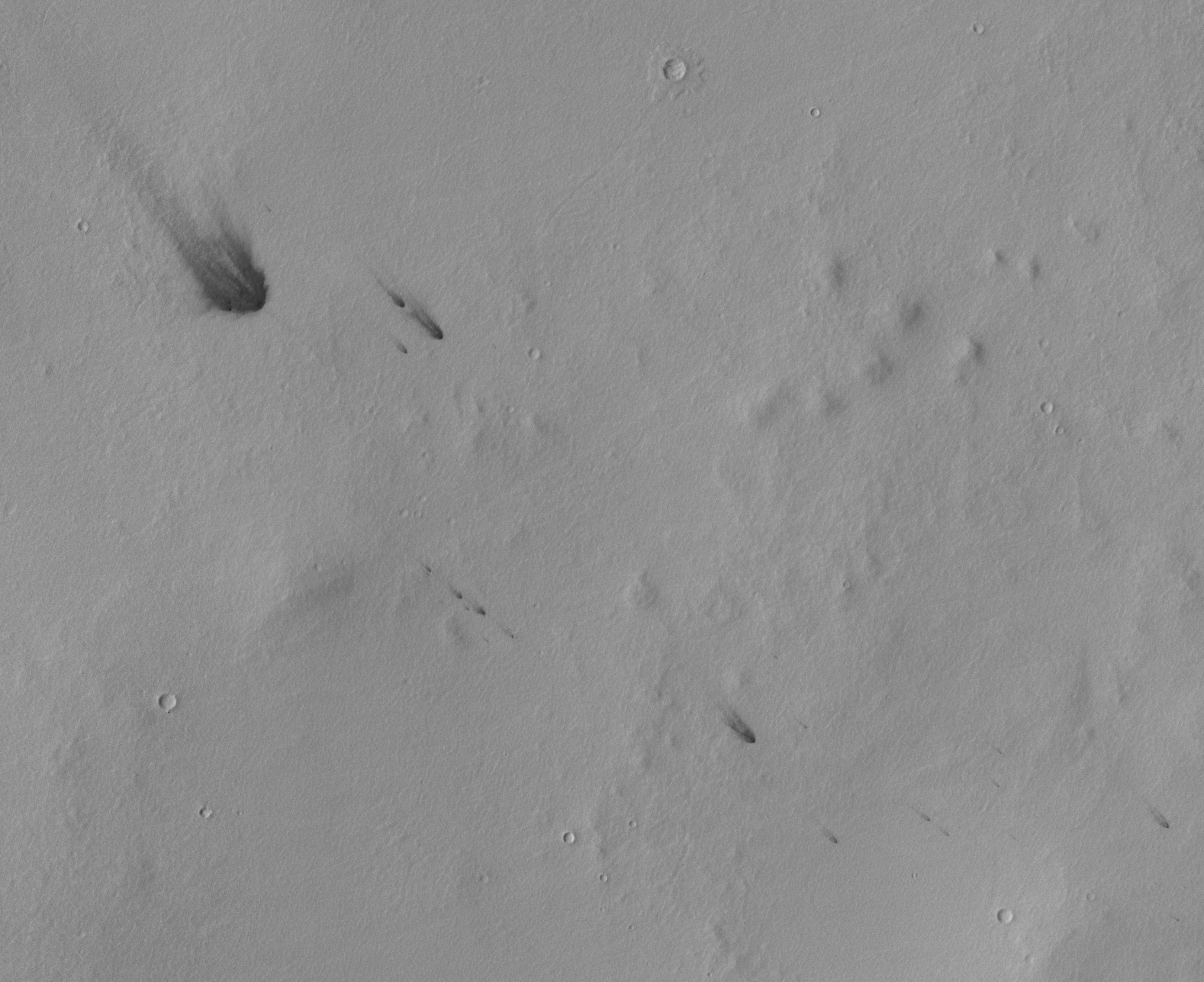
Dusty regions on Mars are often considered to look boring in HiRISE images because the dust obscures surface features. However, new meteor impacts are found most easily in dusty regions such as the one in this image because the new impacts blast away the dust at the surface, leaving obvious dark spots that can be seen in images from the Mars Reconnaissance Orbiter Context Camera (CTX). HiRISE will then take a close up image of the dark spots to image any new craters that have formed as a result of the impact.

As well as confirming a new impact, this image also showed other features commonly found in dusty areas: slope streaks and bed-forms. A close-up picture of the roughly 2.5-kilometer-diameter crater at the bottom of the main image shows ridges on the crater floor where dust has become trapped, and bright and dark streaks down the crater walls where dust has cascaded down the slope.

Image credit: NASA/JPL/University of Arizona

Note: This impact crater is located in Arabia Terra to the west of Cassini Crater.

Tuesday, June 3, 2014

Crater Delta Deposit in Arabia Terra


A delta deposit sits on the floor of this unnamed crater in Arabia Terra. The channel that created the delta dissects the crater rim.
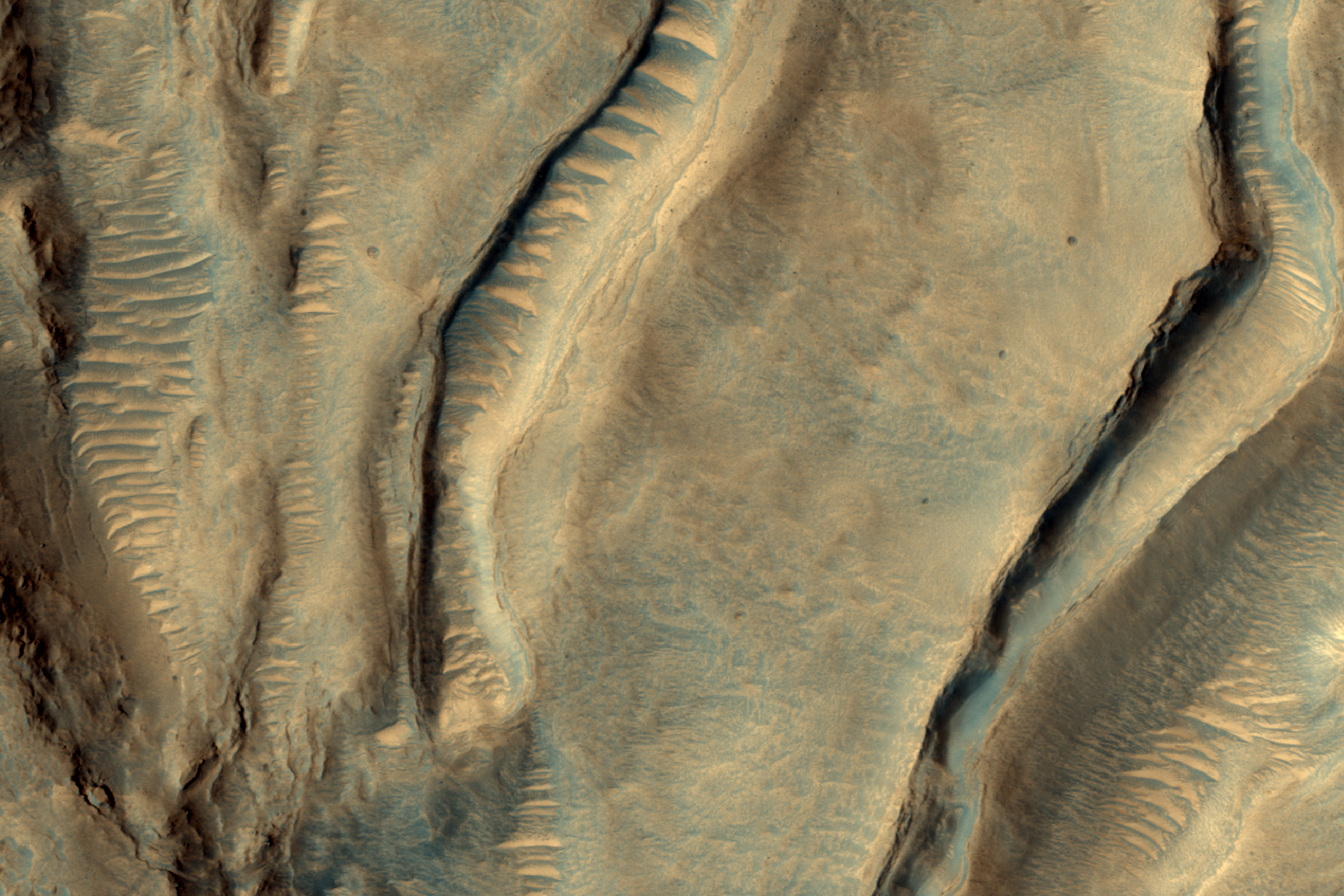
Orbit Number: 54354 Latitude: 31.1307 Longitude: 12.3785 Instrument: VIS Captured: 2014-03-16 08:54

Photo credit: NASA/JPL-Caltech/Arizona State University

Saturday, May 24, 2014

Channels in Northern Arabia Terra


The unnamed channels in this VIS image are located in northern Arabia Terra.
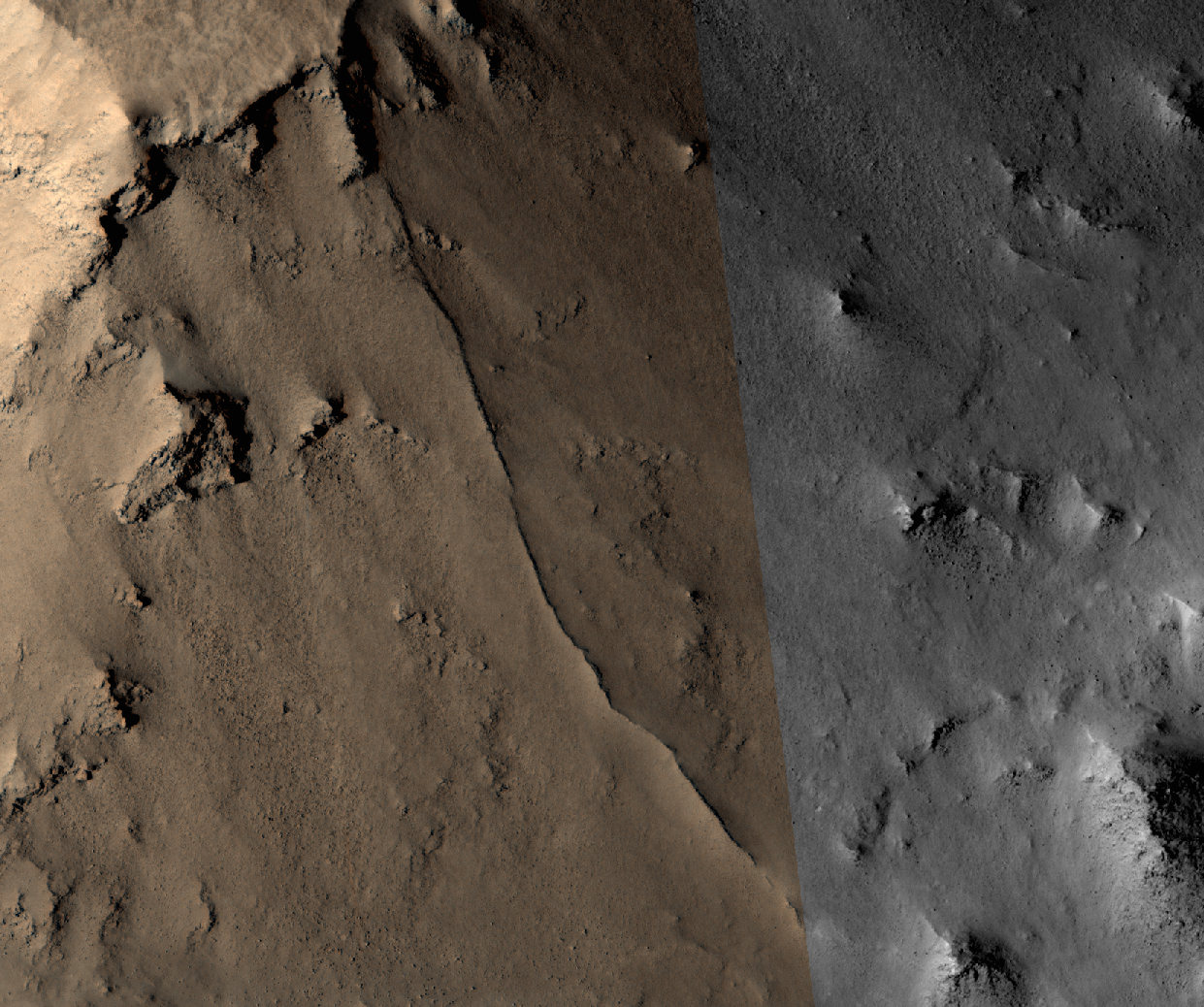
Orbit Number: 54291 Latitude: 38.2988 Longitude: 29.8555 Instrument: VIS Captured: 2014-03-11 04:26

Photo credit: NASA/JPL-Caltech/Arizona State University

Tuesday, May 20, 2014

Channel in Northwestern Arabia Terra


This unnamed channel is located on the northwest margin of Arabia Terra.
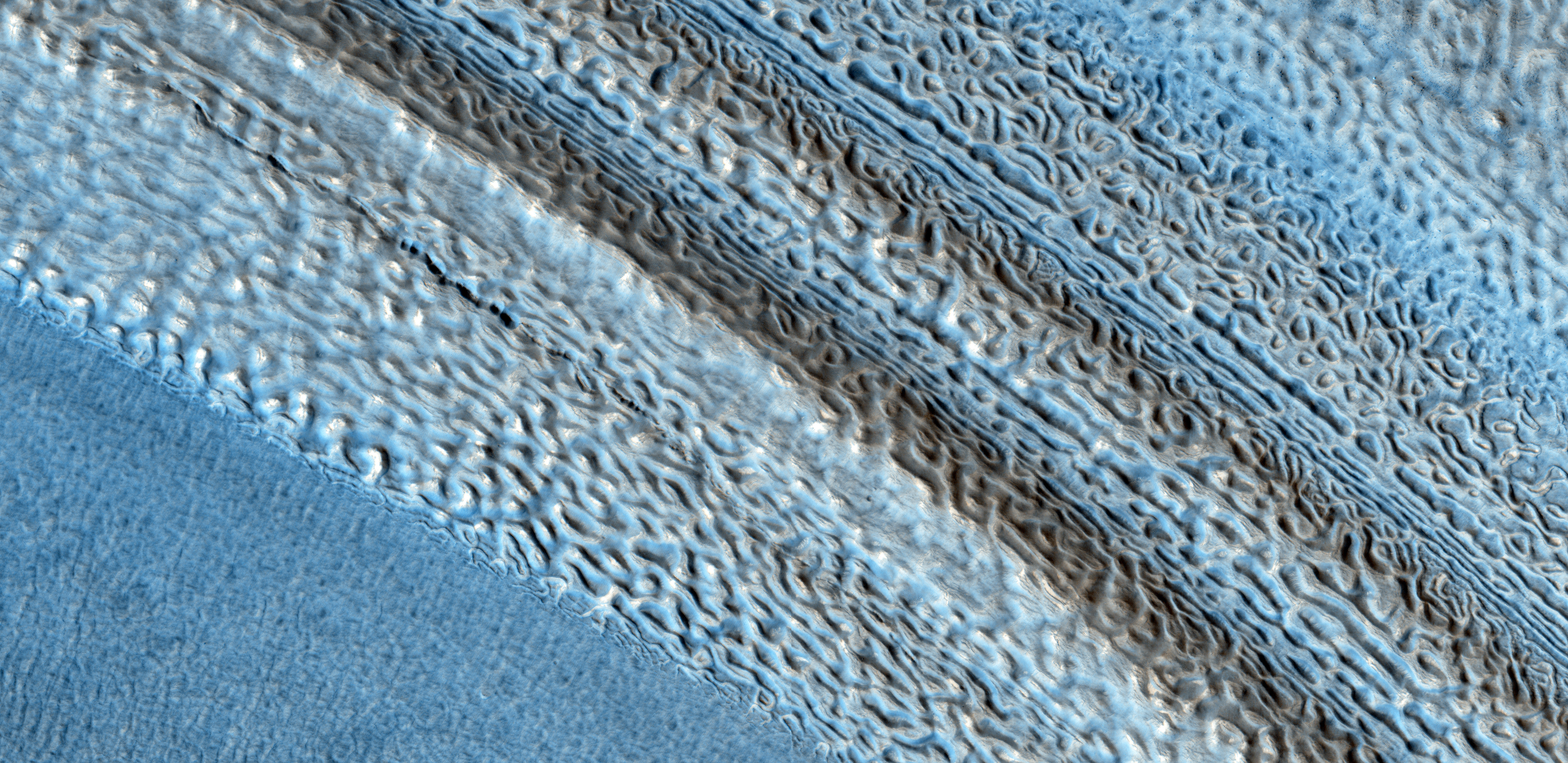
Orbit Number: 54230 Latitude: 32.6306 Longitude: 347.534 Instrument: VIS Captured: 2014-03-06 03:05

Photo credit: NASA/JPL-Caltech/Arizona State University

Saturday, April 19, 2014

Channels in Arabia Terra


Many small channels are visible in this VIS image of Arabia Terra.

Orbit Number: 54067 Latitude: 35.1164 Longitude: 7.39422 Instrument: VIS Captured: 2014-02-20 18:01

Photo credit: NASA/JPL-Caltech/Arizona State University

Wednesday, April 2, 2014

Channel in Arabia Terra


Today's VIS image shows an unnamed channel that dissects the rim of a large crater in Arabia Terra.

Orbit Number: 53879 Latitude: 31.2164 Longitude: 26.7961 Instrument: VIS Captured: 2014-02-05 06:44

Photo credit: NASA/JPL-Caltech/Arizona State University

Sunday, March 30, 2014

Pitted Mound in Northeast Arabia Terra


This fascinating observation shows us a dark-toned mound with pits inside an impact crater. Are these pits the result of sublimation?

The crater itself is an ancient one, as evidenced by the eroded rim. For the mound inside, HiRISE resolution can give us a closer look at textural features that might help explain what we're looking at: layers in pit walls, or perhaps cracks from expansion?

This is a stereo pair with ESP_034324_2040.

Photo credit: NASA/JPL/University of Arizona

Wednesday, March 5, 2014

Slope Streaks in Arabia Terra


Dark slope streaks are found everywhere on the inner rim of this unnamed crater in Arabia Terra.

Orbit Number: 53642 Latitude: 17.2407 Longitude: 17.3787 Instrument: VIS Captured: 2014-01-16 18:44

Photo credit: NASA/JPL-Caltech/Arizona State University

Sunday, January 26, 2014

Oxus Patera Collapse Feature


Oxus Patera is an ancient, eroded depression in northern Arabia Terra. It is not known how Oxus Patera formed, though it has been suggested that the feature represents an ancient caldera formed through collapse and explosive volcanism.

Other possibilities include formation by impact and erosion, or collapse due to removal of subsurface volatiles. Regardless of how the massive depression originally formed, there is little doubt that the feature has been modified by younger ice-related processes.

This image shows an unusual landform on the floor of Oxus Patera. Notice an irregular, scalloped contact trending diagonally from southwest to northeast near the center of the image. The terrain in the upper left is likely composed of fine-grained, weakly consolidated materials because it does not form many topographic features within the unit (few mesas, buttes, mountains, etc.). Where it is eroded, it does not form boulders: it appears to be an easily crumbled, blanketing deposit. The terrain in the lower right is very unusual. It contains smooth surfaces marked by small, irregularly shaped cones and fractures that are bounded by upturned ridges. The boundary between the two terrains consists of scalloped fractures that appear to have formed where the terrain in the lower right has detached from the terrain in the upper left, and partially collapsed.

Photo credit: NASA/JPL/University of Arizona

Tuesday, December 31, 2013

Crater Dunes in the Borderland Between Arabia Terra and Terra Sabaea


Dunes are found on the floor of this unnamed crater located on the margin between Arabia Terra and Terra Sabaea.

Orbit Number: 52843 Latitude: 6.34777 Longitude: 10.1768 Instrument: VIS Captured: 2013-11-12 00:49

Photo credit: NASA/JPL-Caltech/Arizona State University

Thursday, December 26, 2013

Slope Streaks in Arabia Terra


Dark slope streaks mark the inner rim of this unnamed crater in Arabia Terra.

Orbit Number: 52743 Latitude: 20.8045 Longitude: 14.9941 Instrument: VIS Captured: 2013-11-03 19:15

Photo credit: NASA/JPL-Caltech/Arizona State University

Friday, November 15, 2013

Linear Ridges Near Nilosyrtis Mensae


Straight and meandering thin ridges are periodically found on Mars. Such ridges can form in a variety of ways.

Rivers beneath glaciers can deposit rocks and sand leaving a raised ridge, called an esker, when the glacier retreats. Sometimes sandy river beds can become cemented by minerals. Later when the river is gone and the uncemented soils next to the old river bed are eroded more easily, the old river bed itself is left standing.

In this observation, relatively straight and narrow ridges are found crisscrossing the slopes between rocky mesas and adjacent valleys. That these ridges extend along steep slopes is unlike the water-born ridges mentioned above. Additionally, some ridges appear to connect through the mesa and extend also down the opposite slope. These features of the ridges suggest that they cut deep into the interior of the mesas.

A ridge of volcanic rock called a dike occurs when magma is squeezed into a deep fracture in the surrounding rock and upward to (or near) the surface. This magma cools and solidifies into a strong rock that resists erosion better than the fracture rock the magma squeezed into earlier. When erosion of these rocks occurs, the harder volcanic rock is left standing as a ridge and reveals the underground plumbing system of the volcanic vent.

Photo credit: NASA/JPL/University of Arizona

Note: These ridges are located in a channel leading to Nilosyrtis Mensae in far northern Arabia Terra.

Saturday, September 21, 2013

Brain Terrain in Deuteronilus Mensae


Scientists now know that Mars has a lot more ice than once thought. Many lobate features are now known to be almost pure ice, like glaciers on the Earth.

We still don't know for sure if these Martian ice deposits flow like Earth's glaciers. Knowing how fast they flow (if at all!) would help us understand more about the climate of Mars and how it has changed over time.

This image shows one of these icy lobate features wrapping around a small hill. There is an unusual texture on the ice at the base of this hill that people have called “brain terrain.” This strange-looking surface might be related to flow of the ice, but we still don't have a definite explanation for this mystery.

This is a stereo pair with ESP_032875_2195.

Photo credit: NASA/JPL/University of Arizona

Note: This location is on the edge between Arabia Terra to the south and Deuteronilus Mensae to the north.