Showing posts with label Iapygia Quadrangle. Show all posts

Wednesday, September 17, 2014

Banded TARs in Iapygia


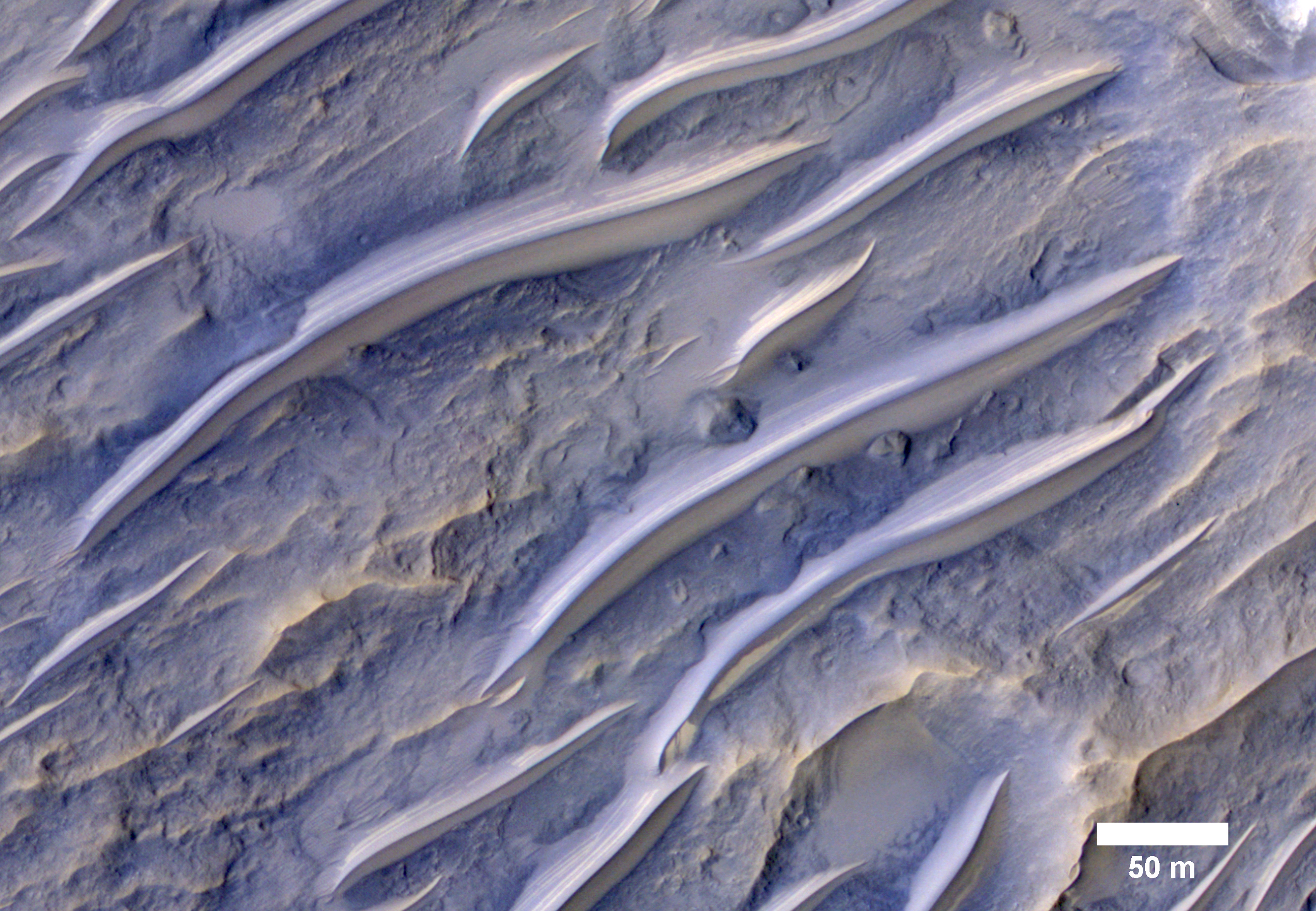
The tropics of Mars are commonly littered with small bright ripples that were somehow shaped by the wind. Called "transverse aeolian ridges", or TARs, the features stand up to 6 meters tall and are spaced a few tens of meters apart. They are typically oriented transverse to modern day wind directions, and often found in channels and crater interiors. The physical process that produces these features is still mysterious. Most TARs display no evidence of internal structure, so it is difficult to discern exactly how they were formed.

While validating a HiRISE digital terrain model of the area, Sarah Mattson of the University of Arizona discovered these rare banded TARs in Iapygia, south of Syrtis Major. These features resemble TARs elsewhere on Mars, except that they show bands or layers on their northwest faces but fewer or none on the southeast sides.

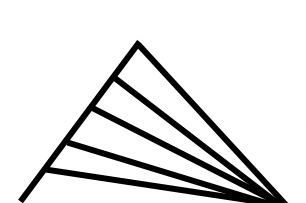
One possible interpretation of this strange layering is that these particular TARs are made up of wedge-shaped layers, as shown in the schematic cross-section illustrating the inferred structure of the TARs. If this hypothesis is correct, it implies that the ripples grew vertically over time, as material accreted at the crests of the ridges. It also suggests that the banded slopes faced upwind.

This observation might provide a valuable clue to the formation of TARs elsewhere on Mars, if they have a similar internal structure but that structure cannot be seen because they are made up of homogeneous materials that are uniform in color.

This is a stereo pair with ESP_021639_1610.

Image credit: NASA/JPL/University of Arizona

Note: For more information, see PIA18806: Banded TARs in Iapygia.

Thursday, July 15, 2010

Harris Crater

The USGS Astrogeology Science Center has announced the naming of a crater on Mars, Harris, named after the late Daniel Lester Harris III (1919-1962). Harris was an American astronomer and scientist who worked in a wide range of fields, including both astronomy and underwater acoustics.

The center of Harris Crater is located at 21.65° South, 66.73° East in the Iapygia Quadrangle of Mars, north of Hellas Planitia.

Friday, February 19, 2010

Eroding Layers in an Impact Crater


This image shows a stack of layers on the floor of an impact crater roughly 30 kilometers across, located in the Iapygia Quadrangle (MC-21) of Mars. Many of the layers appear to be extremely thin, and barely resolved.

In broad view, it is clear that the deposit is eroding into a series of ridges, likely due to the wind. Below the ridges, additional dark-toned layered deposits crop out. These exhibit a variety of textures, some of which may be due to transport of material.

The light ridges are often capped by thin dark layers, and similar layers are exposed on the flanks of the ridges. These layers are likely harder than the rest of the material, and so armor the surface against erosion. They are shedding boulders which roll down the slope, as shown in the subimage. Although these cap layers are relatively resistant, the boulders do not seem to accumulate at the base of the slope, so it is likely that they also disintegrate relatively quickly.

The subimage itself is 250 meters wide. The light is from the left. Boulders are visible on the slopes of the ridges along with thin dark layers including the cap layer, but they are absent on the spurs where the resistant cover has been eroded. This demonstrates that the boulders come only from the dark layers, and are not embedded in the rest of the deposit.
Photo Credit: NASA/JPL/University of Arizona