Showing posts with label Extensional Faults. Show all posts

Monday, August 15, 2011

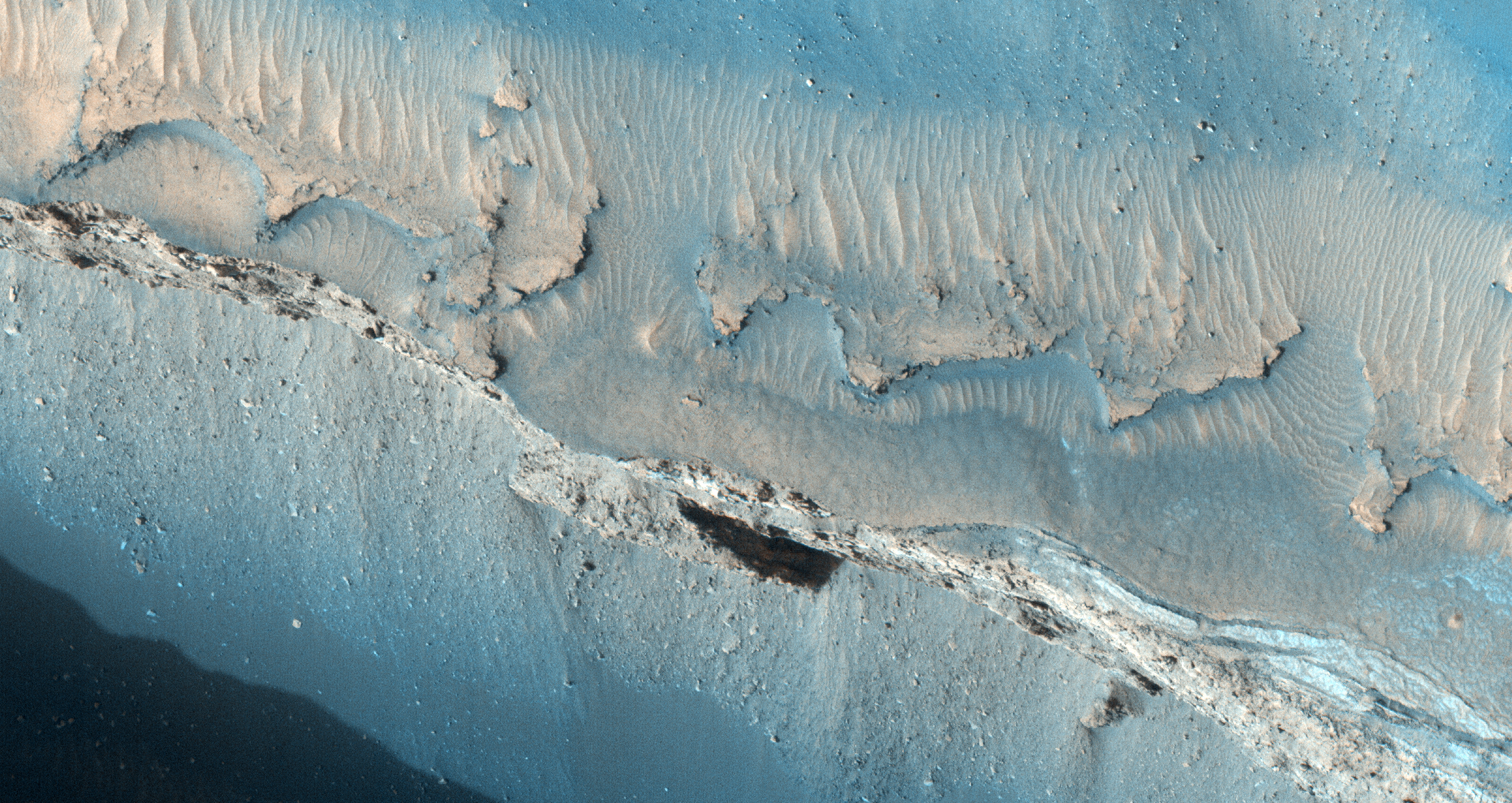
Cerberus Fossae Fractures


Cerberus Fossae is an extensive fracture system in the southern part of Elysium Planitia.

These fractures have acted as a conduit for the release of water and lava onto the surface relatively recently in Martian geologic history. Dark sediment from the trough walls are visible, as well as some subsurface layers.

This is a stereo pair with PSP_004006_1900.

Photo credit: NASA/JPL/University of Arizona

Thursday, December 9, 2010

Pit Crater Chain South of Arsia Mons


This contains a series of craters called pit chains; however they are not formed by impact craters.

There are a few potential ways that these are formed. The pit craters are believed to form by the collapse of lava tubes or magma chambers. They could also form when the crust of Mars gets pulled apart by extensional forces from a growing volcano magma chamber. This leaves structurally weak areas that have a greater chance of collapsing when the area (lava tubes or magma chamber) no longer contains molten lava or is drained from the chamber.

There is evidence that Mars is not the only planet that has features like these. Earth also has similar pit chains that have formed in Iceland. This chain was formed on a known fault line and the pits formed when the region experienced an earthquake.

This process may be similar to the way the Martian pit chains were formed. If "Marsquakes" are the cause of the formation of pit chains, this will support the idea that there is still geologic (tectonic) activity occurring on Mars. The pit chains that have been found on Earth are considerably smaller than similar features that are found on Mars. Earth's are smaller due to higher gravity and weathering makes them smaller and at some point completely erasing them from sight. But Mars has no system to create erosion; therefore the chains on Mars are better preserved.

Photo credit: NASA/JPL/University of Arizona

Friday, November 12, 2010

Cerberus Fossae Fracture


This image shows part of a fracture that is approximately 800 meters (half a mile) wide. This fracture is part of a larger set of similar features that are collectively called Cerberus Fossae.

Some scientists suggest that lava, water, or both erupted from these fractures at some point in Mars' past. The presence of streamlined hills, such as those that are found in river channels on Earth, as well as lava flows, are some of the observations that lead scientists to this interpretation. Thus this fracture may be a large scale example of eruptive vents that form on volcanoes on Earth.

Photo credit: NASA/JPL/University of Arizona

Note: This photo looks very similar to Cerberus Fossae East of the Head of Athabasca Valles

Saturday, October 9, 2010

Fractured Mounds in Elysium Planitia


This observation shows fractured mounds on the southern edge of Elysium Planitia.

The mounds are typically a few kilometers in diameter and about 200 feet tall. The fractures that crisscross their surfaces are dilational (extensional) in nature, suggesting that the mounds formed by localized uplift (i.e., they were pushed up from below).

The mounds are probably composed of solidified lava. They are contiguous with, and texturally similar to, the flood lavas that blanket much of Elysium Planitia, and, where dilation cracks provide cross-sectional exposure, the uplifted material is rocky.

Patches of mechanically weak and disrupted material overlie the rocky mound material. This is particularly conspicuous in the northeast corner of the HiRISE image. These patches may be remnants of a layer that was once more continuous but has been extensively eroded. Smooth lava plains fill the low-lying areas between the mounds. They are riddled with sinuous pressure ridges. The entire area is covered by a relatively thin layer of dust and sand.


Photo credit: NASA/JPL/University of Arizona