Showing posts with label Lockyer Crater. Show all posts

Tuesday, April 8, 2014

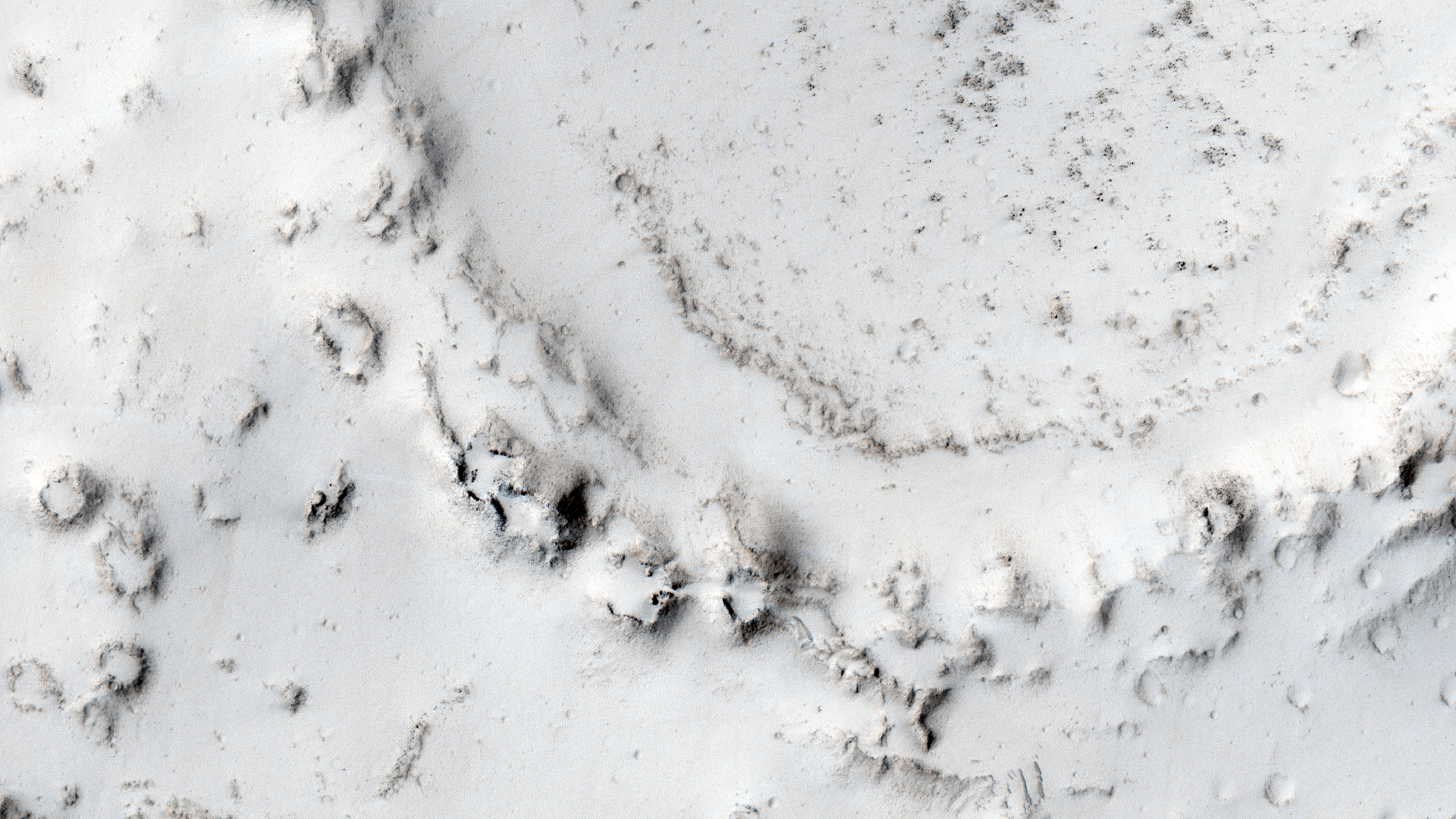
Ring of Rootless Cones in Elysium Planitia


In the center of this observation, we see a ring of cones that have developed over a crater rim. Lava appears to have deflated around and within the ring.

Interestingly, the area around the ring has few cones: did water or steam flow to the crater and make that zone less fertile? These cones are likely "rootless cones," so named because they do not form as a result of direct magma supply, but from the interaction of lava and water or ice in the substrate. The rootless cones in this image may have formed around the crater rim because the lava was thin there.

This is a stereo pair with ESP_034808_2065.

Photo credit: NASA/JPL/University of Arizona

Note: These rootless cones are located in northeastern Elysium Planitia to the southeast of Lockyer Crater.

Friday, April 6, 2012

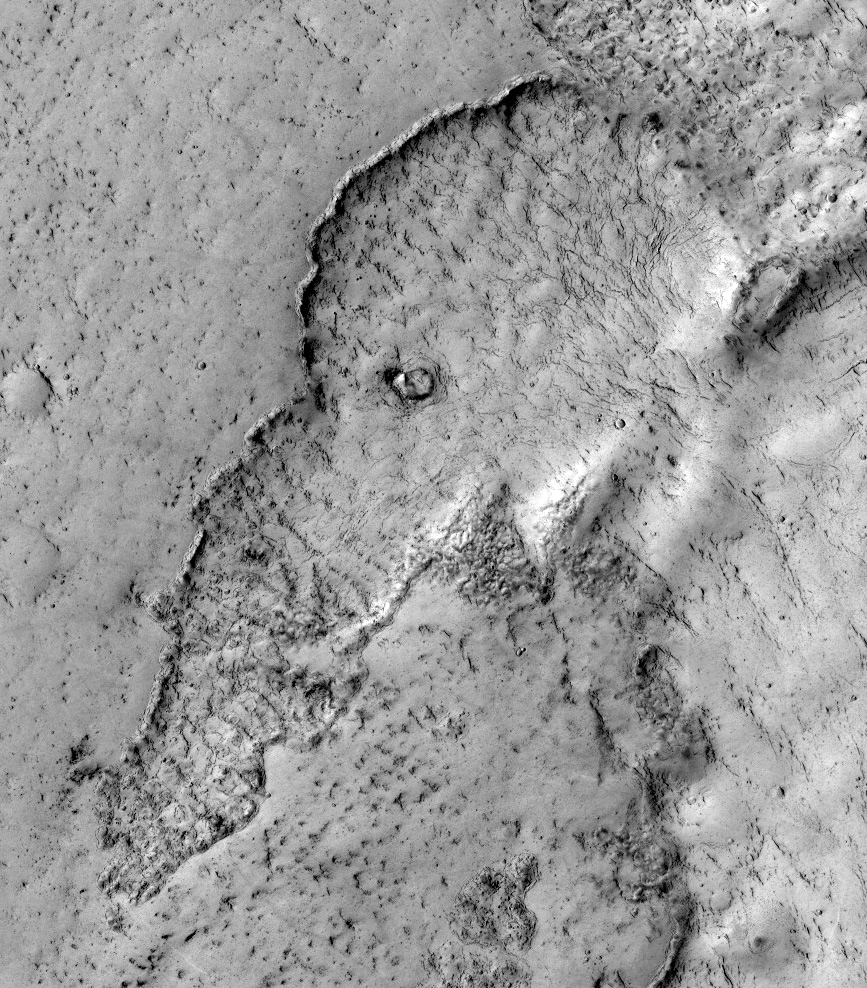
Elephantine Lava Flow in Elysium Planitia


This observation highlights terrain that looks like an elephant. This is a good example of the phenomena "pareidolia," where we see things (such as animals) that aren't really there.

Actually, this image covers the margin of a lava flow in Elysium Planitia, the youngest flood-lava province on Mars. Flood lavas cover extensive areas, and were once thought to be emplaced extremely rapidly, like a flood of water.

Most lava floods on Earth are emplaced over years to decades, and this is probably true for much of the lava on Mars as well. An elephant can walk away from the slowly advancing flow front. However, there is also evidence for much more rapidly flowing lava on Mars, a true flood of lava. In this instance, maybe this elephant couldn't run away fast enough.

Note: the subimage is not map-projected, so approximate North is down.

Photo credit: NASA/JPL/University of Arizona

Note: This site is located in Phlegra Dorsa; the closest named impact crater is Lockyer, which is some distance off to the west.

Wednesday, November 10, 2010

Cones Formed by Hot Lava Running over Water or Ice


These cones are similar in size and shape to cones found in Iceland where hot lava has run over wet ground.

The heat from the lava boils the water which bursts through the lava flow. These steam-driven exploding bubbles of lava throw chunks of molten and solid lava into the air.

A long series of such explosions is needed to build up one of the large cones. The cones appear in chains because the surface of the lava flow was moving while the series of explosions were taking place. This is sort of like a miniature version of how the Hawaiian Island chain forms. The hot spot under Hawaii is fixed but the Earth's crust slides past it.

This image forms a stereo pair with ESP_018457_2065.

Photo credit: NASA/JPL/University of Arizona

Note: This area is located in the northeastern reaches of Elysium Planitia, south of Arcadia Planitia and southeast of Adams and Lockyer craters.