Showing posts with label Nili Patera. Show all posts

Sunday, October 5, 2014

Continual Dune and Ripple Migration in Nili Patera


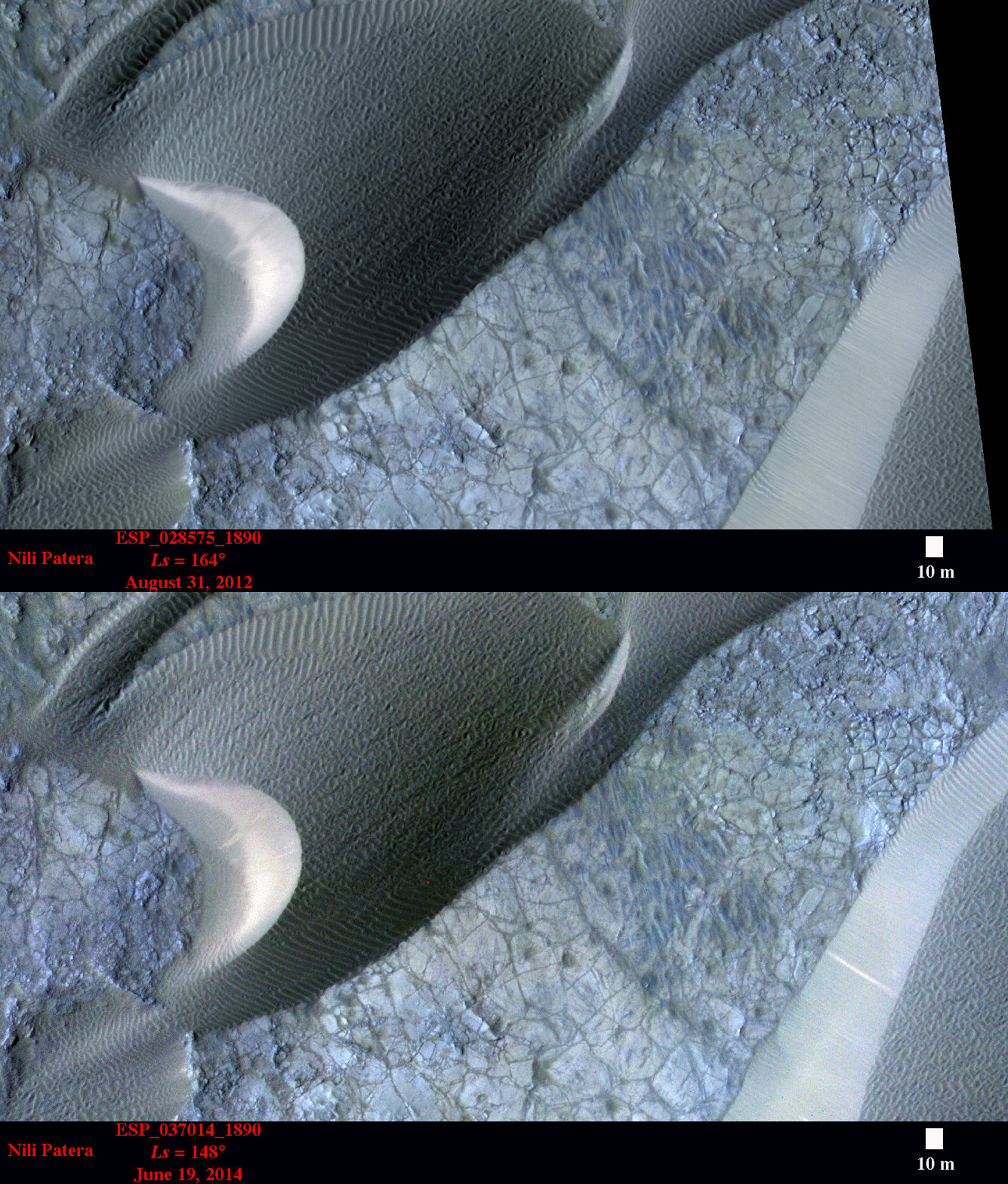
Nili Patera is a region on Mars in which dunes and ripples are moving rapidly. HiRISE continues to monitor this area every couple of months to see changes over seasonal and annual time scales.

Here we see obvious activity over a span of less than two Earth years. Three prominent changes are obvious: 1) the dunes are migrating, with position differences of a few meters in some areas; 2) the ripples on the surfaces of the dunes have undergone so much change that they cannot be reliably tracked over this time interval; and 3) the lee faces of the dunes exhibit new avalanches.

These results show that Nili Patera, and other regions on Mars, are areas of active sand migration and landscape erosion.

Image credit: NASA/JPL/University of Arizona

Note: For more information, see PIA18818: Continual Dune and Ripple Migration in Nili Patera.

Sunday, May 4, 2014

Nili Patera Dunes


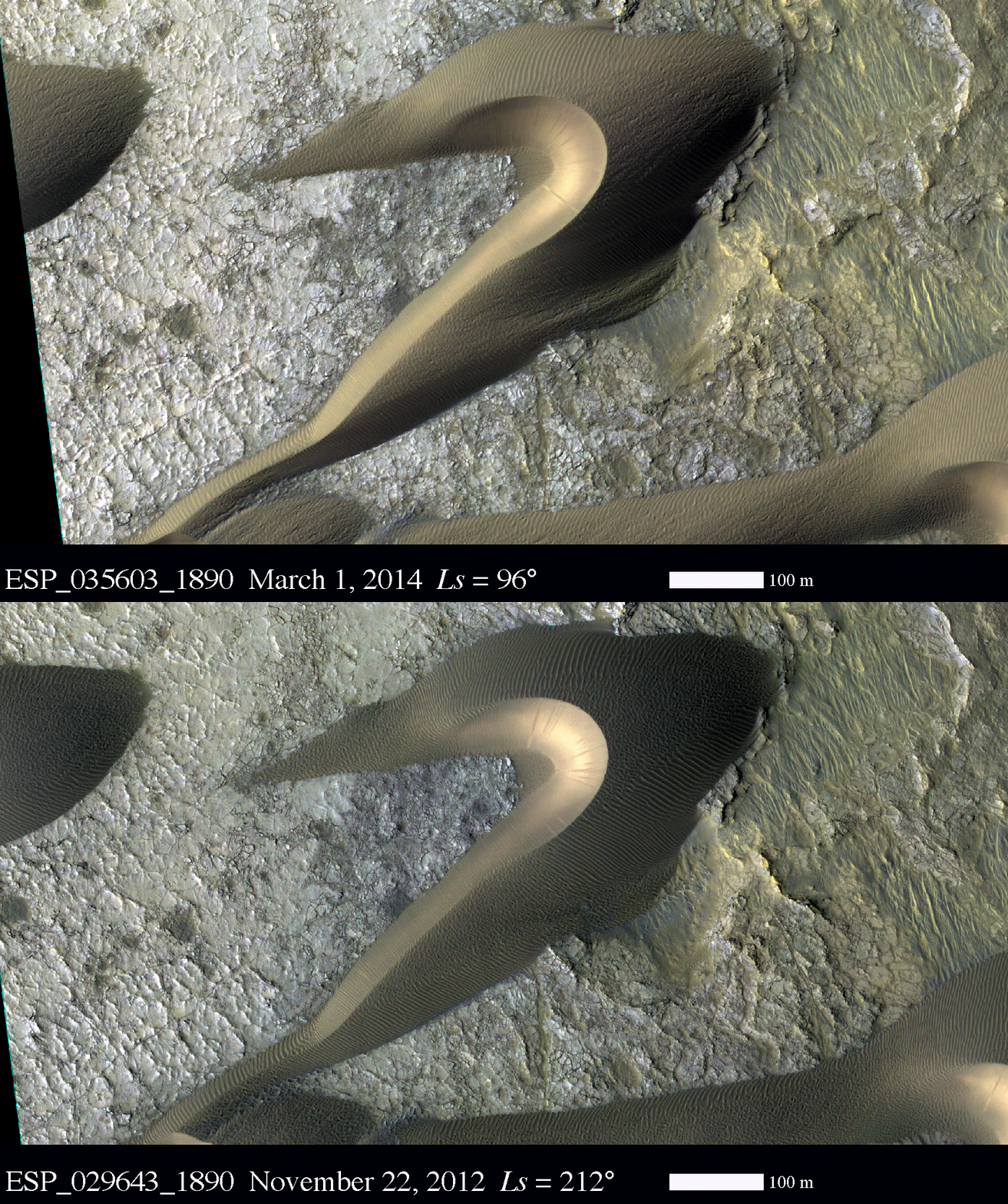
Nili Patera is one of the most active dune fields on Mars. As such, it is continuously monitored with HiRISE, with a new image acquired about every six weeks.

By monitoring the sand dune changes, we can determine how winds vary seasonally and year-to-year. This observation is one of the more recent Nili images (1 March 2014). Compared to an image acquired on 22 November 2012, changes are obvious. The ripples on the dunes have moved, as well some of the dune boundaries, such as the one at upper left. New landslides on the central dune”s lee face are apparent.

Such changes, in just 16 months (and finer scale changes have been seen in just a couple of weeks), demonstrate the effectiveness of wind in modifying the Martian landscape.

Photo credit: NASA/JPL/University of Arizona

Note: For more information, see PIA18244: The Active Dunes of Nili Patera.

Tuesday, January 29, 2013

Butterfly Crater in Syrtis Major Planum


Emily Lakdawalla of the Planetary Society wrote a nice blog entry about her HiWish image here.

She requested stereo coverage, which is also available, and here's a resulting anaglyph cutout.

If you're interested in suggesting a potential target for us to image, consider setting up a HiWish account here.

This is a stereo pair with ESP_029999_1890.

Photo credit: NASA/JPL/University of Arizona

Note: This crater is located between Nili Patera to the west and Isidis Planitia to the east, in Syrtis Major Planum.

Wednesday, May 16, 2012

Advancing Dune in Nili Patera


Back-and-forth blinking of this two-image animation shows movement of a sand dune on Mars. The images are part of a study published by Nature on May 9, 2012, reporting movement of Martian sand dunes at about the same flux (volume per time) as movement of dunes in Antarctica on Earth.

The before-and-after images were taken nearly three Earth years apart by the High Resolution Imaging Science Experiment (HiRISE) camera on NASA's Mars Reconnaissance Orbiter. The scale bar is 50 meters (164 feet). The site is part of a dune field inside the summit caldera of Nili Patera, an ancient volcano, at 8.7 degrees north latitude, 67.3 degrees east longitude.

The images show a dark, rippled sand dune overlying bright-toned rock. They have been "orthorectified," that is, adjusted such that they appear as if viewed from directly overhead. They were then positionally tied together by registering fixed features on the bedrock seen in one image to the same features seen in the other. When the images are blinked back and forth, advance of the dune's lee (downwind) front over the time period of 941 days is clearly seen in the area indicated by the arrow near the lower-left corner. Other arrows indicate places where the margin of the dune has moved. In contrast, the ripples have changed so much that their migration cannot be tracked.

The first image, in which the main body of the dune looks darker due to lighting effects, was taken on October 13, 2007. It is one image product of HiRISE observation PSP_005684_1890. Other image products from the same observation are at http://hirise.lpl.arizona.edu/PSP_005684_1890. The "after" image was taken on May 11, 2010. Other image products from the same HiRISE observation are at http://hirise.lpl.arizona.edu/ESP_017762_1890.

Photo credit: NASA/JPL-Caltech/Univ. of Arizona/JHU-APL

Note: For a similar animation also located at Nili Patera see PIA15680: Ripple Movement on Sand Dune in Nili Patera, Mars. Also, see NASA Spacecraft Detects Changes in Martian Sand Dunes. For an abstract of the Nature article plus additional images, see Science in Motion.

Sunday, May 29, 2011

Nili Patera Dunes


Individual sand dunes are visible in this image of Nili Patera.

Photo credit: NASA/JPL/Arizona State University

Note: This photo is almost identical to this one, this one, and this one.

Friday, May 27, 2011

Nili Patera Dunes


The dunes in this VIS image are located in Nili Patera, one of the two patera of Syrtis Major Planum.

Photo credit: NASA/JPL/Arizona State University

Note: If you click on the Nili Patera label, you'll notice that there are a number of photographs that are of the same landscape (more or less). Why would the THEMIS scientists keep taking pictures of the same ground over and over? I can think of three reasons off-hand: 1) doing so allows the scientists to monitor the ground for any fresh features, such as newly formed impact craters, 2) the scientists can monitor whether or not the wind is pushing the sand dunes along or not and, if so, how quickly the dunes are moving, and 3) because the photos are not exactly covering the same area, a larger mosaic of the area can be made at (more or less) the same resolution.

Saturday, November 27, 2010

Thursday, October 21, 2010

Tuesday, June 29, 2010

Nili Patera Dunes


This VIS image shows dunes on the floor of Nili Patera, one of the two volcanic calderas of Syrtis Major.

Photo credit: NASA/JPL/Arizona State University

Note: In case you're curious, the other caldera in Syrtis Major is known as Meroe Patera.