Showing posts with label Linear Dunes. Show all posts

Wednesday, October 6, 2010

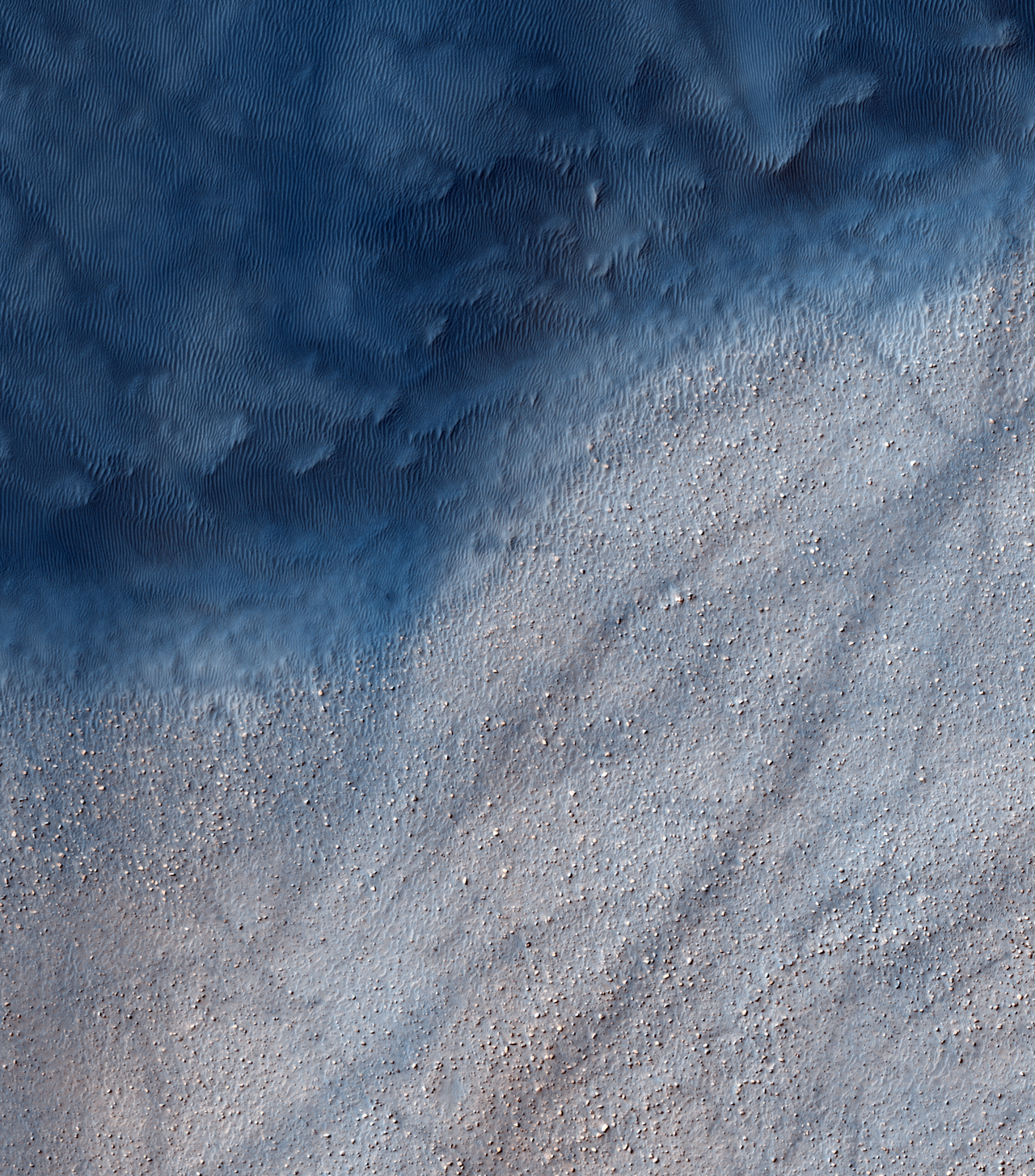
Linear Dunes and Sand Sheets in Herschel Crater


This image shows sand dunes and sheets in the central part of Herschel Crater.

In the northern (top) part of the image, the dunes grade between two morphologies, "barchan" and "linear." Barchans are crescent-shaped, with the horns of the crescents pointing downwind. One barchan is visible in the upper part of the image, with the southeast (lower right) horns longer than the other (see subimage, red box). This trend, along with the position of the steep face of the dune on the south side, indicates that the predominant winds which formed the dunes came from the north.

Southward of the barchan, the dunes grade into long streamers, called "linear dunes." On Earth, barchans form in areas of limited sand supply and linear dunes require two dominant wind directions that meet at an acute angle (i.e., less than 90 degrees). South of the linear dunes the sand covers the terrain in a vast sand sheet (see subimage, blue box). Together, these observations suggest that this part of Mars contains a limited supply of sand that has been subjected to high speed winds coming from two northerly directions.

The surface texture on the upper surface of the barchan dune and sand sheet exhibits corrugated patterns not seen on other dune surfaces. This may be caused by induration and subsequent erosion of some of the sand. Such a hypothesis was proposed by earlier investigators using lower resolution data from the Mars Orbiter Camera.

Photo credit: NASA/JPL/University of Arizona

Sunday, September 5, 2010

Wind Effects South of Olympus Mons


This VIS image of an area south of Olympus Mons shows a region where the wind has been an active agent in modifying the surface. Small linear dunes cover the surface in this image.

Photo credit: NASA/JPL/Arizona State University

Wednesday, August 18, 2010

Dune Field in Noachis Terra


This dune field is on the floor of a small crater in Noachis Terra located in the southern hemisphere of Mars.

The slip faces of the dunes have multiple directions, indicating that there were several wind directions and changes in wind strength when the dunes formed. The dominant dune type are transverse dunes (oriented perpendicular to the prevailing wind direction), with modified barchans (crescent-shaped dunes) in the northern region of the field and incipient linear dunes in the southern region.

The bright material scattered throughout the dune troughs, as well as at the bottom of the image, are outcrops of underlying bedrock.

The bottom of the image clearly displays a mass of dark dust devil tracks. Dust devils are wind funnels that suck up dust as they travel over the surface exposing the dark sandy substrate.

Photo credit: NASA/JPL/University of Arizona

Saturday, March 27, 2010

Dune Symmetry


Dunes of sand-sized materials have been trapped on the floors of many Martian craters. This is one example, from a crater in Noachis Terra, west of the giant Hellas impact basin.

The dunes here are linear, thought to be due to shifting wind directions. In places, each dune is remarkably similar to adjacent dunes, including a reddish (or dust colored) band on northeast-facing slopes. Large angular boulders litter the floor between dunes.

The most extensive linear dune fields know in the Solar System are on Saturn's large moon Titan. Titan has a very different environment and composition, so at meter-scale resolution they probably are very different from Martian dunes.

Photo credit: NASA/JPL/University of Arizona