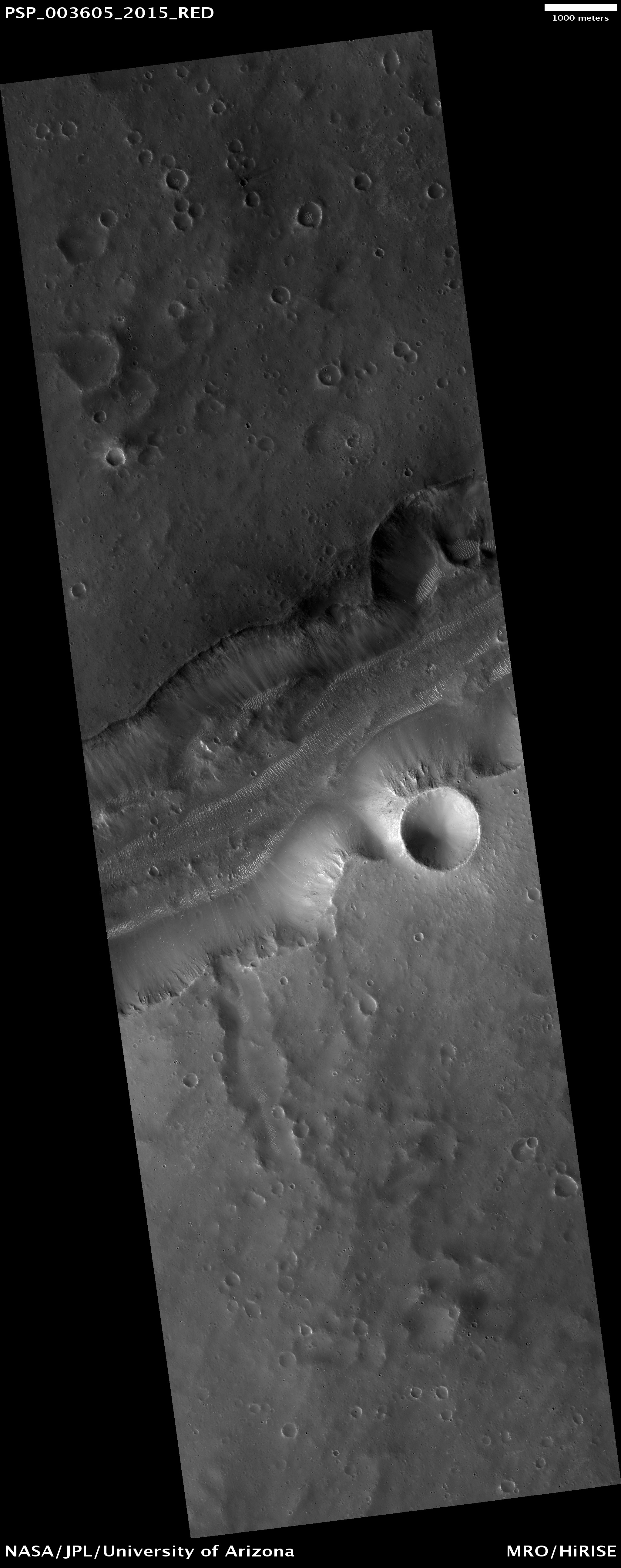
Today's VIS image shows Bahram Vallis where it enters Waspam Crater. Bahram Vallis exits the crater to the north a short distance from this location along the rim of Waspam Crater.
Photo credit: NASA/JPL/Arizona State University
Today's VIS image shows Bahram Vallis where it enters Waspam Crater. Bahram Vallis exits the crater to the north a short distance from this location along the rim of Waspam Crater.

Landslides are one of the most spectacular mass wasting features on Mars in terms of their areal extent and volume. Some of the best preserved landslides are in the Valles Marineris canyon system, but that's not the only place we see evidence for landslides.
This image of Bahram Vallis, a valley along the edges of the circum-Chyrse Basin, has large mounds of material at the base of the valley floor. These deposits of material are different from those deposits seen at Valles Marineris. They do not have a "ribbed" surface of transverse ridges. They also do not have a semi-circular distal margin giving it a lobate appearance and they have not traveled for many kilometers away from their source region like most Valles Marineris landslides do.
These particular deposits have the characteristic shape of rotational landslides or slumps on Earth where material along the entire wall slumps down and piles debris at the base of the slope, much like a person who slumps down the back of a chair. Right at the cliff edge at the top of the slope, the shape of the area where the valley wall gave way to a landslide is not straight, but rather curved or semi-circular. This is typical of large landslides where the failure area has an arcuate "crown" shape. The fact that landslides have occurred here indicates that the valley walls are not stable and the materials respond to Martian gravity with mass movements.
Scientists studying landslides can use these images along with topographic data to model how the wall failed, which can give clues to the nature of the materials (type, strength, etc.) in this region. Another consequence of landslide activity in Bahram Vallis is that the overall width of the valley will increase over time.


Bahram Vallis is a narrow-winding valley (20-22 North, 301-304 East) that terminates at the circum-Chyrse Basin on Mars.
The valley has numerous circular to sub-circular alcoves along its slopes, some with large deposits directly below on the valley floor. These features are evident from earlier image datasets of Mars including THEMIS, MOC, and HRSC, and are indicative of mass-wasting processes that have occurred along the valley walls.
A portion of the valley was imaged by the HiRISE camera at approximately 30 centimeters/pixel resolution in a location with both alcoves and valley floor deposits. Several features are apparent: a well-defined circular crown and main scarp, tensional cracks along the crown margins, and a well-defined accumulation zone with slump deposits.
The general appearance of these landslides is similar to terrestrial rock and/or loose earth rotational landslides. The Bahram landslides are also different from other well-documented landslides on Mars, such as those in the Valles Marineris canyon system that have lobate forms and longitudinal and/or transverse ridges on their surfaces. Future study of these landslide deposits will incorporate elevation data from the digital topographic model to assess the stability of valley walls using standard earth geotechnical models.