Showing posts with label Hesperia Planum. Show all posts

Monday, March 17, 2014

Impact Crater in Hesperia Planum


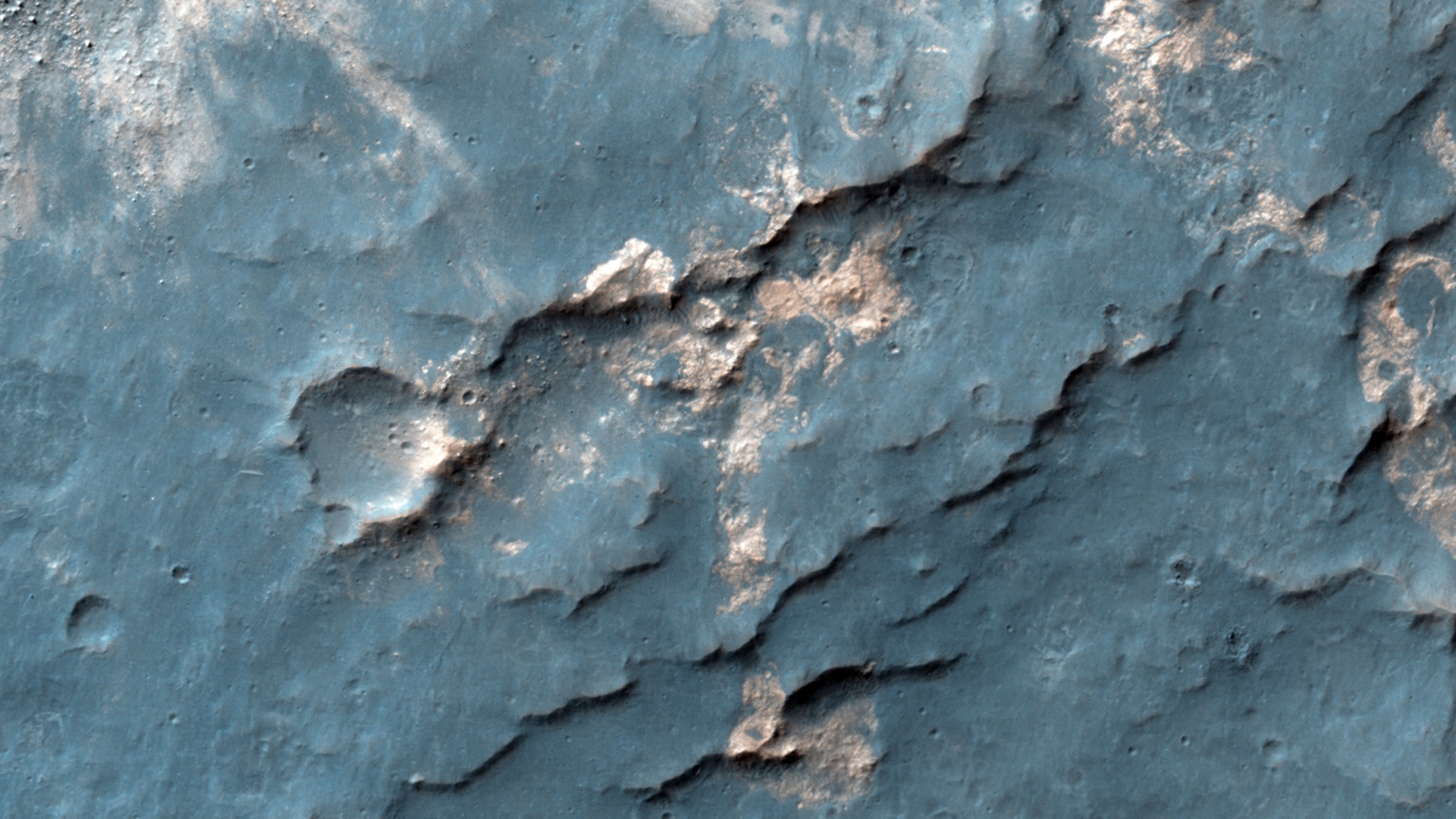
Sandwiched between a crater nearly 4 kilometer across and a much larger and older crater over 15-kilometers in diameter is this small impact crater with light-toned material exposed in its ejecta.

Because the material is still brighter than the surrounding surface, darker dust settling out of the atmosphere has not had time to cover it up, so the crater is fairly recent. Of course, “recent” could mean on the order of thousands of years or older. This small crater is also fairly shallow and smooth in its interior.

This light-toned rock deposit is also visible along neighboring scarps and even in the rock strata exposed along the rim of the larger 15-kilometer crater, indicating that the formation of this rocky strata predates all of these craters. The brightness and color of these deposits are the result of different minerals within the rock relative to the nearby darker rocks and soils, and perhaps indicate extensive chemical interaction between water and the native rocks.

Photo credit: NASA/JPL/University of Arizona

Note: This impact crater is located in Hesperia Planum, northeast of Tyrrhena Patera.

Thursday, November 7, 2013

Landslide in Hesperia Planum


A small landslide deposit is visible in this VIS image of an unnamed crater.

Orbit Number: 52166 Latitude: -7.06073 Longitude: 113.607 Instrument: VIS Captured: 2013-09-17 05:56

Photo credit: NASA/JPL-Caltech/Arizona State University

Note: This impact crater is located in northeastern Hesperia Planum.

Sunday, August 4, 2013

Tagus Valles


In the ancient cratered southern highlands of Mars, the faint traces of a wet past are seen in the form of channels (lower center), fluidized debris around craters (bottom right) and blocks of eroded sediments (top left). Volcanic activity may have deposited the fine dusting of dark material visible in the top left.

The image was taken by the High Resolution Stereo Camera on ESA’s Mars Express on 15 January 2013 (orbit 11504), with a ground resolution of approximately 22 m per pixel. The image center lies at about 4°S / 114°E, close to Tagus Valles in an unnamed region north of Hesperia Planum.

Photo credit: ESA/DLR/FU Berlin (G. Neukum)

Note: For more information, see Tagus Valles Topography and Tagus Valles 3D.

Wednesday, February 1, 2012

Very Fresh Impact Crater Superposing a Wrinkle Ridge in Hesperia Planum


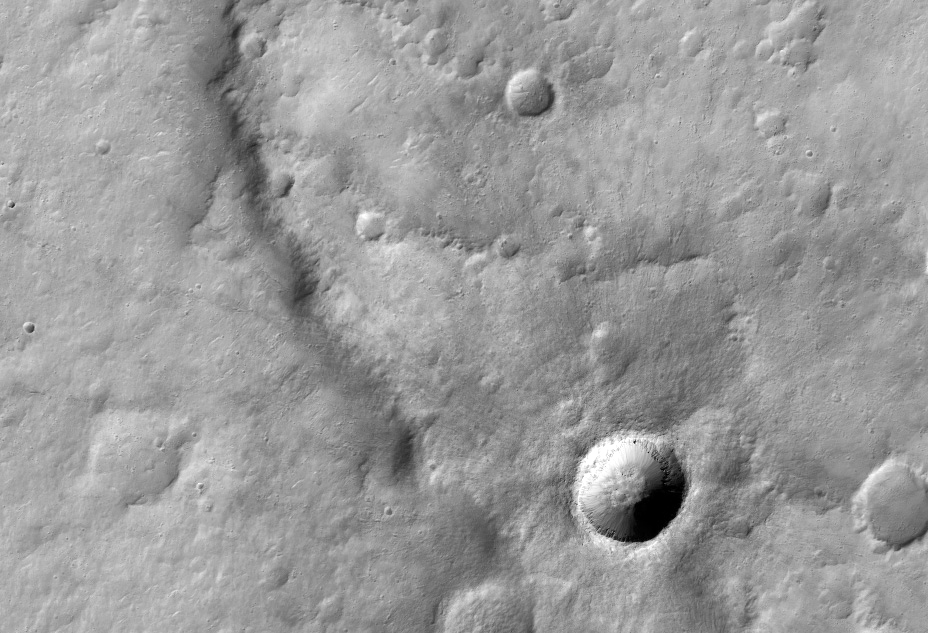
The ridge captured in this HiRISE image is called a wrinkle ridge. This wrinkle ridge is located in Hesperia Planum, a region of over two million square kilometers (over 770,000 square miles) in the southern highlands of Mars. It is located northwest of the Hellas basin and adjacent to Tyrrhena Patera and contains abundant orthogonal and intersecting wrinkle ridges.

Wrinkle ridges are long, winding topographic highs and are often characterized by a broad arch with superposed narrow asymmetric ridges. These features have also been identified on the Moon, Mercury, and Venus. Their origin is attributed to horizontal compression or shortening of the crust due to faulting and folding. They commonly have asymmetrical cross sectional profiles and an offset in elevation on either side of the ridge.

Superposing or located on top of the wrinkle ridge, is a very fresh impact crater. We can tell that this crater is fresh because of its relatively sharp or crisp rim and unmodified shape. If you look closely, you can see faint rays of relatively fine material, boulders, and smaller secondary craters radiating from the crater and superposing the wrinkle ridge and older surrounding craters.

Photo credit: NASA/JPL/University of Arizona

Note: For an mp4 video clip of this area, including additional photographs, click here.

Sunday, February 3, 2008

Butterfly Crater in Hesperia Planum, by Mars Express

Credits: ESA/DLR/FU Berlin (G. Neukum)

Because I truly am a glutton for punishment, I've started another blog, The Ministry of Space Exploration, which focuses on the remainder of the universe other than Mars. This particular post happens to be the first one written at The Ministry since that blog started. Please visit The Ministry of Space Exploration.

This image, taken by the High Resolution Stereo Camera (HRSC) on board ESA’s Mars Express spacecraft, shows a large elliptical impact crater in the Hesperia Planum region of Mars.

The HRSC obtained these images during orbit 368 with a ground resolution of approximately 16.7 meters per pixel. The scenes show the region of Hesperia Planum, at approximately 35.3° South and 118.7° East.

[The crater measures] ...approximately 24.4 km long, 11.2 km wide and reaching a maximum depth of approximately 650 meters below the surrounding plains.

Ejecta from this impact can be seen extending away from the crater, including two prominent lobes of material north-west and south-east of the crater.

...

This appears to be an impact crater that was subsequently resurfaced by lava flows, preserving the outline of the underlying crater. The curving features visible in the north of the image, known as 'wrinkle ridges,' are caused by compressional tectonics.

While the majority of impact craters are relatively circular, the elliptical shape of this impact crater suggests a very low impact angle (less than 10 degrees).

The long axis of the impact crater is viewed as the impacting direction of the projectile. Similar elliptical craters are observed elsewhere on Mars, as well as on our Moon.