Showing posts with label Saravan Crater. Show all posts

Friday, June 1, 2012

Different Materials Exposed along a Wallrock Slope in Coprates Chasma


This image shows several kilometers of topography exposed along the wallrock within Coprates Chasma. Higher topography is towards the bottom of the image while the floor of Coprates Chasma is visible at the top of the image.

There are patches of brighter materials exposed within the wallrock and along the chasma floor. The bright massive rocks exposed in the wallrock likely represent weathered rocks that have altered to this brighter material.

Lower down the wallrock and along the chasma floor, the brighter material appears layered and could represent sediments deposited within the chasma when water or ice may have existed here. The image also shows finer material composed of eroded wallrock and aeolian debris that is mass wasting downslope.

Photo credit: NASA/JPL/University of Arizona

Note: This image is located in far eastern Coprates Chasma, near the entrance of Capri Chasma. The closest named feature is Saravan Crater, to the south.

Saturday, October 8, 2011

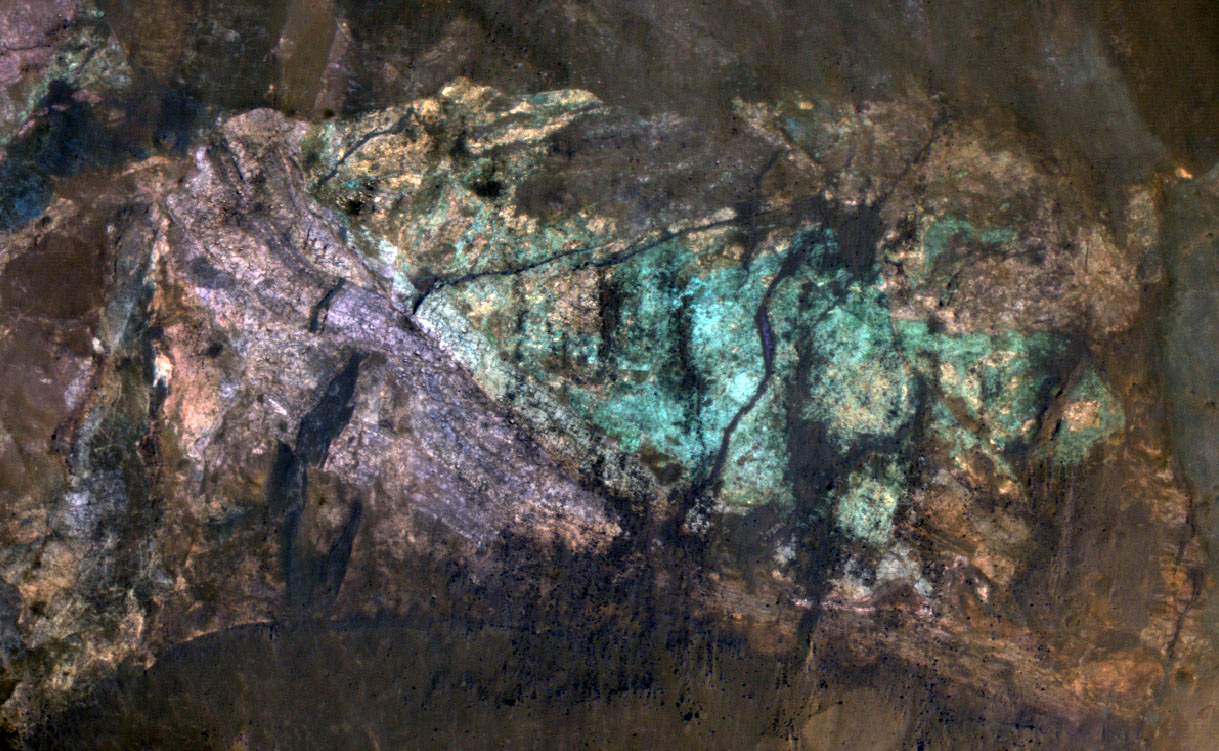
Colorful Central Peak in Noachis Terra


Small impact craters retain their original bowl shape, but once a crater is large enough that the force of gravity on the slopes of the crater wall is greater than the strength of the target material, the wall collapses inward to form a central peak.

On Mars, the transition between simple (bowl-shaped) and complex craters is observed to occur at about 7-kilometer diameter. The formation of central peaks in complex craters brings up material from deep beneath the Martian surface. Therefore, central peaks of complex craters are good places to look for ancient rocks.

The colorful rocks exposed in the central peak visible in this image probably reflect variations in mineral content that were caused by water activity early in Mars' history. The CRISM hyperspectral image that was taken at the same time as this HiRISE image may show evidence for the various types of minerals that presumably are responsible for the colors visible here.

Photo credit: NASA/JPL/University of Arizona

Note: This crater is located in northwestern Noachis Terra, east of Nectaris Fossae and south of Saravan Crater.