Showing posts with label Pasteur Crater. Show all posts

Saturday, February 4, 2012

Active Erosion in Pasteur Crater


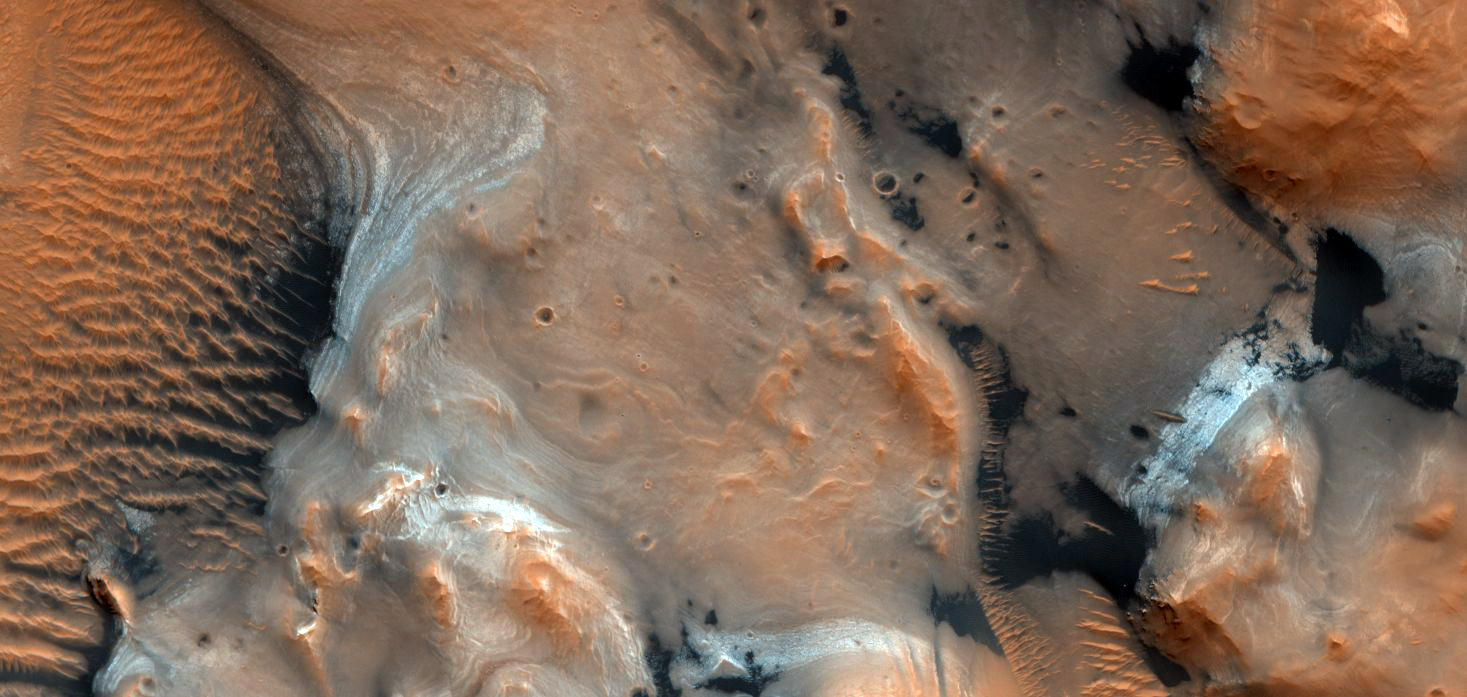
This image shows knobs and bluffs that are being actively eroded by the Martian wind. Fine, light-toned sedimentary layering is exposed in the bedrock at the base of the cliffs.

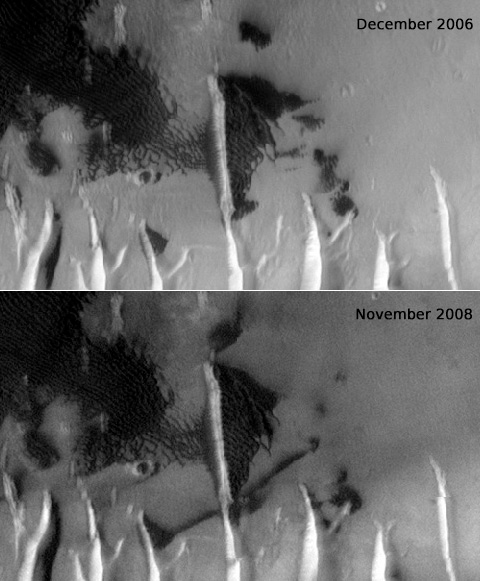
Also in this scene are two types of unconsolidated aeolian sediments. The reddish ridges are relatively immobile, and are probably similar to granule ripples on Earth that are protected from the winds by a surface layer of coarse grains. The dark gray dunes are probably made up of fine (approximately 0.1 mm) basaltic sand. Previous HiRISE images (PSP_001756_1995, PSP_010643_1995) showed that the sand in Pasteur Crater is currently mobile.

This sand is thought to be locally derived, from dark deposits within a small crater called Euphrates that is located within Pasteur, upwind of the sand dunes. The movement of this sand contributes to the erosion of the ancient bedrock, sandblasting the formation into the knobs seen today and exposing layers that were deposited in ages past.

Photo credit: NASA/JPL/University of Arizona

Monday, July 26, 2010

Pasteur Crater


The small, dark features in this VIS image are sand dunes. The majority of the dunes appear to be located within eroded deposits on the floor of Pasteur Crater.

Photo credit: NASA/JPL/Arizona State University

Saturday, February 27, 2010

Central Deposits in Pasteur Crater

This observation shows a portion of the central sedimentary deposits in Pasteur Crater [located in Arabia Terra].

The deposits in this image [are] now being eroded into knobs and ridges. The erosion is probably dominated by wind, as most of the ridges are parallel. This is common in wind-eroded features, with the ridges generally aligned with the prevailing wind.

At high resolution, layering is revealed in many of the knobs and outcrops. The horizontal layers indicate that the material was deposited uniformly over a broad area. Possible origins include volcanic airfall or lacustrine (lake) deposits. After deposition, the rock in this area has been fractured and faulted, forming a diverse array of cracks.

The mottled appearance of much of the image is caused by dark, featureless patches which may be wind-blown dust. These have interacted with lighter-toned ridges and ripples which are probably also formed by aeolian (wind) processes. In places, the dark patches partially cover the ripples, indicating that they have moved more recently, but they must be thin because the ripples frequently stand above surrounding dark material.

The ripples exhibit multiple interacting orientations in some places, producing networks of small ridges which reflect movement in winds from several directions.
Photo Credits: NASA/JPL/University of Arizona