This VIS image of the south pole shows a surface with numerous oval depressions. This texture has been described as looking like swiss cheese.
Orbit Number: 56300 Latitude: -86.7211 Longitude: 355.028 Instrument: VIS Captured: 2014-08-23 11:26
Photo credit: NASA/JPL-Caltech/Arizona State University
Today's polar image shows an unusual surface texture. The circular depressions look like Swiss cheese.
Orbit Number: 56475 Latitude: -86.65 Longitude: 355.117 Instrument: VIS Captured: 2014-09-06 21:13
Photo credit: NASA/JPL-Caltech/Arizona State University

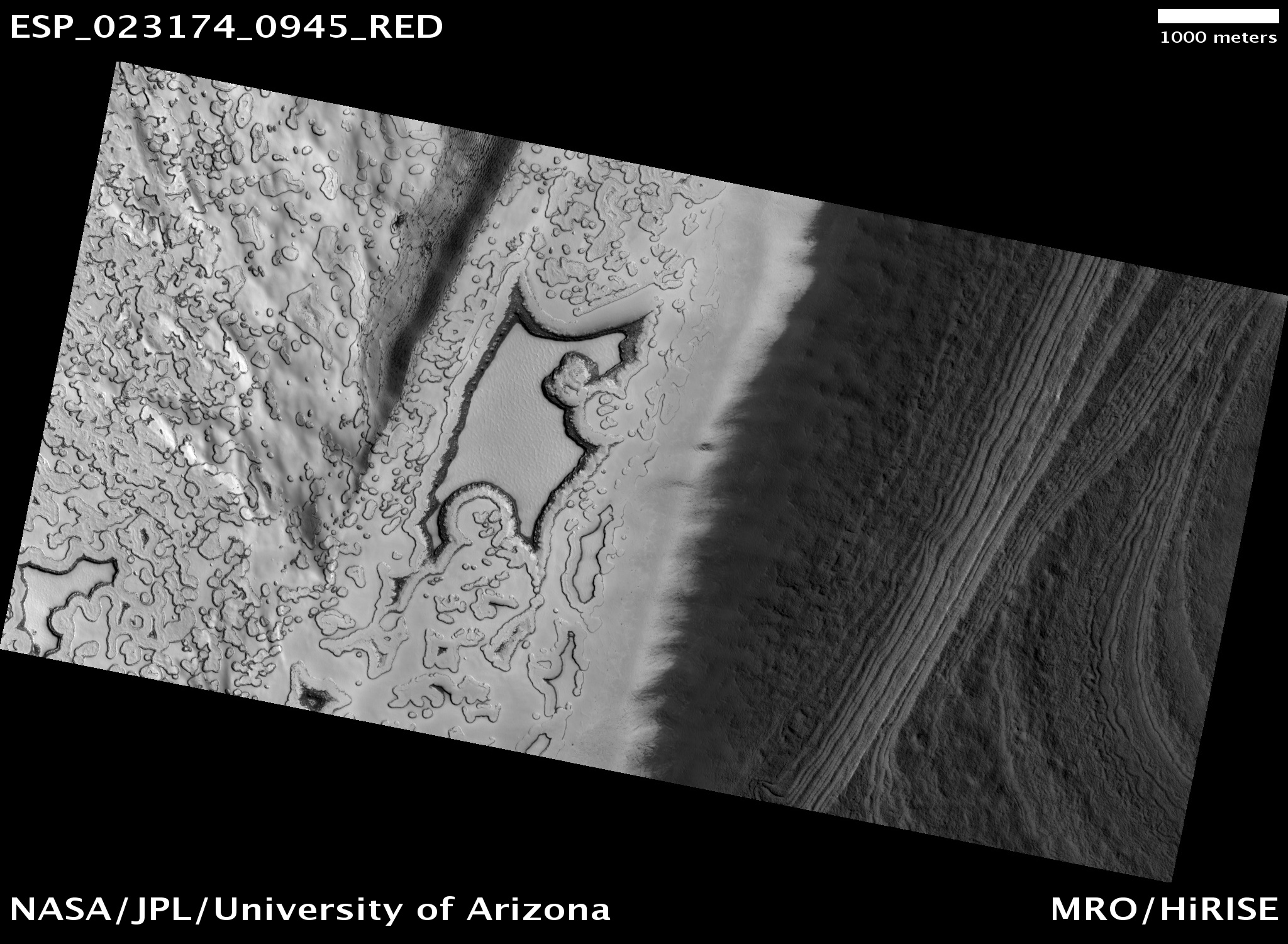
The full image captures the margin of the South polar residual ice cap where it meets the surrounding terrain. It was taken during the end of the Mars southern hemisphere summer.
Towards the north (left in the map-projected image), what is informally referred to as "Swiss cheese terrain" can be seen. This is thought to be formed as frozen carbon dioxide periodically sublimates (turns from solid directly to gas as the area warms).
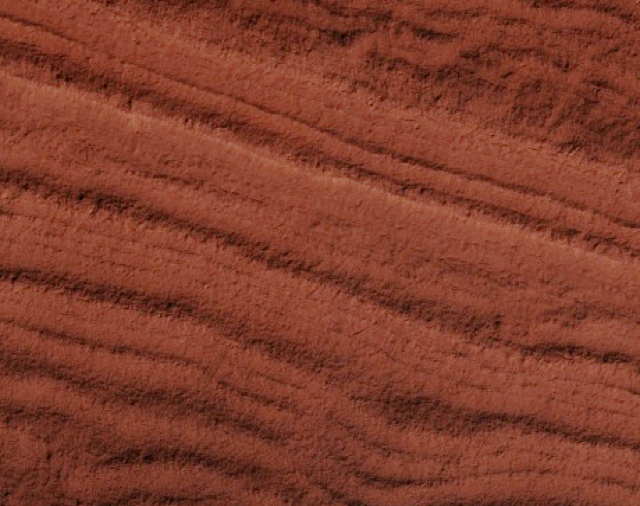
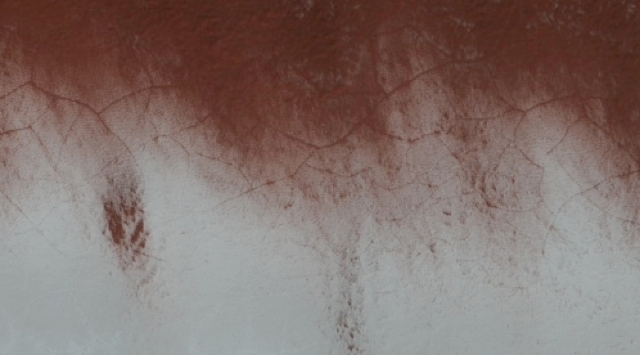
Where the dust and ice meet, the dramatic color difference between these two materials serves to highlight a small area of polygonal cracking. Further south, the carbon dioxide ice has given way to more familiar, dusty Mars terrain, here organized in layers.
Scientists monitor the same polar locations within a Mars year to examine the development, erosion, and modification of ice features. However, many areas also warrant study from year-to-year to determine what role inter-annual variability plays in the changing landscape. Previous images from this area can be found here: ESP_012559_0945, ESP_014273_0945, ESP_014405_0945.
Photo credit: NASA/JPL/University of Arizona

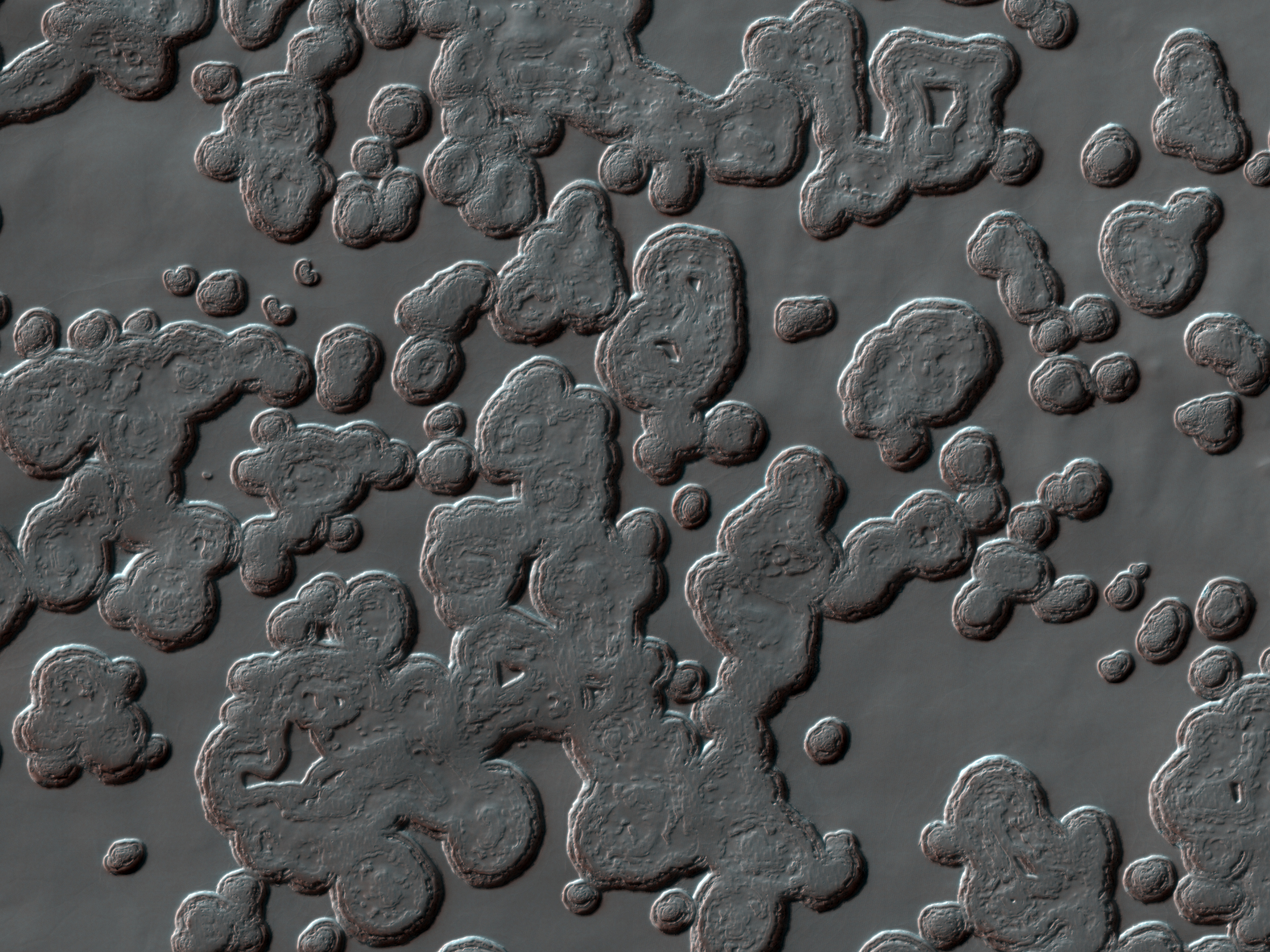
This image represents a Martian terrain containing "Swiss cheese" features. This terrain is found only within the residue of the southern polar cap, which comprises of mostly frozen carbon dioxide and water.
These particular features are flat-floored, circular depressions that are believed to form from different rates in the seasonal changes of the carbon dioxide and water ices. Varying rates in sublimation - when these ices change directly to vapors upon heat and back to deposited solids upon cooling - produces these rimmed depressions from the flat polar ice plane. It is hypothesized that the depression areas are made up of dry ice, carbon dioxide, and the material below consists of the water ice.
This carbon dioxide solid rises and slightly evaporates into the thin atmosphere in the summer while the water layer remains in place. As the south pole cools with seasonal change, the "Swiss cheese" formation is obtained with risen carbon dioxide rimmed depressions and flat water mesas. The Martian north pole will evaporate all of its carbon dioxide in the summer; however the south pole is colder and this may explain why this terrain is only found in this area.
Some of the circular features in the full image show distinct cusps that point in the direction of the pole. These cusps suggest insolation, a measure of solar radiation that is pushing the movement/formation of these depressions away from the pole. There is also an observed lateral outward growth of the features at the rate of about one-to-three meters a year, indicating to scientists that the depressions must form in a carbon dioxide medium.
Photo credit: NASA/JPL/University of Arizona

This image is taken in one of the troughs that are typical within the stack of Martian south polar layered deposits.
Viewed at low resolution, sequences of layers of different albedos, or brightnesses, and/or textures can be seen. At full resolution, the different tones and textures can be seen to be due to different shapes and sizes of polygonal fractures, surface knobiness, and surface cover and concentration of frost, often within polygonal fractures.
Faint criss-crossing troughs and dimples can be discerned on even the smoothest surfaces. Perhaps the most notable features in the image are the distinct round to heart-shaped to blob-shaped depressions scattered throughout the smooth areas, dubbed "swiss-cheese terrain."
The smooth material is solid carbon dioxide ice representing the uppermost layer of the south polar residual cap. The retention of carbon dioxide ice throughout the year by the southern polar cap is one characteristic that distinguishes it significantly from Mars' north polar cap. The swiss-cheese depressions are areas in which sublimation of the carbon dioxide ice was initiated at a particular location and spread laterally from that point, creating rounded depressions typically several to 10 meters deep.
In HiRISE images, it is evident that this carbon dioxide-rich material is actually comprised of several individual horizontal layers. In this particular location, several images had been acquired over the previous decade by the Mars Orbiter Camera (MOC) at slightly lower resolutions. In a series of those MOC images, the swiss-cheese depressions were seen to enlarge radially, or grow over a time period of several years.
Part of the HiRISE imaging campaign includes continued monitoring of these features (at higher resolution) to understand their growth rates and patterns. In turn, we can better comprehend the role of carbon dioxide — the main component of the Mars atmosphere — in the current Mars climate regime.
Photo credit:
NASA/JPL/University of Arizona

As on Earth, the seasonal frost caps of Mars grow and recede each year. But seasonal frost on Mars is composed of carbon dioxide ice (also known as dry ice), not water ice as on our planet.
Near the south pole of Mars, the seasonal carbon dioxide frost never completely disappears, leaving a residual ice cap of carbon dioxide ice throughout the summer. This HiRISE image shows part of the south polar residual cap, with many shallow pits dubbed "Swiss cheese" terrain. Because the sun is always low in the sky at this latitude, the steep walls of the pits receive more solar energy than the high-standing, flat areas between the pits. This causes the walls of the pits to retreat several meters per year as sunlight causes the carbon dioxide ice to evaporate directly to gas, a process called "sublimation."
In some depressions, ridges or blocks of material a couple of meters (several feet) across are visible at the base of the depression walls, likely fallen from the walls during the sublimation and retreat process. At this rate, the layer of carbon dioxide ice could completely disappear in about 100 years if not replenished.
Photo credit: NASA/JPL/University of Arizona