Friday, January 16, 2009

Discovery of Significant Amounts of Methane on Mars

An interesting article out of NASA today. While I suspect that the methane plumes mentioned are probably of geologic origin, the idea that microorganisms (endoliths) may be living underneath the surface of Mars is not a new one. Certainly the possibility of a biologic origin to some or all of the Martian methane is quite plausible.


Mars today is a world of cold and lonely deserts, apparently without life of any kind, at least on the surface. Indeed it looks like Mars has been cold and dry for billions of years, with an atmosphere so thin, any liquid water on the surface quickly boils away while the sun's ultraviolet radiation scorches the ground.

The situation sounds bleak, but research published today in Science Express reveals new hope for the Red Planet. The first definitive detection of methane in the atmosphere of Mars indicates that Mars is still alive, in either a biologic or geologic sense, according to a team of NASA and university scientists.

"Methane is quickly destroyed in the Martian atmosphere in a variety of ways, so our discovery of substantial plumes of methane in the northern hemisphere of Mars in 2003 indicates some ongoing process is releasing the gas," says lead author Michael Mumma of NASA's Goddard Space Flight Center. "At northern mid-summer, methane is released at a rate comparable to that of the massive hydrocarbon seep at Coal Oil Point in Santa Barbara, California."

Methane -- four atoms of hydrogen bound to a carbon atom -- is the main component of natural gas on Earth. It is of interest to astrobiologists because much of Earth's methane come from living organisms digesting their nutrients. However, life is not required to produce the gas. Other purely geological processes, like oxidation of iron, also release methane. "Right now, we don't have enough information to tell if biology or geology -- or both -- is producing the methane on Mars," said Mumma. "But it does tell us that the planet is still alive, at least in a geologic sense. It's as if Mars is challenging us, saying, hey, find out what this means."

If microscopic Martian life is producing the methane, it likely resides far below the surface, where it's still warm enough for liquid water to exist. Liquid water, as well as energy sources and a supply of carbon, are necessary for all known forms of life.

"On Earth, microorganisms thrive 2 to 3 kilometers (about 1.2 to 1.9 miles) beneath the Witwatersrand basin of South Africa, where natural radioactivity splits water molecules into molecular hydrogen (H2) and oxygen (O). The organisms use the hydrogen for energy. It might be possible for similar organisms to survive for billions of years below the permafrost layer on Mars, where water is liquid, radiation supplies energy, and carbon dioxide provides carbon," says Mumma.

"Gases, like methane, accumulated in such underground zones might be released into the atmosphere if pores or fissures open during the warm seasons, connecting the deep zones to the atmosphere at crater walls or canyons," he says.

"Microbes that produced methane from hydrogen and carbon dioxide were one of the earliest forms of life on Earth," notes Carl Pilcher, Director of the NASA Astrobiology Institute which partially supported the research. "If life ever existed on Mars, it's reasonable to think that its metabolism might have involved making methane from Martian atmospheric carbon dioxide."

However, it is possible a geologic process produced the Martian methane, either now or eons ago. On Earth, the conversion of iron oxide (rust) into the serpentine group of minerals creates methane, and on Mars this process could proceed using water, carbon dioxide, and the planet's internal heat. Another possibility is vulcanism: Although there is no evidence of currently active Martian volcanoes, ancient methane trapped in ice "cages" called clathrates might now be released.

The team found methane in the atmosphere of Mars by carefully observing the planet over several Mars years (and all Martian seasons) using spectrometers attached to telescopes at NASA's Infrared Telescope Facility, run by the University of Hawaii, and the W. M. Keck telescope, both at Mauna Kea, Hawaii.

"We observed and mapped multiple plumes of methane on Mars, one of which released about 19,000 metric tons of methane," says Geronimo Villanueva of the Catholic University of America in Washington, D.C. Villanueva is stationed at NASA Goddard and is co-author of the paper. "The plumes were emitted during the warmer seasons -- spring and summer -- perhaps because the permafrost blocking cracks and fissures vaporized, allowing methane to seep into the Martian air. Curiously, some plumes had water vapor while others did not," he says.

According to the team, the plumes were seen over areas that show evidence of ancient ground ice or flowing water. For example, plumes appeared over northern hemisphere regions such as east of Arabia Terra, the Nili Fossae region, and the south-east quadrant of Syrtis Major, an ancient volcano 1,200 kilometers (about 745 miles) across.

It will take future missions, like NASA's Mars Science Laboratory, to discover the origin of the Martian methane. One way to tell if life is the source of the gas is by measuring isotope ratios. Isotopes are heavier versions of an element; for example, deuterium is a heavier version of hydrogen. In molecules that contain hydrogen, like water and methane, the rare deuterium occasionally replaces a hydrogen atom. Since life prefers to use the lighter isotopes, if the methane has less deuterium than the water released with it on Mars, it's a sign that life is producing the methane.

Whatever future research reveals--biology or geology--one thing is already clear: Mars is not so dead, after all.

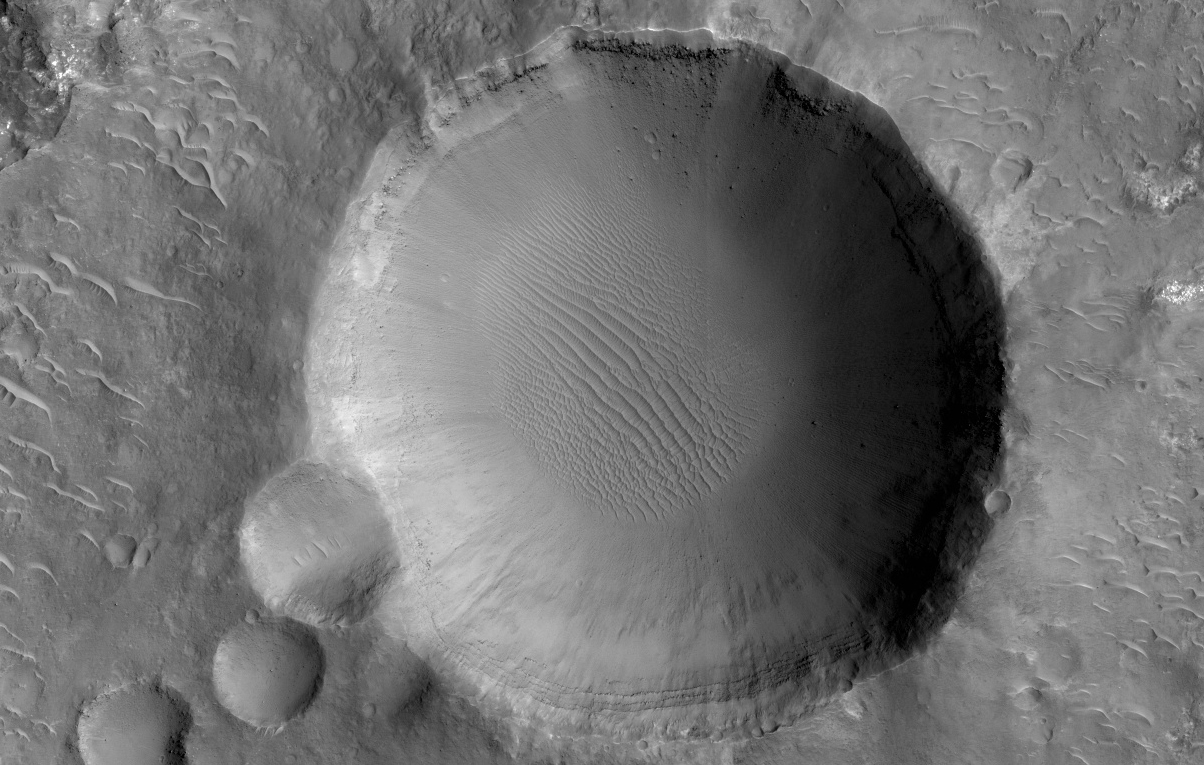
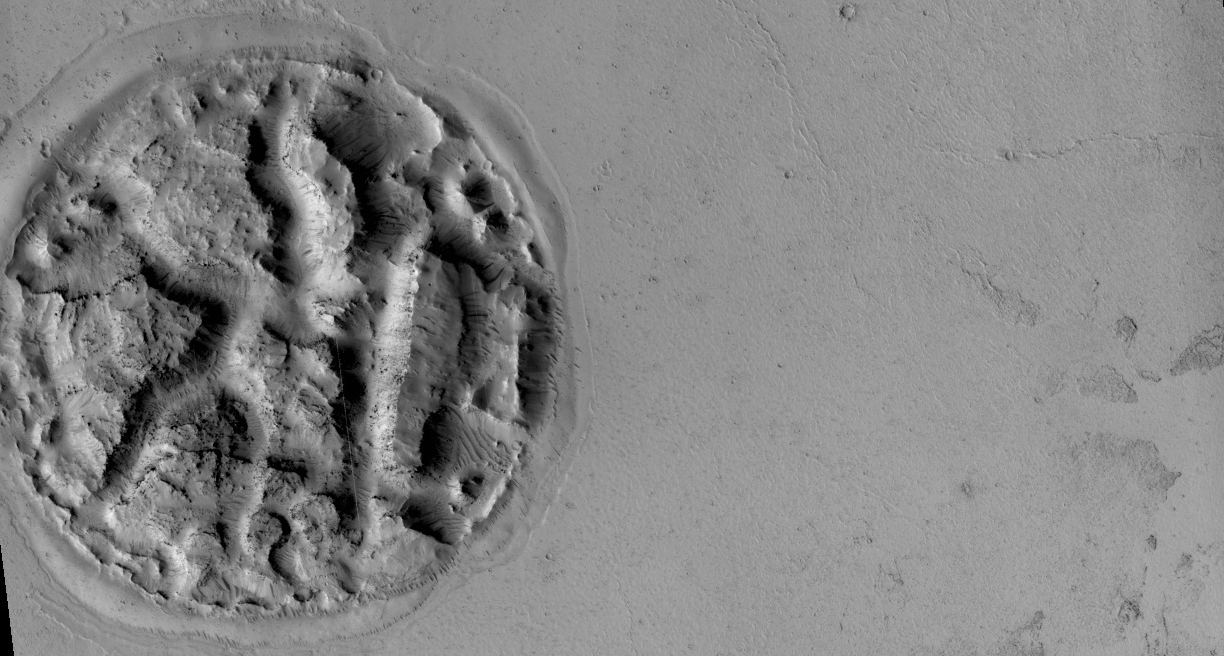
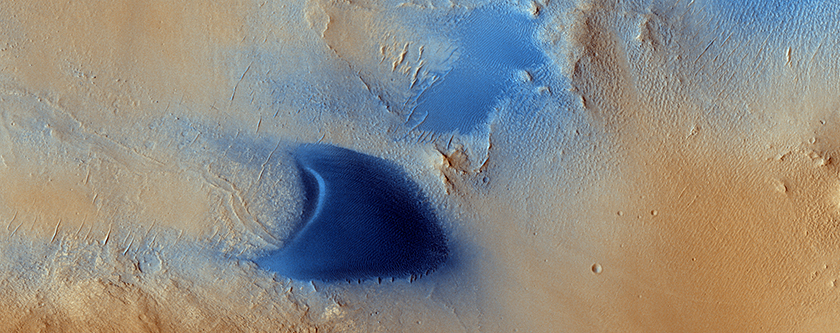
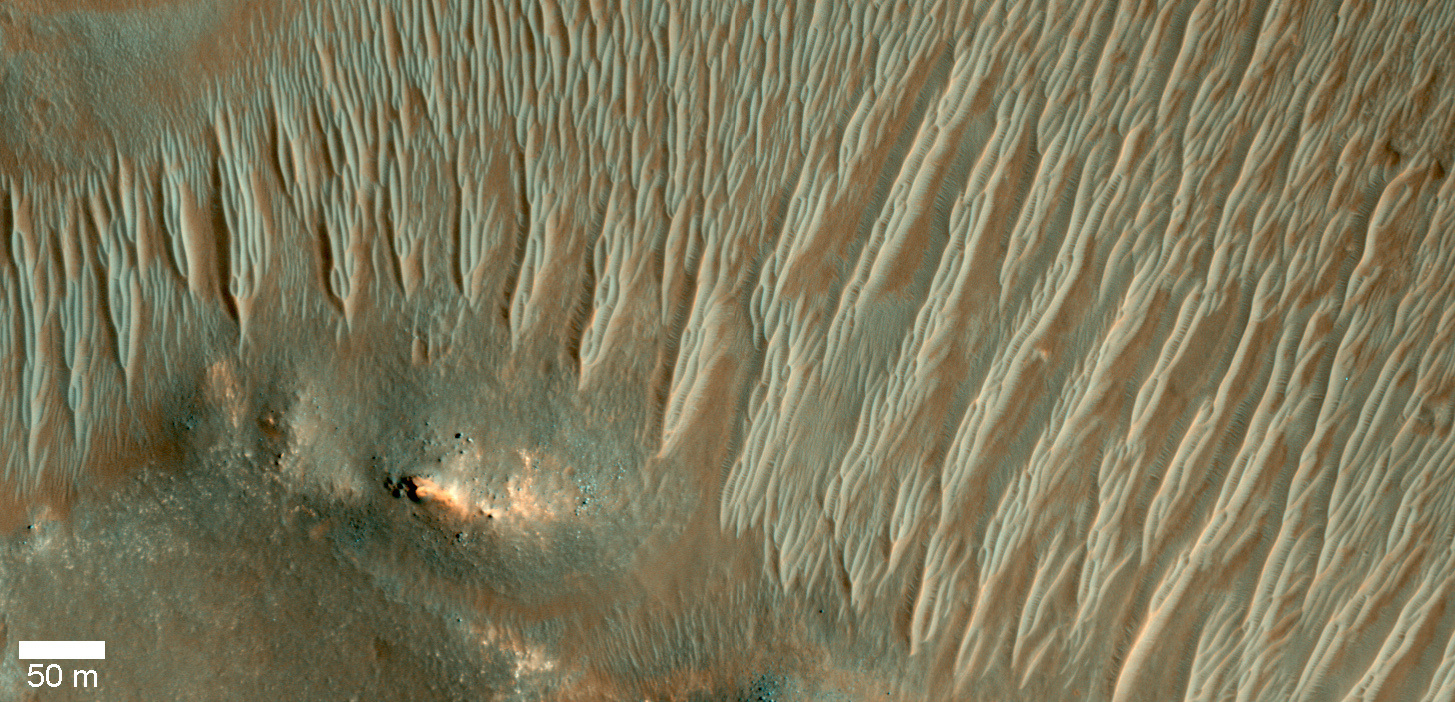
Photo Credits: Trent Schindler/NASA (first picture); NASA (second picture) For more pictures and animations, please click here

Tuesday, May 27, 2008

Mars Phoenix Lander Descending

Credit: NASA/JPL-Caltech/University of Arizona

This is a very unique and interesting photograph. There are two versions of this photo available from NASA; one with no background and this one with. I've chosen this particular image because it has a better resolution with respect to seeing all of the spacecraft, the parachute and its cords.

NASA's Mars Phoenix Lander can be seen parachuting down to Mars, in this image captured by the High Resolution Imaging Science Experiment (HiRISE) camera on NASA's Mars Reconnaissance Orbiter. This is the first time that a spacecraft has imaged the final descent of another spacecraft onto a planetary body.

From a distance of about 310 kilometers (193 miles) above the surface of the Red Planet, Mars Reconnaissance Orbiter pointed its HiRISE obliquely toward Phoenix shortly after it opened its parachute while descending through the Martian atmosphere. The image reveals an apparent 10-meter-wide (30-foot-wide) parachute fully inflated. The bright pixels below the parachute show a dangling Phoenix. The image faintly detects the chords attaching the backshell and parachute. The surroundings look dark, but corresponds to the fully illuminated Martian surface, which is much darker than the parachute and backshell.

Phoenix released its parachute at an altitude of about 12.6 kilometers (7.8 miles) and a velocity of 1.7 times the speed of sound.

The HiRISE, acquired this image on May 25, 2008, at 4:36 p.m. Pacific Time (7:36 p.m. Eastern Time). It is a highly oblique view of the Martian surface, 26 degrees above the horizon, or 64 degrees from the normal straight-down imaging of Mars Reconnaissance Orbiter. The image has a scale of 0.76 meters per pixel.

This image has been brightened to show the patterned surface of Mars in the background.

Monday, May 26, 2008

Mars Phoenix Lander Lands on Mars


Photos credit: NASA/JPL-Calech/University of Arizona

I'm happy to say that the Mars Phoenix Lander has landed safely on Mars. The spacecraft was launched from Cape Canaveral last August, and successfully set down in the part of Mars known as the Vastitas Borealis (literally, northern vastness or widespread lowlands). The Vastitas Borealis lies 3-4 km below the mean radius of the planet (the Martian equivalent of sea level), that completely encircles the northern hemisphere of Mars from about 50°-60° North to about 80° North, where it meets the Planum Boreum, the northern polar plain where the ice cap is located. It is believed that the Vastitas Borealis may have been an ocean in Mars' ancient past, and that the Phoenix Lander may discover ice beneath a thin layer of dirt.

Unlike the rovers
Spirit and Opportunity, which are both mobile and have been operational for a number of years, the Phoenix Lander will remain in one place, where it landed, and is expected to survive for about three months or so, when the weather will freeze the spacecraft. In the meantime, the Phoenix Lander has an arm that will scoop soil and ice samples and place them into several chemistry laboratories inside the spacecraft, which will try to determine the soil chemistry, the amount of water and water vapor in the soil, and the soil's level of conductivity. The goal is to determine whether the Martian environment has ever been favorable to microbial life. In addition to the above-mentioned equipment, there's also several cameras on board plus a meteorological station, all of which are standard equipment for Martian vehicles today.

The two photos here are some of the first images taken by the
Phoenix Lander. Both photos, which are approximate-color images, show a landscape that is strewn with tiny pebbles and shows polygonal cracking, a pattern seen widely in Martian high latitudes and also observed in permafrost terrains on Earth. The polygonal cracking is believed to have resulted from seasonal freezing and thawing of surface ice.

Sunday, February 3, 2008

Butterfly Crater in Hesperia Planum, by Mars Express

Credits: ESA/DLR/FU Berlin (G. Neukum)

Because I truly am a glutton for punishment, I've started another blog, The Ministry of Space Exploration, which focuses on the remainder of the universe other than Mars. This particular post happens to be the first one written at The Ministry since that blog started. Please visit The Ministry of Space Exploration.

This image, taken by the High Resolution Stereo Camera (HRSC) on board ESA’s Mars Express spacecraft, shows a large elliptical impact crater in the Hesperia Planum region of Mars.

The HRSC obtained these images during orbit 368 with a ground resolution of approximately 16.7 meters per pixel. The scenes show the region of Hesperia Planum, at approximately 35.3° South and 118.7° East.

[The crater measures] ...approximately 24.4 km long, 11.2 km wide and reaching a maximum depth of approximately 650 meters below the surrounding plains.

Ejecta from this impact can be seen extending away from the crater, including two prominent lobes of material north-west and south-east of the crater.

...

This appears to be an impact crater that was subsequently resurfaced by lava flows, preserving the outline of the underlying crater. The curving features visible in the north of the image, known as 'wrinkle ridges,' are caused by compressional tectonics.

While the majority of impact craters are relatively circular, the elliptical shape of this impact crater suggests a very low impact angle (less than 10 degrees).

The long axis of the impact crater is viewed as the impacting direction of the projectile. Similar elliptical craters are observed elsewhere on Mars, as well as on our Moon.

Saturday, December 22, 2007

Breaking News: Asteroid Threatens to Hit Mars

Science@NASA has a short article on an asteroid that may hit Mars next January 30th. The asteroid, if it does hit Mars, is expected to create a crater about one kilometer wide. CNN International, which aired this story last night, suggested (with tongue firmly in cheek) that we call on Bruce Willis.

Also, be sure to click on the animation link below.

December 21, 2007: Astronomers funded by NASA are monitoring the trajectory of an asteroid named 2007 WD5 that is expected to cross the orbital path of Mars early next year. Calculations by NASA's Near-Earth Object Office at the Jet Propulsion Laboratory indicate that the 164-ft wide asteroid may pass within 30,000 miles of Mars at about 6 a.m. EST on Jan. 30, 2008.

"Right now asteroid 2007 WD5 is about half-way between the Earth and Mars and closing the distance [to Mars] at a speed of about 27,900 miles per hour," said Don Yeomans, manager of the Near Earth Object Office at JPL.


Above: This artist rendering uses an arrow to show the predicted path of the asteroid on Jan. 30, 2008. The orange swath indicates the area it is expected to pass through. Mars may or may not be in the asteroid's path. Image credit: NASA/JPL. [Animation]

There is a 1-in-75 chance of 2007 WD5 hitting Mars; researchers can't be more confident than that because of uncertainties in the asteroid's orbit. If this unlikely event were to occur, however, the strike would happen somewhere within a broad swath across the planet north of where the Opportunity rover is.

"We estimate such impacts occur on Mars every thousand years or so," said Steve Chesley, a scientist at JPL. "If 2007 WD5 were to thump Mars on Jan. 30, we calculate it would hit at about 30,000 miles per hour and might create a crater more than half-a-mile wide." The Mars Rover Opportunity is currently exploring a crater approximately this size.

Such a collision could release about three megatons of energy. Scientists believe an event of comparable magnitude occurred here on Earth in 1908 in Tunguska, Siberia, but no crater was created. The object was disintegrated by Earth's atmosphere before it hit the ground, although the air blast devastated a large area of unpopulated forest. The Martian atmosphere is much thinner than Earth's so a similar sized impactor would be more likely to reach the ground.

Asteroid 2007 WD5 was first discovered on Nov. 20, 2007, by the NASA-funded Catalina Sky Survey and put on a "watch list" because its orbit passes near the Earth. Further observations from both the NASA-funded Spacewatch at Kitt Peak, Ariz., and the Magdalena Ridge Observatory in New Mexico gave scientists enough data to determine that the asteroid was not a danger to Earth, but could potentially impact Mars.

Because the asteroid has been tracked for little more than a month, there is still some uncertainly about the path it will take. "Over the next five weeks, we hope to gather more information from observatories so we can further refine the asteroid's trajectory," says Yeomans. More data could eliminate or confirm the possibility of an impact.

Update: This news actually came out back on January 9th, but I only noticed the information now (January 28th). The potential collision of Asteroid 2007 WD5 with Mars has been "effectively ruled out" by NASA's Near Earth Object Program:

Since our last update, we have received numerous tracking measurements of asteroid 2007 WD5 from four different observatories. These new data have led to a significant reduction in the position uncertainties during the asteroid's close approach to Mars on Jan. 30, 2008. As a result, the impact probability has dropped dramatically, to approximately 0.01% or 1 in 10,000 odds, effectively ruling out the possible collision with Mars.

Our best estimate now is that 2007 WD5 will pass about 26,000 km from the planet's center (about 7 Mars radii from the surface) at around 12:00 UTC (4:00 am PST) on Jan. 30th. With 99.7% confidence, the pass should be no closer than 4000 km from the surface.

Friday, December 14, 2007

MARSIS and Subsurface Geology

One of the purposes of the MARSIS instrument is to probe Mars' subsurface geology to a depth of five kilometers. To do this, MARSIS sends low-frequency radio waves down to the surface and records the echoes that have bounced back to Mars Express. In November 2005, the European Space Agency (ESA) reported that the MARSIS team had discovered buried impact craters and hints of the presence of deep underground water ice.

Credit: ASI/NASA/ESA/Univ. of Rome/JPL

First results revealed an almost circular structure, about 250 kilometers in diameter, shallowly buried under the surface of the northern lowlands of Chryse Planitia (see the map below). Scientists have interpreted it as a buried basin of impact origin. Echo structures, as shown in the radargram images above, form a distinctive collection that include parabolic arcs and an additional planar reflecting feature parallel to the ground, 160 km long. The images were taken in two different orbits, spaced about 50 km apart.

Credit: ASI/NASA/ESA/Univ. of Rome/JPL/MOLA

The topographic map, based on Mars Orbiter Laser Altimeter (MOLA) data, shows the MARS Express groundtracks and the arc structures detected by MARSIS that are interpreted to be part of the buried impact basin. The topographic relief represented in the image is 1 km, from low (purple) to high (red). The projected arcs are shown in red for orbit 1892 and white for orbit 1903. There is no obvious feature in the surface topography that corresponds to the buried feature identified with MARSIS data.

The parabolic arcs correspond to ring structures that could be interpreted as the rims of one or more buried impact basins. Other echoes show what may be rim-wall 'slump blocks' or 'peak-ring' features. The planar reflection is consistent with a flat interface that separates the floor of the basin, situated at a depth of about 1.5 to 2.5 km, from a layer of overlying different material. It is possible that this planar feature is a low-density, water-ice-rich material at least partially filling the basin.

Credit: ASI/NASA/ESA/Univ. of Rome/JPL/MOLA Science Team

MARSIS also probed the layered deposits that surround the north pole of Mars, in an area between 10º and 40º East longitude. The interior layers and the base of these deposits are poorly exposed. Prior interpretations could only be based on imaging, topographic measurements and other surface techniques. However, MARSIS results (above) show two strong and distinct echoes coming from the area corresponding to a surface reflection and subsurface interface between two different materials.

The MARSIS radargram image (top) shows data from the subsurface of Mars in the layered deposits that surround the north pole. The lower image shows the position of the ground track on a topographic map of the area based on MOLA data. The total elevation difference shown in the topographic map is about 2 km, between the lowest surface (magenta) and the highest (orange) over an area 458 km wide.

The MARSIS echo trace splits into two traces to the right of center, at the point where the spacecraft's groundtrack crosses from the smooth plains onto the elevated layered deposits on the right. The upper trace is the echo from the surface of the deposits, while the lower trace is interpreted to be the boundary between the lower surface of the deposits and the underlying material, believed to be basaltic regolith. The strength of the lower echo suggests that the intervening material is nearly pure water ice. The time delay between the two echoes reaches a maximum of 21 microseconds at the right of the image, corresponding to a thickness of 1.8 km of ice. This conclusion appears to rule out the hypothesis of a melt zone at the base of the northern layered deposits.

Wednesday, December 12, 2007

MARSIS

Credit: ESA

Continuing with our discussion of instruments aboard Mars Express:

MARSIS, the Mars Advanced Radar for Subsurface and Ionosphere Sounding, was developed by the University of Rome, Italy, in partnership with NASA’s Jet Propulsion Laboratory (JPL). It is the first instrument to actually look below the surface of Mars, using low-frequency microwaves reflected by the different layers of matter. Its primary objective is to map the distribution of water, both liquid and solid (ice), in the upper portion of the crust of Mars; the instrument is also designed to probe Mars' subsurface geology and to measure the planet's ionosphere. MARSIS consists of three antennas: two "dipole" booms 20 meters long, and one seven-meter "monopole" boom oriented perpendicular to the first two. The instrument works by sending a coded stream of radio waves towards Mars at night, and analyzing their distinctive echoes. From this, scientists can then make deductions about the surface and subsurface structure. Operations are conducted on both Mars' day-side and night-side. The night-side is for deep subsurface sounding: during the night the ionosphere of Mars does not interfere with the lower-frequency signals needed by the instrument to penetrate the planet's surface, down to a depth of five kilometers. Day-side operations use higher frequency radio waves, which allows MARSIS to conduct shallow probing of the subsurface and atmospheric sounding. The MARSIS operation altitudes are up to 800 kilometers for subsurface sounding and up to 1200 kilometers for studying the ionosphere.

The extension of the three MARSIS booms was originally planned to deploy in April 2004. However, computer simulations pointed to a risk that the booms could lash back and harm the spacecraft and its instruments during deployment. The ESA then delayed deployment until the boom supplier (JPL) and the spacecraft prime contractor (Astrium, France), together with ESA’s experts, had conducted further analyses and simulations of the boom behavior during deployment and the possible impact on the spacecraft. Once the magnitude of the risk involved had been assessed and the relevant mitigation scenarios defined, ESA decided to proceed with releasing the MARSIS antennas in May 2005. Deployment of the first boom was started on May 5, 2005. At first, there was no indication of any problems, but later it was discovered that one segment of the boom did not lock. Using the Sun's heat to expand the segments of the MARSIS antenna, the last segment locked in successfully on May 10th. The second 20-meter boom was successfully deployed on June 14th, and the third boom on June 17th. On June 22nd, the ESA announced that MARSIS was fully operational, and the instrument began science operations on July 4th.

The above drawing is an impression of the completely deployed MARSIS experiment on board ESA's Mars Express orbiter with the two 20-meter and one 7-meter booms sprung out and locked into place.

Sunday, December 9, 2007

SPICAM Detects Ozone on the Earth

Credit: ESA/CNRS Verrieres

On July 3, 2003, thirty-one days after launch and from a distance of about 7 million km, the SPICAM instrument on board Mars Express was turned toward Earth. The main scientific objective of SPICAM is to observe both ozone and water vapor in the atmosphere of Mars. This test was to see how well SPICAM could detect ozone on Earth. Here, ozone forms a natural screen that protects life on Earth from harmful ultraviolet (UV) solar radiation. However, on Mars, the quantity of ozone is about 100 times less than that on Earth, making survival on the surface of Mars very difficult for any lifeforms.


In this first graph, above, the red line shows the simulated results that would be expected from SPICAM if the Earth's atmosphere had no ozone; i.e., if the atmosphere was not able to absorb ultraviolet radiation. The blue line is the simulated results with a realistic Earth atmosphere containing ozone.


The second graph shows the actual results obtained by SPICAM. The blue line indicates the spectrum (the intensity of light as a function of wavelength) of the Earth in ultraviolet light. This light comes from solar light scattered by the atmosphere of the Earth back to outer space. Only the peak just above 300 nm is significantly above the level of "noise." The red line, on the other hand, is the spectrum of the Sun in ultraviolet light. This is the amount of ultraviolet light the Earth would receive if the Earth didn't have the thick atmosphere with ozone that it has. (Conversely, the red line indicates the amount of ultraviolet radiation the moon does receive as, of course, the moon has no atmosphere to protect it.) The difference between the two lines, then, is the amount of ultraviolet radiation the Earth's atmosphere absorbs. As you can see, the ozone layer absorbs most of the ultraviolet radiation below 300 nm, preventing harmful effects on the DNA molecules of all living species exposed to the Sun.

As Jean-Loup Bertaux, principal investigator from Service d'Aéronomie/IPSL (the agency responsible for SPICAM), drolly said, "Together with the OMEGA infrared spectrometer detection of water vapor and oxygen, the detection of copious amounts of ozone in the atmosphere indicates that this planet that we call Earth could sustain life."

Saturday, December 8, 2007

SPICAM and the Aurora at Terra Cimmeria


Credit (Map): NASA/MGS
Credit (Photo): NASA/ESA

Another instrument aboard Mars Express is SPICAM (Spectroscopy for the Investigations and the Characteristics of the Atmosphere on Mars), developed by the Service d'Aéronomie du CNRS/IPSL (Verrières-le-Buisson, France) ,the Belgian Institute for Space Aeronomy (BIRA-IASB; Brussels, Belgium), and the Space Research Institute of the Russian Academy of Sciences (IKI; Moscow, Russia). SPICAM was originally on board the ill-fated Mars 96. However, a new instrument was placed aboard Mars Express, and a similar instrument (SPICAV) is on the European Space Agency's (ESA) Venus Express.

SPICAM is a lightweight (4.7 kg) ultraviolet-infrared dual spectrometer dedicated primarily to the study of the atmosphere of Mars. SPICAM makes measurements of the Martian atmosphere mainly through stellar and solar occultations. Through this method, SPICAM can make measurements of the Martian atmosphere's chemistry, the atmosphere's structure and dynamics (including its density and temperature) through vertical profiles, measurements of aerosols and dust particles and their vertical distribution, and measurements of the ionosphere and the rate of escape of atmospheric molecules. The ultraviolet sensor also measures the level of ozone in the Martian atmosphere, and the infrared sensor measures water vapor.

On August 14, 2004, SPICAM detected a new type of aurora on Mars. On Earth and among the gas giants (Jupiter, Saturn, Uranus, and Neptune), aurorae occur along the planetary magnetic field lines near the poles, and are produced by charged particles (electrons, protons and ions) precipitating along those lines. Venus also produces aurorae, although of a different type. Because Venus has no "intrinsic" (planetary) magnetic field, Venusian aurorae appear as bright and diffuse patches of varying shape and intensity, sometimes distributed across the full planetary disc. Venusian aurorae are produced by the impact of electrons originating from the solar wind and precipitating in the night-side atmosphere.

Like Venus, Mars is a planet with no intrinsic magnetic field. However, it was suggested that Mars could have aurorae as well, and this hypothesis was reinforced by Mars Global Surveyor's discovery of crustal magnetic anomalies, most likely the remnants of an old planetary magnetic field.

SPICAM detected light emissions in the southern hemisphere on Mars, in Terra Cimmeria, during night-time observations in the region of 177º East, 52º South. The total size of the emission region was about 30 km across, and possibly about 8 km high. By analyzing the map of crustal magnetic anomalies compiled with Mars Global Surveyor’s data, scientists observed that the region of the emissions corresponds to the area where the strongest magnetic field is localized. This correlation indicates that the origin of the light emission actually was a flux of electrons moving along the crust magnetic lines and exciting the upper atmosphere of Mars.

The above map shows the crustal magnetic field intensity in the Terra Cimmeria region. The aurora was located in an area where the crustal magnetic field is very strong (dark red in the image). The photo underneath is of the same region as the map.

Thursday, October 18, 2007

Breaking News: NASA Extends Operations for Its Long-Lived Mars Rovers

Credit: NASA/JPL-Caltech

Sorry for such an irregular posting schedule, but between work and family I've found that I've been extremely lucky to get anything posted to this blog in the past two months. I will resume my history of Mars exploration as and when I can. In the meantime, here is some breaking news with regard to the two rovers on Mars, Spirit and Opportunity, from the NASA website:

NASA is extending, for a fifth time, the activities of the Mars Exploration Rovers, Spirit and Opportunity. The decision keeps the trailblazing mobile robotic pioneers active on opposite sides of Mars, possibly through 2009. This extended mission and the associated science are dependent upon the continued productivity and operability of the rovers.

"We are extremely happy to be able to further the exploration of Mars. The rovers are amazing machines, and they continue to produce amazing scientific results operating far beyond their design life," said Alan Stern, associate administrator for NASA's Science Mission Directorate, Washington.

The twin rovers landed on Mars in January 2004, 45 months ago, on missions originally planned to last 90 days. In September, Opportunity began descending into Victoria Crater in Mars' Meridiani Planum region. At approximately 800 meters wide (half a mile) and 70 meters deep (230 feet), it is the largest crater the rover has visited. Spirit climbed onto a volcanic plateau in a range of hills that were on the distant horizon from its landing site.

"After more than three-and-a-half years, Spirit and Opportunity are showing some signs of aging, but they are in good health and capable of conducting great science," said John Callas, rover project manager at NASA's Jet Propulsion Laboratory, Pasadena, Calif.

The rovers each carry a suite of sophisticated instruments to examine the geology of Mars for information about past environmental conditions. Opportunity has returned dramatic evidence that its area of Mars stayed wet for an extended period of time long ago, with conditions that could have been suitable for sustaining microbial life. Spirit has found evidence in the region it is exploring that water in some form has altered the mineral composition of some soils and rocks.

To date, Spirit has driven 7.26 kilometers (4.51 miles) and has returned more than 102,000 images. Opportunity has driven 11.57 kilometers (7.19 miles) and has returned more than 94,000 images.

Among the rovers' many other accomplishments:

  • Opportunity has analyzed a series of exposed rock layers recording how environmental conditions changed during the times when the layers were deposited and later modified. Wind-blown dunes came and went. The water table fluctuated.

  • Spirit has recorded dust devils forming and moving. The images were made into movie clips, providing new insight into the interaction of Mars' atmosphere and surface.

  • Both rovers have found metallic meteorites on Mars. Opportunity discovered one rock with a composition similar to a meteorite that reached Earth from Mars.

  • The above image was taken by the panoramic camera on the Mars Exploration Rover Opportunity, showing the view of Victoria Crater from Duck Bay. Opportunity reached Victoria Crater on Sol 951 (September 27, 2006) after traversing 9.28 kilometers (5.77 miles) since her landing site at Eagle Crater. Victoria Crater is roughly 800 meters (one-half mile) wide -- about five times wider than Endurance Crater, and 40 times as wide as Eagle crater. The south face of the 6 meter (20 foot) tall layered Cape Verde promontory can be seen in the left side of the inner crater wall, about 50 meters (about 165 feet) away from the rover at the time of the imaging. The north face of the 15 meter (50 foot) tall stack of layered rocks called Cabo Frio can be seen on the right side of the inner crater wall.

    This approximate true color mosaic was taken on Sols 952 and 953 (September 28 and 29, 2006), and was released to the public on September 28, 2007. There are 30 separate pointings through 6 different filters at each pointing. This mosaic was generated from Pancam's 753 nm, 535 nm, and 482 nm filters.